
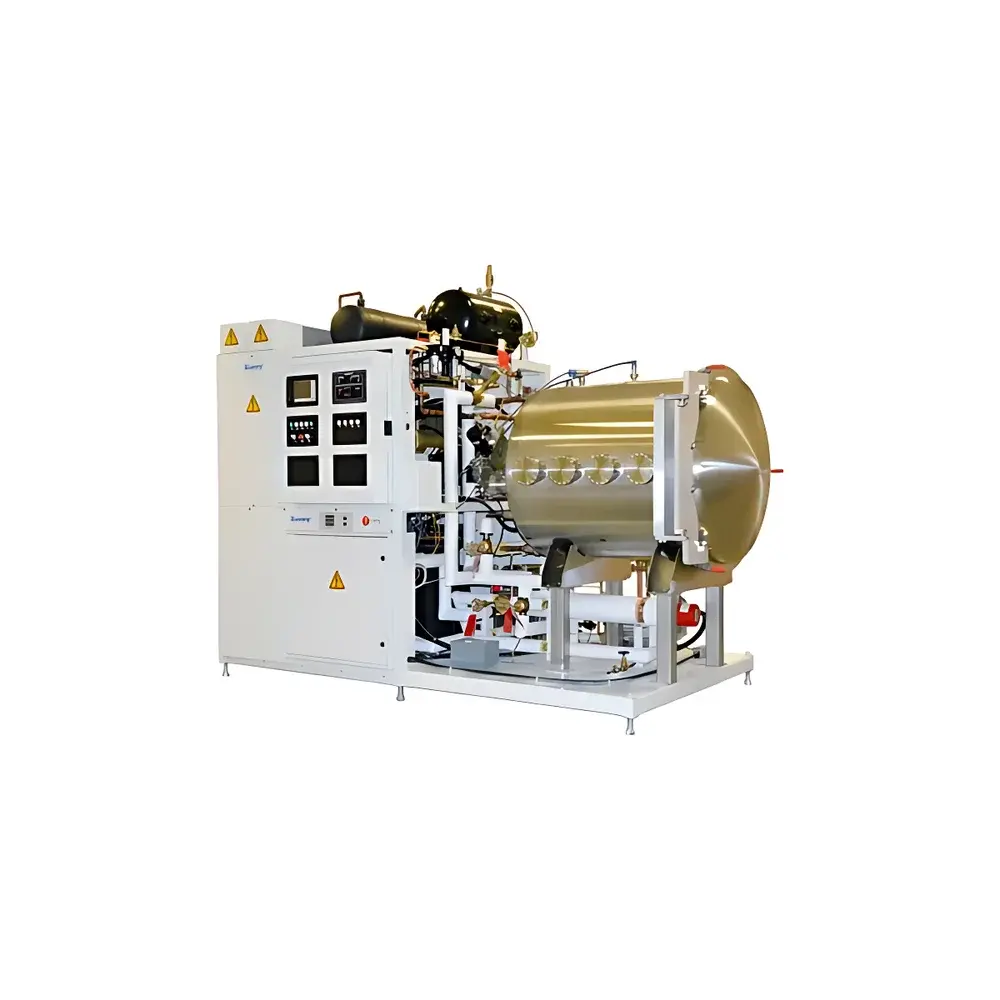
Blue M TENNEY Vacuum Thermal Test Chamber
| Brand | Blue M |
|---|---|
| Origin | USA |
| Manufacturer Type | Authorized Distributor |
| Product Category | Imported |
| Model | TENNEY Vacuum Chamber |
| Price Range | USD 70,000 – 140,000 (FOB) |
| Max Operating Temperature | +200°C |
| Temperature Range | Ambient to +200°C |
| Temperature Uniformity | ±1.0°C |
| Temperature Stability | ±0.5°C |
| Temperature Deviation | ±1.0°C |
| Ramp-up Time | ≤100 min (ambient to +200°C) |
| Internal Chamber Dimensions (W×H×D) | 1016 mm × 2057 mm × 2007 mm to 1626 mm × 2616 mm × 2515 mm |
| Volume Range | 2.65–226 ft³ |
| Base Pressure | ≤1×10⁻⁷ Torr (field-achievable) |
| Ultimate Vacuum (with cryo/turbo pumping) | ≤5.0×10⁻⁶ Torr in ≤4 hours |
| Thermal Range with LN₂/GN₂ Cooling | −150°C to +150°C |
| Optional Cryogenic Shield | −184°C |
| Vacuum Bake Capability | Yes |
| Construction | Electropolished 316L Stainless Steel Vessel |
| Compliance | ASME BPVC Section VIII Div. 1, OSHA 1910.146, NEC Article 500/505 |
Overview
The Blue M TENNEY Vacuum Thermal Test Chamber is a high-integrity, aerospace-grade environmental simulation system engineered for thermal-vacuum (TVAC) testing of spacecraft components, satellites, optical payloads, and mission-critical electronics. Based on decades of heritage in space qualification testing, this chamber integrates ultra-high vacuum capability with precise, wide-range temperature control—enabling replication of the combined thermal and pressure conditions encountered in low Earth orbit (LEO), geosynchronous orbit (GEO), and deep-space environments. The system operates on fundamental principles of conductive and radiative heat transfer under controlled low-pressure atmospheres, where convective effects are minimized. Its stainless steel vacuum vessel is designed to ASME Boiler and Pressure Vessel Code Section VIII Division 1 standards, ensuring structural integrity at both atmospheric and sub-10⁻⁷ Torr operating pressures. All mechanical, thermal, and vacuum subsystems—including cryogenic shrouds, turbo-molecular pump trains, and bake-out heaters—are factory-integrated and validated as a single functional unit.
Key Features
- Electropolished 316L stainless steel vacuum chamber with full O-ring sealed access doors and feedthroughs for instrumentation, power, and fluid lines
- Modular thermal control architecture supporting resistive heating, liquid nitrogen (LN₂) cryogenic cooling, and gaseous nitrogen (GN₂) recondensation systems
- Optional integrated vacuum bake-out system with distributed heaters and temperature mapping sensors for outgassing validation per ASTM E595 and ECSS-Q-ST-70-02C
- Multi-stage vacuum train configurable with dry scroll pumps, turbomolecular pumps, cryopumps, or ion pumps—optimized for ultimate pressure, pumping speed, and hydrocarbon-free operation
- Real-time pressure monitoring via capacitance manometers and cold cathode gauges with traceable calibration to NIST standards
- Redundant safety interlocks compliant with OSHA 1910.146 and IEC 61508 SIL 2, including vacuum loss detection, overtemperature cutoff, and door lock verification
- Customizable internal geometry: cylindrical, rectangular, or hybrid configurations; standard volumes from 2.65 ft³ to 226 ft³
Sample Compatibility & Compliance
The TENNEY Vacuum Thermal Test Chamber accommodates large-format payloads—including full-scale satellite buses, deployable solar arrays, and infrared sensor assemblies—within its scalable internal envelope. Chamber dimensions support both horizontal and vertical test orientations, with optional vibration-isolated mounting platforms available for concurrent TVAC + mechanical stress testing. All materials used in vacuum-facing surfaces meet NASA-STD-6002 and ECSS-Q-ST-70-02C outgassing requirements (TML ≤1.0%, CVCM ≤0.1%). The system supports qualification testing per MIL-STD-810H Method 505.7 (Low Pressure), MIL-STD-1540D (Spacecraft System Verification), and ECSS-E-ST-10-03C (Thermal Vacuum Testing). Full audit trails, electronic signatures, and 21 CFR Part 11–compliant data logging are available via optional software packages for GMP/GLP-regulated applications.
Software & Data Management
Control and monitoring are executed through a dedicated industrial PC running TENNEY’s proprietary TVAC Control Suite—a deterministic real-time application built on a deterministic Windows OS platform. The interface provides synchronized acquisition of up to 128 thermocouple/RTD channels, 8 pressure transducers, and 4 mass flow controllers, with timestamped data stored in .CSV and .TDMS formats. Automated test sequencing supports ramp-soak-hold profiles, pressure ramping protocols, and conditional logic triggers (e.g., “hold at 1×10⁻⁶ Torr until chamber wall temperature stabilizes within ±0.3°C for 30 minutes”). Data export complies with ASTM E2911 and ISO/IEC 17025 requirements for measurement uncertainty reporting. Optional integration with LabVIEW, MATLAB, or enterprise MES/QMS platforms is supported via OPC UA and Modbus TCP protocols.
Applications
- Thermal vacuum cycling of avionics modules and radiation-hardened microelectronics
- Outgassing characterization and contamination control validation for optical coatings and detector housings
- Thermal balance testing of spacecraft thermal control systems (heaters, MLI blankets, heat pipes)
- Pre-launch environmental stress screening (ESS) per GEVS and NASA-HDBK-7120.5
- Materials compatibility testing under combined thermal and ultra-high vacuum exposure
- Ground-based simulation of lunar surface thermal cycling (−180°C to +130°C diurnal extremes)
FAQ
What vacuum level can the chamber achieve, and how is it verified?
The system achieves ≤1×10⁻⁷ Torr at base pressure using a combination of turbomolecular and cryogenic pumping. Verification is performed with dual-gauge measurement (capacitance manometer + cold cathode gauge) and documented via NIST-traceable calibration certificates.
Is the chamber suitable for testing flight hardware requiring NASA Class 100 cleanroom-equivalent conditions?
Yes—electropolished 316L stainless steel surfaces, ultra-low particulate seals, and optional HEPA-filtered purge gas inlets support ISO Class 5 (Class 100) particle control during vent cycles.
Can the system perform automated thermal vacuum cycling per ECSS-E-ST-10-03C Annex D?
Yes—the control software includes preconfigured templates for ECSS-defined thermal vacuum cycles, including soak durations, pressure ramp rates, and pass/fail criteria for temperature uniformity and stability.
What documentation is provided for regulatory audits?
Each system ships with Factory Acceptance Test (FAT) reports, ASME U-1 stamp documentation, electrical safety certification (UL 61010-1), and a complete traceability matrix linking all sensors, calibrations, and software versions to ISO/IEC 17025 and 21 CFR Part 11 requirements.
Are custom feedthroughs and instrumentation ports supported?
Yes—standard configurations include 12–24 vacuum-rated electrical, thermocouple, and coaxial feedthroughs; custom port layouts, flange types (CF, KF, ISO-K), and hermetic fiber optic penetrations are available upon request.



