
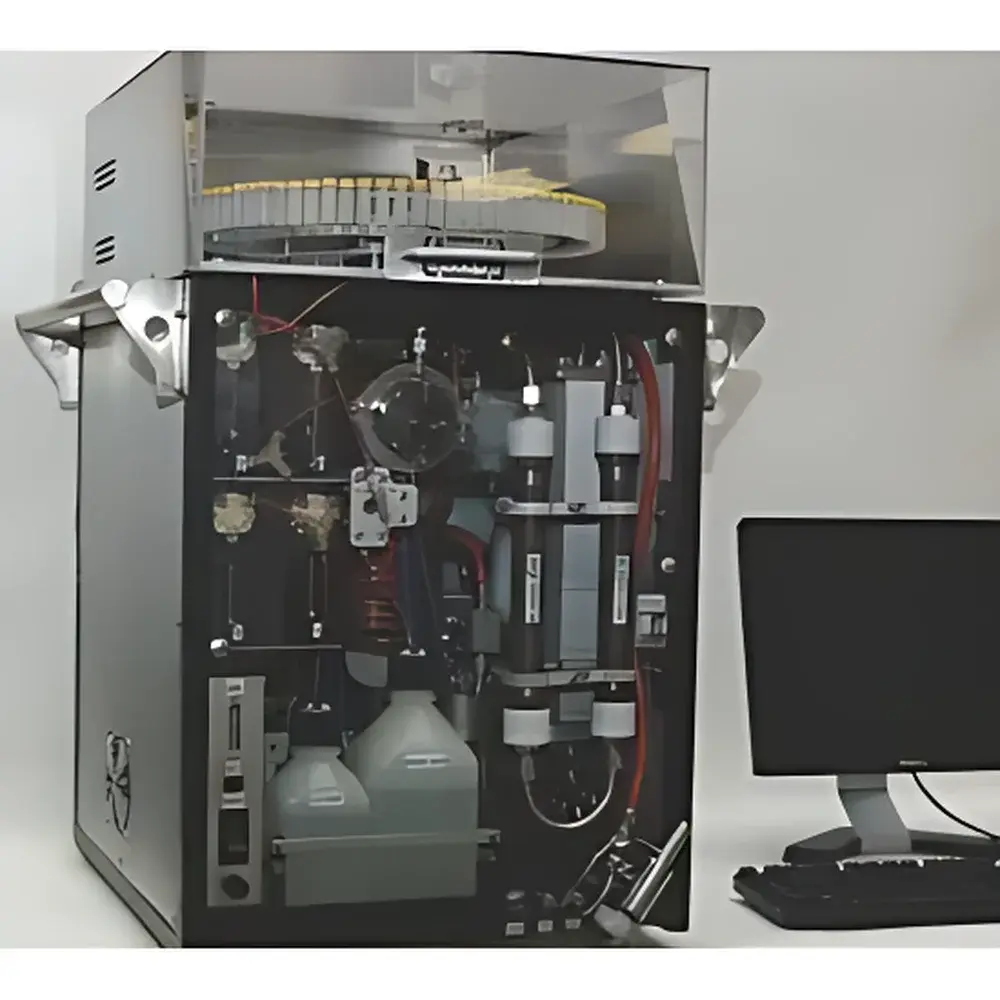
BMI/Brechtel PILS Model 4002 Aerosol Liquid Sampling and Chemical Composition Analysis System
| Brand | BMI/Brechtel Manufacturing Inc. |
|---|---|
| Origin | USA |
| Manufacturer Type | Authorized Distributor |
| Import Status | Imported |
| Model | Model 4002 |
| Price | Upon Request |
| Inlet Cut-Off Size | 1.0 µm or 2.5 µm |
| Sample Flow Rate | 15.0 L/min |
| Steam Generator Liquid Flow | 1.5 mL/min |
| Nebulizer Water/Sample Flow (Syringe Pump) | 0.03–1.0 mL/min |
| Nebulizer Tip Temperature | 98.5 ± 1.5 °C |
| Heater Temperature Range | 100–300 °C |
| Droplet Cut-Off Size | 1.0 µm |
| LOD for Inorganic Ions (SO₄²⁻, NO₃⁻, Cl⁻, NH₄⁺, K⁺, Na⁺, Ca²⁺, Mg²⁺) | 100 ng/m³ |
| LOD for Organic Acids (Acetate, Formate, Oxalate) | 50 ng/m³ |
| LOD for Water-Soluble Organic Carbon (WSOC) | 10 ppb |
| Sampler Capacity | 38 or 80 vials |
| Vial Volume Options | 1, 2, 10, 12, 20 mL |
| Minimum/Maximum Collection Time per Vial | 30 s – 12 h |
| Collected Liquid Volume per Vial | 0.03–20 mL |
| Operating Temperature | 15–45 °C |
| Power Input | 100–230 VAC |
| Max Current (Autosampler) | 1.5–2.5 A |
| Dimensions (w×d×h, with autosampler) | 43 × 48 × 69 cm |
| Weight (with autosampler) | 52 kg |
Overview
The BMI/Brechtel PILS Model 4002 Aerosol Liquid Sampling and Chemical Composition Analysis System is a field-deployable, thermophoretic-based instrument engineered for the quantitative, time-resolved collection of water-soluble aerosol components from ambient air. It operates on the principle of particle-to-liquid conversion: aerosol-laden air is drawn through a size-selective inertial impactor (1.0 µm or 2.5 µm cut-off), followed by rapid thermal vaporization in a high-efficiency steam jet nebulizer. Submicron particles are entrained in saturated steam at precisely controlled temperature (98.5 ± 1.5 °C), condensing into liquid droplets that are subsequently size-selected again (1.0 µm cut-off) and collected as aqueous samples. This two-stage thermophoretic enrichment ensures high collection efficiency for PM₁ and PM₂.₅ water-soluble fractions while minimizing volatilization losses—critical for accurate speciation of semi-volatile species such as nitrate, ammonium, and low-molecular-weight organic acids. Designed for unattended operation in diverse environments—from ground-based monitoring stations to airborne platforms—the Model 4002 delivers chemically stable, analytically compatible liquid extracts suitable for downstream ion chromatography (IC), total organic carbon (TOC), or mass spectrometry analysis.
Key Features
- High-fidelity, real-time aerosol liquid sampling with programmable time resolution from 30 seconds to 12 hours per sample
- Dual-capacity rotating autosampler supporting either 38 vials (for extended-duration campaigns) or 80 vials (for high-temporal-resolution studies)
- Configurable vial volumes (1, 2, 10, 12, and 20 mL) enabling optimization of detection limits and analytical compatibility
- Fully automated local or remote control via RS-232 interface; compatible with external PCs for scheduled sampling cycles and parameter logging
- Integrated environmental sensor suite recording ambient temperature, relative humidity, barometric pressure, and volumetric flow rate in parallel with sample acquisition
- Thermally stabilized heater system (100–300 °C, auto-controlled) ensuring consistent nebulization efficiency across variable ambient conditions
- Modular design allowing integration with user-supplied ion chromatographs, TOC analyzers, or custom offline analytical workflows
- Uninterrupted operation capability up to 19 days without manual intervention when configured with appropriate power and data storage infrastructure
Sample Compatibility & Compliance
The PILS Model 4002 generates aqueous extracts optimized for standard regulatory and research-grade analytical methods. Its output is directly compatible with EPA Method IO-3.3 (for anions/cations), ASTM D7915 (for WSOC), and ISO 29842:2014 (for aerosol water-soluble ion analysis). The system’s documented limits of detection—100 ng/m³ for major inorganic ions, 50 ng/m³ for short-chain organic acids, and 10 ppb for WSOC—align with requirements for compliance monitoring under EU Directive 2008/50/EC and U.S. NAAQS secondary standards. All hardware and software modules support audit-ready metadata tagging, including timestamped sensor logs, vial position tracking, and calibration event records—facilitating GLP-compliant data handling and FDA 21 CFR Part 11–aligned electronic record retention when integrated with validated laboratory information management systems (LIMS).
Software & Data Management
The PILS Windows-based control and acquisition software provides a graphical user interface for configuring sampling sequences, setting temperature profiles, defining vial fill volumes, and scheduling calibration events. It supports real-time display of system status (nebulizer temperature, flow stability, heater setpoint deviation) and automatic flagging of out-of-specification operational parameters. Raw sensor data—including ambient temperature, RH, pressure, and flow—are time-stamped and exported in CSV format alongside vial assignment metadata. Remote operation is enabled via serial command protocol over RS-232, permitting integration into centralized environmental monitoring networks. Software configuration files are version-controlled and exportable for reproducibility auditing. No cloud dependency is required; all data reside locally unless explicitly routed to external servers via user-defined network policies.
Applications
- Long-term atmospheric chemistry studies targeting diurnal and seasonal trends in secondary inorganic aerosol formation (e.g., sulfate, nitrate, ammonium)
- Aircraft-based vertical profiling of water-soluble organic carbon (WSOC) and organic acid speciation in boundary layer and free troposphere
- Source apportionment campaigns requiring high-temporal-resolution chemical fingerprints for receptor modeling (e.g., PMF, CMB)
- Process evaluation of air pollution control technologies, including scrubber efficiency for soluble ion removal
- Validation of regional chemical transport models (CTMs) against speciated aerosol field measurements
- Indoor air quality assessments in occupational settings where water-soluble irritants (e.g., formate, acetate) may originate from cleaning agents or industrial emissions
FAQ
What aerosol size fractions does the PILS Model 4002 target?
The system uses a前置 inertial impactor with selectable 1.0 µm or 2.5 µm aerodynamic cut-off diameters to isolate PM₁ or PM₂.₅ fractions prior to liquid conversion.
Can the PILS be operated aboard aircraft?
Yes—the compact footprint (43 × 48 × 69 cm), shock-resistant construction, and wide operating temperature range (15–45 °C) make it suitable for pressurized cabin or under-wing pod installations with appropriate power conditioning.
Is offline analysis mandatory, or does the system include onboard detection?
The PILS Model 4002 is a sample preparation platform only. It delivers quantified aqueous extracts for external analysis; no integrated detectors are included.
How is calibration performed for quantitative reporting?
Calibration is conducted using certified aqueous standards traceable to NIST SRMs, introduced via the syringe pump during system setup. Software supports multi-point calibration curves and drift correction based on periodic blank injections.
Does the system meet requirements for regulatory reporting?
While not certified as a standalone reference method, its performance characteristics and documentation support use as a Federal Equivalent Method (FEM) or supplemental monitoring tool under U.S. EPA and European EEA guidelines when operated and maintained per manufacturer specifications and QA/QC protocols.







