
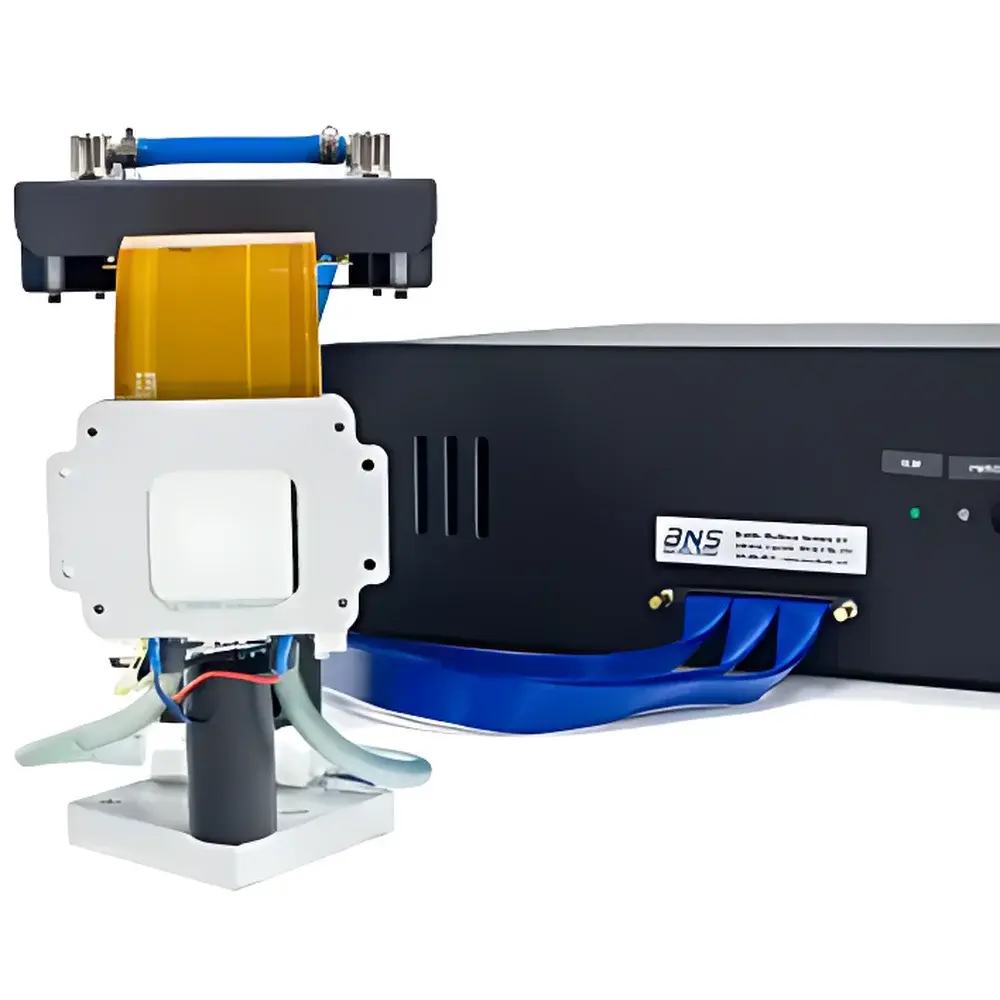
BNS 1536×1536 Pure-Phase High-Speed Liquid Crystal Spatial Light Modulator
| Brand | BNS (Boulder Nonlinear Systems) |
|---|---|
| Origin | USA |
| Model | 1536×1536 |
| Frame Rate | Up to 1000 Hz @ 1064 nm |
| Active Area | 30.7 mm × 30.7 mm |
| Pixel Count | 1536 × 1536 |
| Fill Factor | 96% |
| Drive Voltage | 12 V |
| Type | Pure-Phase LC-SLM |
| Compliance | RoHS, CE |
Overview
The BNS 1536×1536 Pure-Phase High-Speed Liquid Crystal Spatial Light Modulator is an engineered optical component designed for precision wavefront control in demanding scientific and industrial applications. Operating on the principle of electrically addressed liquid crystal birefringence modulation, this device enables spatially resolved, pixel-by-pixel phase retardation without amplitude modulation—ensuring minimal optical loss and high diffraction efficiency in phase-only holographic configurations. Its native resolution of 1536 × 1536 pixels over a 30.7 mm × 30.7 mm active aperture delivers exceptional spatial sampling density (19.9 µm pixel pitch), supporting high-fidelity beam shaping, complex mode generation (e.g., Laguerre–Gaussian, Bessel), and real-time adaptive correction. The modulator achieves frame rates up to 1000 Hz at 1064 nm—enabled by optimized LC cell design, low-capacitance electrode architecture, and high-bandwidth analog video interface—making it suitable for closed-loop adaptive optics systems where latency and temporal fidelity are critical.
Key Features
- Pure-phase modulation architecture with <96% fill factor, minimizing zero-order leakage and maximizing usable diffraction efficiency
- Native resolution of 1536 × 1536 pixels; uniform pixel pitch of 19.9 µm across full active area
- High-speed operation: sustained 1000 Hz frame rate at 1064 nm with sub-millisecond rise/fall times (typ. <300 µs)
- 12 V analog drive voltage range, compatible with standard high-resolution DAC-based controller interfaces
- Optimized for near-infrared wavelengths (1030–1080 nm), with anti-reflection coatings specified for 1064 nm (R < 0.25% per surface)
- Robust thermal management design enabling stable phase response under continuous operation
- Integrated timing synchronization I/O (TTL-compatible trigger in/out) for precise system-level coordination with lasers, cameras, or DAQ hardware
Sample Compatibility & Compliance
This SLM is intended for integration into optically isolated, vibration-damped laboratory environments typical of ultrafast laser labs, multiphoton microscopy platforms, and astronomical adaptive optics testbeds. It supports standard optical mounting via kinematic cage system adapters (e.g., Thorlabs SM2-threaded flange) and accepts collimated input beams with diameters up to 25 mm (full utilization of active area recommended for optimal phase uniformity). The device complies with RoHS Directive 2011/65/EU and CE marking requirements for electromagnetic compatibility (EMC Directive 2014/30/EU) and low-voltage safety (LVD Directive 2014/35/EU). While not certified for medical or aerospace use out-of-the-box, its design adheres to ISO 9001-aligned manufacturing controls and traceable calibration protocols used in metrology-grade optical component production.
Software & Data Management
BNS provides the proprietary SLM Control Studio software suite (Windows 10/11, 64-bit), supporting real-time phase pattern generation, GPU-accelerated hologram calculation (including Gerchberg–Saxton and direct binary search algorithms), and hardware-synchronized playback from memory buffers. The API includes C/C++, Python (via ctypes), and MATLAB bindings—enabling integration into custom LabVIEW, Python-based acquisition pipelines (e.g., with PyVISA or OpenCV), or commercial platforms such as Thorlabs’ Kinesis or NIS-Elements. All phase maps are stored in IEEE 754-compliant 16-bit unsigned integer format (.bin or .tif), ensuring bit-perfect reproducibility. Audit trails—including timestamped pattern load events, firmware version logs, and thermal sensor readings—are retained locally and exportable for GLP/GMP-aligned documentation workflows.
Applications
- Adaptive Optics: Real-time wavefront correction in retinal imaging, laser guide star systems, and high-power laser beam control
- Two-Photon Microscopy: Dynamic multi-focus scanning, scanless volumetric excitation, and aberration compensation in deep-tissue imaging
- Neuroscience: Patterned optogenetic stimulation with spatiotemporal precision across neuronal populations in vitro and in vivo
- Quantum Optics: Generation and sorting of orbital angular momentum (OAM) states, quantum walk implementations, and entangled photon shaping
- Ultrafast Pulse Shaping: Spectral phase modulation in conjunction with 4f pulse shapers for coherent control experiments
- Holographic Optical Trapping: Simultaneous manipulation of multiple micro-objects with independent trajectory control
FAQ
What is the maximum usable optical power density at 1064 nm?
The device is rated for continuous-wave irradiance up to 5 W/cm² at 1064 nm with proper heat sinking; pulsed operation (e.g., Ti:sapphire, Yb:fiber) requires peak fluence limits below 10 mJ/cm² per pulse (10 ns duration) to avoid LC degradation.
Is the phase response linearized and calibrated out-of-the-box?
Yes—each unit ships with a factory-measured, wavelength-specific phase-to-voltage lookup table (LUT) and nonlinearity correction coefficients embedded in firmware; user recalibration is optional via built-in interferometric self-test mode.
Can this SLM be synchronized with external cameras or laser triggers?
Yes—dedicated TTL-compatible SYNC IN and SYNC OUT ports support hardware-level triggering with jitter <10 ns, enabling lock-step operation with sCMOS cameras (e.g., Hamamatsu ORCA-Fusion) or cavity-dumped ultrafast oscillators.
Does the controller support real-time phase feedback loops?
The integrated FPGA-based timing engine supports closed-loop operation at up to 500 Hz using external wavefront sensor data (e.g., Shack–Hartmann) streamed via PCIe or USB3; latency from sensor input to phase update is <1.2 ms.
Are custom AR coatings available for other wavelengths?
Yes—BNS offers optional broadband (700–1100 nm) or wavelength-specific (e.g., 780 nm, 1550 nm) anti-reflection coatings; lead time and minimum order quantities apply.



