
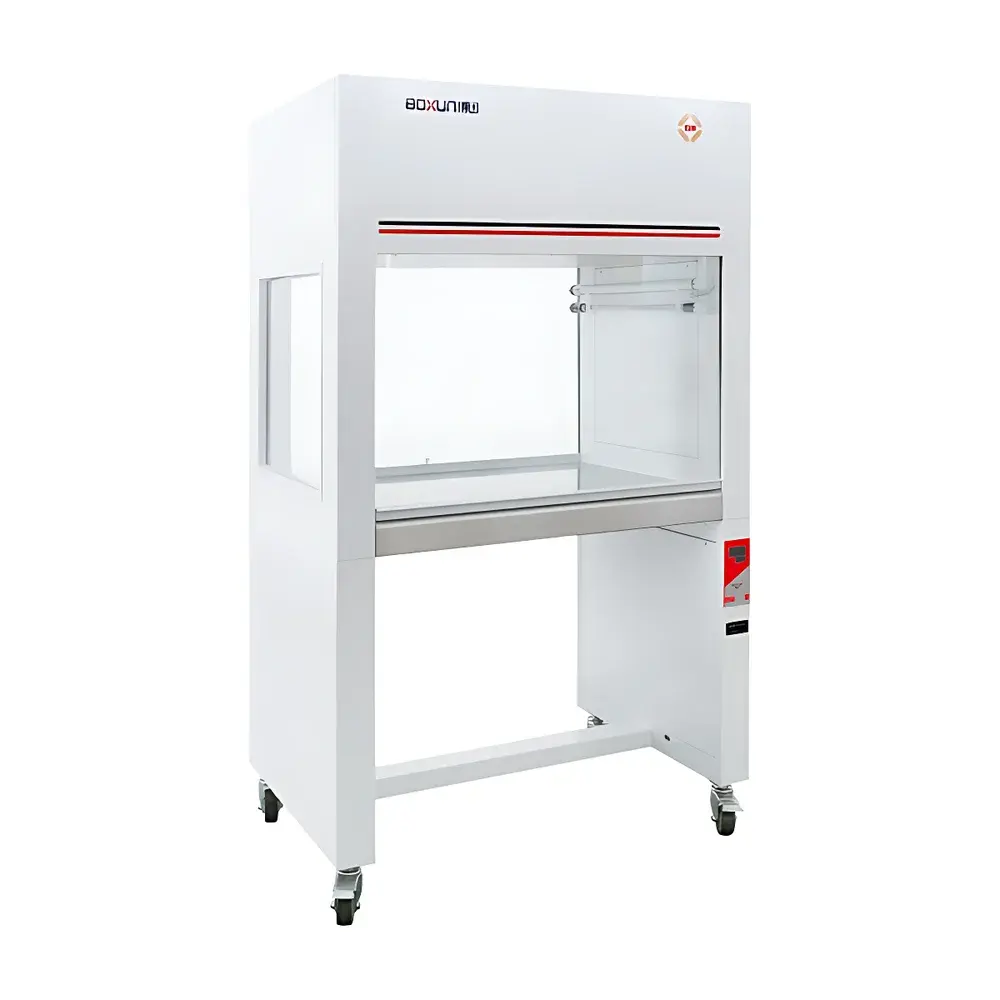
BOXUN VS-840-2 Vertical Flow Clean Bench
| Brand | BOXUN |
|---|---|
| Origin | Shanghai, China |
| Manufacturer Type | Authorized Distributor |
| Product Category | Domestic |
| Model | VS-840-2 |
| Instrument Type | Vertical Flow Clean Bench |
| Cleanliness Class | ISO Class 5 (100-grade, ≥99.99% filtration efficiency for particles ≥0.5 µm) |
| Noise Level | ≤67 dB(A) |
| User Capacity | Single-operator, dual-front access |
| Airflow Pattern | Vertical downward laminar flow |
| Work Area Dimensions (W×D×H) | 830 × 650 × 520 mm |
| Overall Dimensions (W×D×H) | 990 × 700 × 1650 mm |
| HEPA Filter Specification | 780 × 565 × 50 mm (1 unit) |
| Pre-filter | Medium-efficiency panel filter |
| Air Velocity Range | 0.3–0.6 m/s (adjustable in six steps) |
| Illumination | ≥300 lux |
| UV Lamp | 20 W × 1 (timer-controlled, 0–999 min) |
| Fluorescent Lamp | 20 W × 1 |
| Vibration Amplitude (peak-to-peak) | ≤5 µm (X/Y/Z axes) |
| Weight | 120 kg |
| Power Consumption | 0.15 kW |
| Electrical Supply | AC 220 V ±10%, 50/60 Hz |
Overview
The BOXUN VS-840-2 Vertical Flow Clean Bench is an ISO Class 5-certified laminar airflow workstation engineered to deliver a particle-controlled environment for non-sterile but contamination-sensitive procedures. Operating on the principle of vertical unidirectional airflow—where air is drawn through a pre-filter and then forced downward through a certified HEPA filter (≥99.99% efficiency at 0.5 µm)—the unit establishes a continuous, low-turbulence curtain of purified air across the work surface. This configuration isolates the operator from the process while minimizing cross-contamination between samples and reagents. Unlike biological safety cabinets, the VS-840-2 does not recirculate air nor provide personnel protection against biohazards; it is strictly intended for applications requiring environmental particulate control—such as cell culture preparation, media dispensing, electronic component handling, and analytical sample staging—where sterility of the workspace—not the operator—is the primary objective.
Key Features
- Vertical laminar airflow architecture with adjustable velocity (0.3–0.6 m/s) across six discrete settings, enabling optimization for diverse procedural requirements including sensitive instrumentation setup or high-volume pipetting.
- Robust structural design: cold-rolled steel enclosure with electrostatic epoxy coating; work surface and interior chamber fabricated from brushed SUS304 stainless steel for corrosion resistance, chemical compatibility, and ease of decontamination.
- Integrated dual-lighting system: independently switchable 20 W fluorescent lamp (≥300 lux at work surface) and 20 W UV-C germicidal lamp with programmable timer (0–999 minutes), supporting both operational illumination and post-use surface decontamination.
- Intuitive LCD control interface with tactile membrane switches—providing real-time feedback on fan speed, UV timer status, and operational mode without mechanical wear.
- Counterbalanced sash mechanism allows smooth, tool-free positioning of the front access window within its full vertical travel range, ensuring ergonomic adaptability for users of varying height.
- Dual-stage filtration: a washable medium-efficiency pre-filter extends the service life of the main HEPA filter (780 × 565 × 50 mm); both filters conform to EN 1822-1:2019 classification standards for H14-grade performance.
Sample Compatibility & Compliance
The VS-840-2 is compatible with standard laboratory consumables—including Petri dishes, multiwell plates, flasks, and pipette tip racks—and accommodates equipment up to 520 mm in working height. Its vertical flow configuration ensures minimal turbulence interference during micro-pipetting or optical alignment tasks. The unit complies with ISO 14644-1:2015 for cleanroom performance verification and meets the airflow uniformity and particle-counting criteria defined in IEST-RP-CC002.3 for laminar flow devices. While not certified to NSF/ANSI 49 or EN 12469 (as it provides no personnel or environmental protection), its construction and filter validation align with GLP-aligned facility requirements for non-hazardous sample preparation zones. Documentation includes factory-issued filter integrity test reports and airflow velocity calibration certificates traceable to national metrology institutes.
Software & Data Management
The VS-840-2 operates via embedded firmware without external software dependency. All operational parameters—including fan speed selection, UV exposure duration, and lighting activation—are stored in non-volatile memory and persist across power cycles. Though not equipped with network connectivity or data logging, the control system supports audit-ready manual recordkeeping: the LCD display logs cumulative UV runtime (in minutes), and physical operation logs can be maintained per internal SOPs. For laboratories operating under FDA 21 CFR Part 11 or EU Annex 11 frameworks, the unit may be integrated into broader facility monitoring systems via optional analog voltage output modules (available upon request), enabling centralized tracking of operational status and maintenance intervals.
Applications
- Preparation of sterile culture media and reagents prior to autoclaving or filtration.
- Handling of non-pathogenic microbial strains, plant tissue explants, and primary mammalian cells in academic and industrial R&D labs.
- Assembly and testing of high-precision optical and microelectronic components where airborne particulates compromise yield.
- Environmental monitoring sample processing—including filter preparation and gravimetric analysis—in accordance with EPA Method 202 and ISO 12103-1.
- QC/QA staging for pharmaceutical excipient weighing and tablet sampling under cGMP Annex 1-aligned cleanroom support environments.
FAQ
Does the VS-840-2 provide protection against biological aerosols or hazardous chemicals?
No. It is a clean bench—not a biosafety cabinet—and offers no containment for operators or the environment. It must not be used for work involving Risk Group 2+ agents or volatile toxic compounds.
What is the recommended HEPA filter replacement interval?
Under typical usage (8 hrs/day, ISO Class 5 ambient air), the HEPA filter requires replacement every 18–24 months; however, differential pressure monitoring and annual particle challenge testing per ISO 14644-3 are required to validate continued compliance.
Can the unit be installed in a non-ISO classified room?
Yes—but upstream air quality directly affects filter lifespan and cleanliness stability. Installation in ISO Class 8 or better environments is strongly advised to maintain consistent 100-grade performance.
Is the UV lamp intensity validated at installation?
Yes. Each unit ships with a calibrated UV radiometer report confirming irradiance ≥100 µW/cm² at 1 cm from the lamp surface, per IEC 62471 photobiological safety guidelines.
Does the sash position affect airflow uniformity?
Within the specified operating range (fully open to 200 mm above work surface), airflow velocity and uniformity remain within ±10% of setpoint, as verified by ISO 14644-3 traverse testing.



