
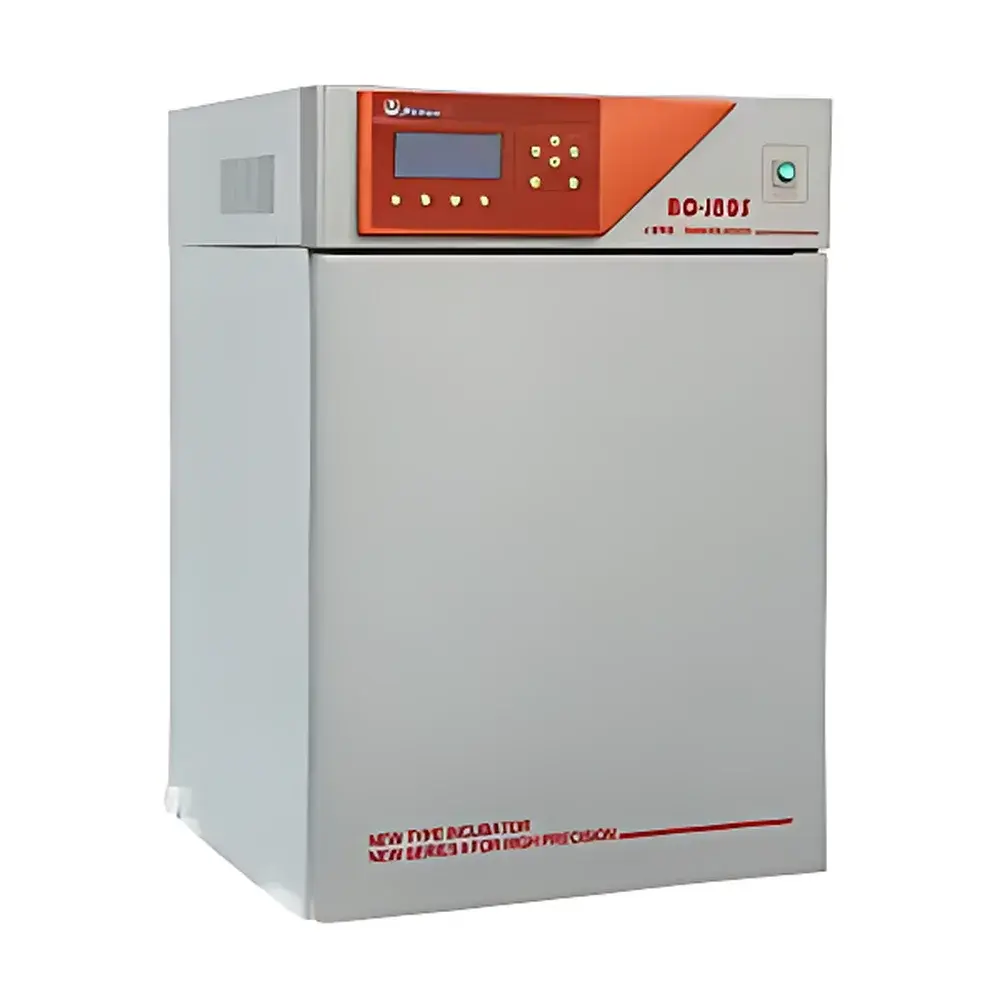
BOXUN BC-J160 CO₂ Incubator (Gas-Jacketed, TCD Sensor)
| Brand | BOXUN |
|---|---|
| Origin | Shanghai, China |
| Manufacturer Type | Direct Manufacturer |
| Country of Origin | China |
| Model | BC-J160 (Gas-Jacketed, Thermal Conductivity Detection) |
| Temperature Range | Ambient +5°C to 60°C |
| Temperature Uniformity | ≤ ±0.5°C |
| Temperature Stability | ≤ ±0.2°C |
| Temperature Resolution | 0.1°C |
| CO₂ Range | 0–19.9% |
| CO₂ Sensing Method | Thermal Conductivity Detector (TCD) |
| CO₂ Recovery Time | ≤ (setpoint %) × 2 minutes |
| Chamber Volume | 160 L |
| Internal Dimensions (W×D×H) | 540 × 490 × 680 mm |
| External Dimensions (W×D×H) | 700 × 650 × 1030 mm |
| Power Supply | AC 220 V ±10%, 50 Hz ±2% |
| Rated Power | 800 W |
| Humidification Method | Natural Evaporation |
| Filtration Efficiency | ≥99.998% for particles ≥0.3 µm (dual HEPA filters) |
| Display | High-brightness LCD with simultaneous real-time display of temperature and CO₂ concentration |
| Safety Features | Dual independent temperature control systems, over-temperature audible/visual alarm, door-heating anti-condensation system, power-failure data retention and auto-recovery |
| Interface | RS-485 for PC or data logger connectivity |
| Optional Accessories | Thermal printer (curve printing), GPRS SMS alert module, remote PC monitoring software |
Overview
The BOXUN BC-J160 CO₂ Incubator is a gas-jacketed, microprocessor-controlled environmental chamber engineered for reliable, long-term cultivation of mammalian cells, primary tissues, and sensitive microbial cultures under physiologically relevant conditions. It maintains precise control of three critical parameters—temperature, CO₂ concentration, and relative humidity—within a sealed, contamination-resistant stainless-steel chamber. The system employs thermal conductivity detection (TCD) for CO₂ measurement, a robust, drift-resistant method widely adopted in academic and industrial cell culture labs where calibration stability and operational longevity are prioritized over ultra-high-speed response. Its gas-jacketed heating architecture ensures rapid thermal recovery after door openings and superior temperature uniformity across the entire 160 L working volume—critical for reproducible passage-dependent assays, stem cell expansion, and bioprocess development workflows.
Key Features
- Gas-jacketed thermal design with dual PT100 temperature sensors and chip-based adaptive suppression control minimizes thermal overshoot and stabilizes chamber conditions following door access.
- Dual independent control loops: primary regulation with fail-safe secondary monitoring circuitry ensures continuous operational integrity—even during main controller fault or power interruption.
- Integrated door-heating system prevents inner-glass condensation, preserving optical clarity for uninterrupted microscopic observation and reducing moisture loss during routine handling.
- Double-stage HEPA filtration (≥99.998% efficiency for ≥0.3 µm particles) installed on both intake and exhaust pathways maintains ISO Class 5-equivalent internal air quality without requiring external ducting.
- 90°C high-humidity decontamination cycle eliminates mycoplasma, fungi, and non-spore-forming bacteria; validated per ISO 14644-1 cleanroom protocols for routine chamber sanitization.
- RS-485 serial interface supports integration with laboratory information management systems (LIMS), SCADA platforms, or custom Python/Matlab-based monitoring scripts for audit-ready data logging.
- Non-volatile memory retains all setpoints, alarms, and historical event logs during unexpected power loss; automatic parameter restoration upon re-powering complies with GLP/GMP data integrity requirements (21 CFR Part 11–ready when paired with compliant software).
Sample Compatibility & Compliance
The BC-J160 accommodates standard tissue-culture formats—including T-25 to T-225 flasks, 6–96-well plates, Petri dishes, roller bottles, and cryovial racks—across three adjustable stainless-steel shelves. Its chamber sealing integrity (tested per ASTM E2877-13) ensures CO₂ concentration deviation remains within ±0.2% of setpoint over 24 h at 5% CO₂ and 37°C. The unit conforms to IEC 61010-1:2010 safety standards for laboratory equipment and meets electromagnetic compatibility (EMC) requirements per EN 61326-1. While not certified as an FDA-listed medical device, its performance characteristics align with USP recommendations for cell therapy manufacturing environments and support adherence to ISO 5555 (cell culture incubator validation guidelines).
Software & Data Management
The embedded firmware supports time-stamped event logging (door openings, CO₂ excursions, temperature deviations, alarm triggers) with configurable retention (up to 30 days onboard). When connected via RS-485 to a host PC running BOXUN’s optional LabLink™ software (Windows 10/11 compatible), users gain access to real-time graphing, customizable alarm thresholds, PDF report generation, and CSV export for statistical process control (SPC) analysis. All electronic records include user ID, timestamp, and action type—enabling full traceability required under GLP audits and internal QA review cycles.
Applications
This incubator serves core workflows in academic research laboratories, contract development and manufacturing organizations (CDMOs), and pharmaceutical QC units. Typical use cases include: maintenance of human iPSC lines under feeder-free conditions; serial passaging of primary tumor organoids; aerobic cultivation of fastidious pathogens (e.g., Helicobacter pylori, Neisseria gonorrhoeae); co-culture experiments involving endothelial and immune cells; and pre-incubation of ELISA plates prior to assay execution. Its stable CO₂ delivery and uniform thermal field make it suitable for applications demanding low inter-batch variability—such as transfection efficiency optimization, CRISPR-Cas9 editing validation, and monoclonal antibody production seeding.
FAQ
What CO₂ sensing technology does the BC-J160 employ, and how often does it require calibration?
The BC-J160 uses a thermal conductivity detector (TCD), which requires no consumables or zero-gas calibration. Field verification against a NIST-traceable reference gas (e.g., 5.00 ±0.05% CO₂ in N₂) is recommended annually or after major maintenance.
Is the humidity level actively controlled or passively maintained?
Humidity is maintained via natural evaporation from a removable stainless-steel water pan; no ultrasonic humidifier or steam generator is integrated. At 37°C and 5% CO₂, typical RH ranges between 85–95% with the pan filled to the indicated line.
Can the BC-J160 be validated per IQ/OQ/PQ protocols?
Yes—the unit provides accessible sensor ports, documented uncertainty budgets for TCD and PT100 elements, and a factory-issued as-built drawing package. Full qualification documentation templates (including mapping study guidance) are available upon request from BOXUN Technical Support.
Does the incubator support remote monitoring outside the local network?
With the optional GPRS module, SMS alerts (e.g., door-left-open, temperature excursion) can be sent to up to five pre-authorized mobile numbers. For LAN/WAN integration, the RS-485 port must be connected to a gateway supporting Modbus RTU or TCP/IP bridging.
Are third-party accessories (e.g., CO₂ analyzers, external hygrometers) compatible?
While BOXUN does not guarantee interoperability, the RS-485 interface adheres to standard Modbus RTU framing. Integration with external devices requires protocol-level alignment and is subject to end-user validation per ISO/IEC 17025 principles.





