
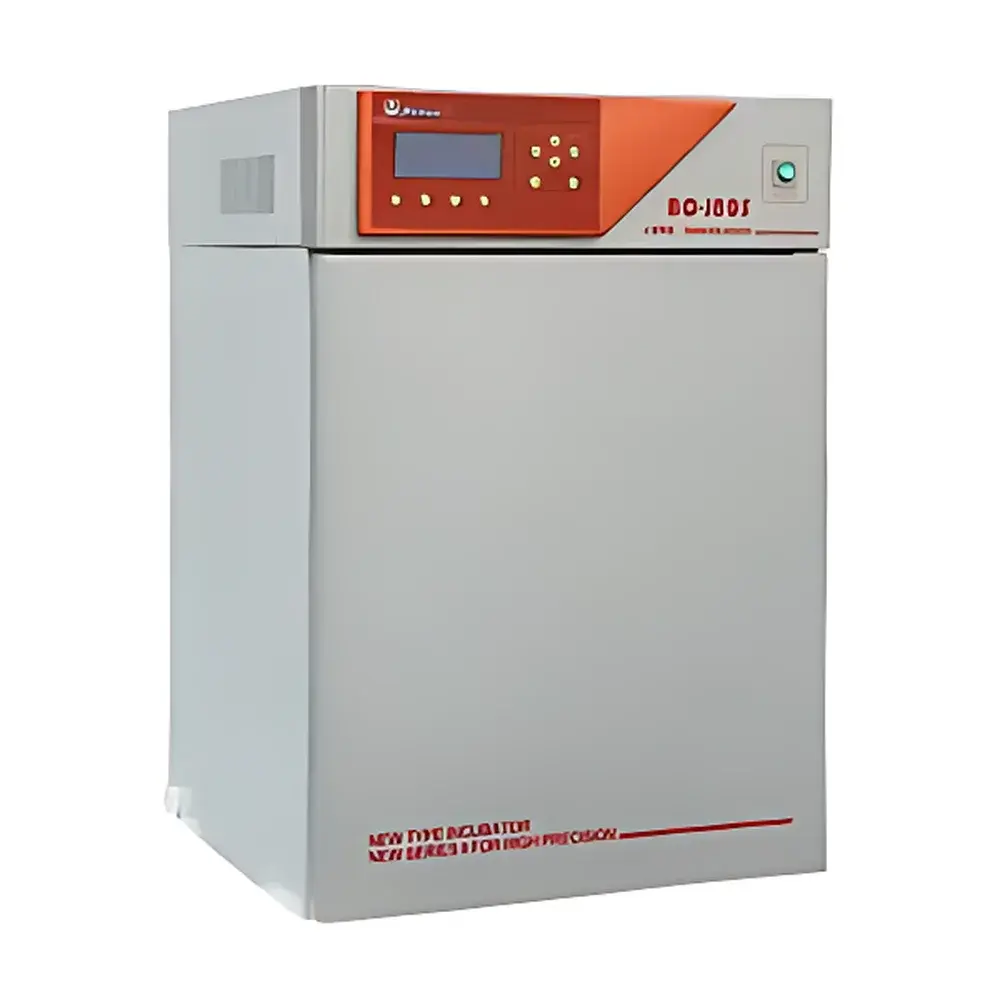
BOXUN BC-J250 CO₂ Incubator (Gas-Jacketed, TCD Sensor)
| Brand | BOXUN |
|---|---|
| Origin | Shanghai, China |
| Manufacturer Type | Direct Manufacturer |
| Country of Origin | China |
| Model | BC-J250 (Gas-Jacketed, Thermal Conductivity Detector) |
| Temperature Range | Ambient +5°C to 60°C |
| Temperature Uniformity | ≤ ±0.5°C |
| Temperature Stability | ≤ ±0.2°C |
| Temperature Resolution | 0.1°C |
| CO₂ Range | 0–19.9% (v/v) |
| CO₂ Control Method | Thermal Conductivity Detection (TCD) |
| CO₂ Recovery Time | ≤ [setpoint %] × 2 minutes |
| Chamber Volume | 250 L |
| Internal Dimensions (W×D×H) | 600 × 600 × 770 mm |
| External Dimensions (W×D×H) | 840 × 775 × 1175 mm |
| Power Supply | AC 220 V ±10%, 50 Hz ±2% |
| Input Power | 850 W |
| Humidification Method | Natural Evaporation |
| Filtration Efficiency | ≥99.998% for particles ≥0.3 µm |
| Number of Shelves | 3 adjustable stainless steel shelves |
| Interface | RS-485 for external data logging or PC integration |
Overview
The BOXUN BC-J250 CO₂ Incubator is a gas-jacketed, microprocessor-controlled environmental chamber engineered for precise and stable maintenance of mammalian cell cultures, primary tissues, and sensitive microbial strains under physiologically relevant conditions. It operates on the principle of thermal conductivity detection (TCD) for real-time CO₂ concentration monitoring and feedback-regulated gas injection—ensuring rapid equilibration and long-term stability of the gaseous environment. The gas-jacketed heating architecture provides superior thermal inertia and uniformity compared to water-jacketed or direct-heating designs, minimizing temperature fluctuations during door openings and enabling consistent incubation across the full 250 L working volume. Designed for routine use in academic research laboratories, biopharmaceutical QC facilities, and clinical cell culture suites, the BC-J250 meets foundational requirements for GLP-compliant cell expansion, stem cell maintenance, and preclinical assay development.
Key Features
- Gas-jacketed thermal system with dual independent temperature sensors and chip-based auto-suppression logic to mitigate transient thermal disturbances caused by door access.
- TCD-based CO₂ sensing with automatic calibration compensation; achieves ≤ [setpoint %] × 2 min recovery time following chamber interruption.
- High-efficiency dual-stage particulate filtration: 0.3 µm HEPA-grade filter with ≥99.998% retention efficiency, integrated upstream of the internal air circulation path.
- 90°C high-humidity decontamination cycle validated for non-corrosive, residue-free microbial reduction—including spores—without requiring chemical agents.
- Electropolished 304 stainless-steel interior chamber with seamless welds and rounded corners; optimized airflow ducting ensures ≤ ±0.5°C temperature uniformity (ASTM E1753-22 compliant test methodology).
- Intelligent door-heating system prevents condensation on the inner glass viewport, preserving optical clarity during humidified operation (RH ≥90%).
- Dual-redundant control architecture: primary microcontroller with independent backup monitor circuitry providing fail-safe overtemperature and CO₂ deviation alerts via audible/visual indicators.
- RS-485 serial interface supporting Modbus RTU protocol for integration into centralized lab monitoring systems or third-party SCADA platforms.
Sample Compatibility & Compliance
The BC-J250 accommodates standard tissue-culture flasks (T25–T225), multi-well plates (6–96-well), Petri dishes, roller bottles, and cryogenic storage racks across its three adjustable stainless-steel shelves. Its sealed chamber design maintains CO₂ setpoints within ±0.2% of target over 24-hour continuous operation, fulfilling minimum performance criteria outlined in ISO 13408-4 (Aseptic processing of health care products — Part 4: Isolators) and USP (Cellular and Gene Therapy Products). While not certified to IEC 61010-1 or FDA 21 CFR Part 11 out-of-the-box, the instrument’s parameter memory with power-loss recovery, audit-trail-capable event logging (via optional RS-485-connected software), and configurable alarm thresholds support alignment with GMP Annex 1 and WHO TRS 961 documentation requirements when deployed within validated workflows.
Software & Data Management
The BC-J250 includes embedded firmware supporting local parameter configuration, real-time display of chamber temperature, CO₂ concentration, and relative humidity via a high-brightness LCD interface. For extended data governance, the RS-485 port enables connection to externally hosted acquisition software (e.g., LabVIEW, MATLAB, or custom Python-based daemons) that can record timestamped sensor values at user-defined intervals. Optional accessories—including an integrated thermal printer (curve-print capable), GPRS-enabled SMS alert module, or Ethernet-to-RS485 gateway—extend traceability for remote labs or multi-site operations. All logged data retains metadata including operator ID (if authenticated), session start/stop timestamps, and system error codes—facilitating retrospective review per ALCOA+ principles.
Applications
- Long-term expansion of adherent and suspension mammalian cell lines (e.g., CHO, HEK293, HeLa) under tightly controlled pH (via CO₂/bicarbonate buffering) and temperature regimes.
- Cultivation of human primary cells—including fibroblasts, endothelial cells, and PBMCs—requiring low-oxygen adaptation protocols when paired with optional N₂/CO₂ blending modules.
- Microbial culture of fastidious organisms (e.g., Capnocytophaga, Neisseria gonorrhoeae) dependent on elevated CO₂ for metabolic activation.
- Preparation of feeder layers for pluripotent stem cell derivation and differentiation assays where batch-to-batch consistency in growth kinetics is critical.
- Stability testing of biologics in formulation development, where controlled humidity and CO₂ levels simulate physiological delivery environments.
FAQ
What CO₂ sensing technology does the BC-J250 employ, and how does it compare to infrared (IR) sensors?
The BC-J250 uses thermal conductivity detection (TCD), a robust, drift-resistant method well-suited for general-purpose CO₂ monitoring in clean-room-adjacent environments. Unlike IR sensors, TCD requires no optical windows or periodic recalibration but exhibits slightly lower specificity in mixed-gas atmospheres containing hydrogen or helium.
Is the 90°C humidified decontamination cycle validated against specific microbial strains?
Validation data per EN 14885 is not supplied with the base unit; users are advised to perform in-house biological indicator challenges (e.g., Geobacillus stearothermophilus spores) when implementing this cycle as part of a formal sterilization protocol.
Can the BC-J250 maintain humidity above 95% RH without external water reservoir refilling?
Yes—the natural evaporation humidification system sustains ≥95% RH for >72 hours at 37°C/5% CO₂ with the standard 2.5 L internal water pan, assuming ambient lab humidity remains below 60% RH.
Does the RS-485 interface support Modbus TCP conversion via industrial gateways?
Yes—standard RS-485 Modbus RTU framing is compatible with commercially available protocol converters enabling TCP/IP bridging for integration into enterprise laboratory information management systems (LIMS).
Are shelf load ratings and maximum airflow obstruction limits specified in the manual?
Maximum distributed load per shelf is 15 kg; total obstructed surface area should not exceed 40% of any single shelf plane to preserve laminar recirculation and thermal uniformity.
Related Products




