
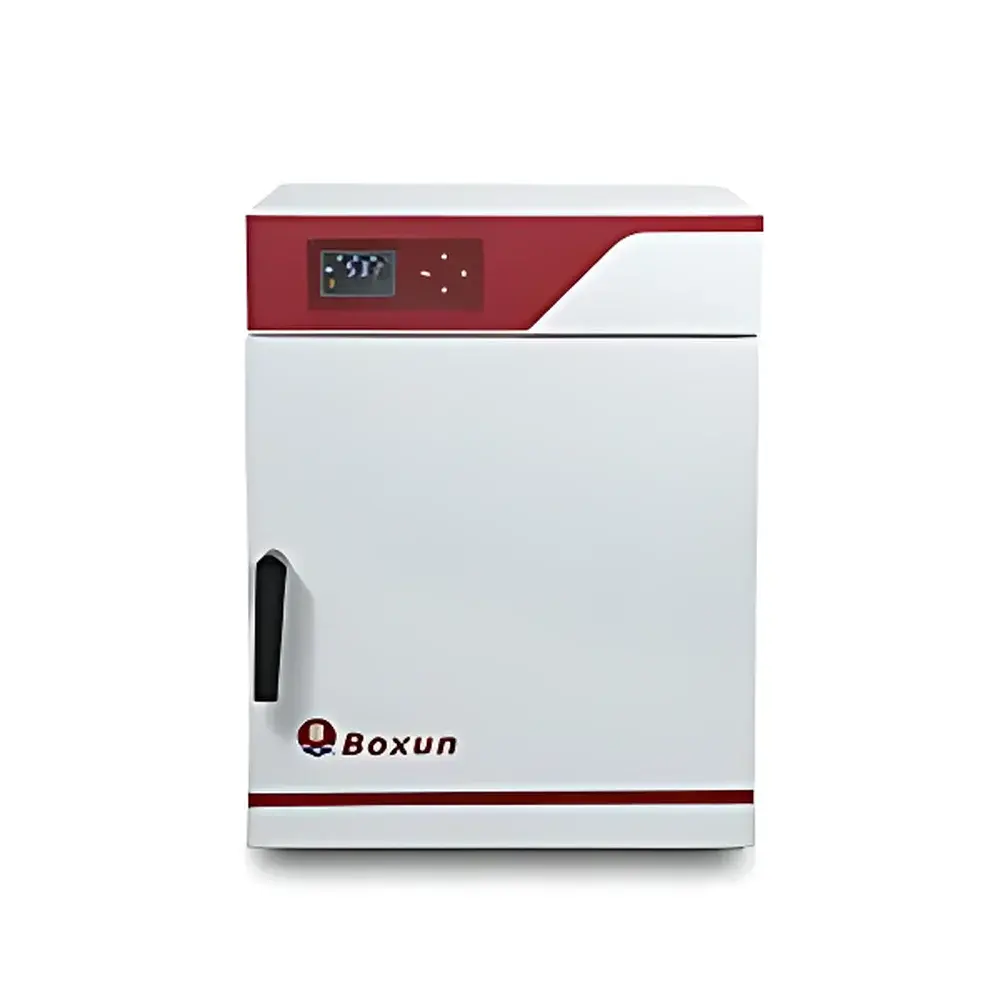
Boxun BGZ-306 High-Temperature Forced-Air Drying Oven
| Brand | Boxun |
|---|---|
| Origin | Shanghai, China |
| Manufacturer Type | Direct Manufacturer |
| Product Category | Domestic |
| Model | BGZ-306 |
| Instrument Type | High-Temperature Drying Oven |
| Temperature Range | Ambient +5°C to 300°C |
| Temperature Uniformity | ±2% |
| External Dimensions | 865 × 764 × 1017 mm |
| Internal Chamber Dimensions | 720 × 530 × 745 mm |
| Interior Material | Mirror-Finish Stainless Steel |
| Heating Method | Forced-Air Circulation (PMMA II Control System) |
| Temperature Resolution | 0.1°C |
| Temperature Stability | ±0.8°C at 105°C |
| Rated Power | 2750 W |
| Timer Range | 0–9999 min/h |
| Delay Start Range | 0–999 min |
| Programmable Stages | 10 segments × 100 cycles |
| Chamber Volume | 284 L |
| Standard Shelves | 3 (max. 10) |
| Shelf Load Capacity | 15 kg per shelf |
| Interface | RS-485 |
| Power Recovery Function | Yes |
Overview
The Boxun BGZ-306 High-Temperature Forced-Air Drying Oven is an industrial-grade laboratory drying and thermal processing system engineered for precision temperature control, uniform heat distribution, and long-term operational reliability. Designed around the principle of convection-driven thermal homogenization, the oven employs a high-efficiency axial fan coupled with a multi-stage adjustable air circulation system to ensure consistent airflow velocity and minimal thermal gradient across the entire 284 L working chamber. Its operating range spans from ambient +5°C to 300°C—making it suitable for applications requiring elevated thermal stability, including polymer curing, ceramic sintering pre-treatment, moisture removal from refractory materials, and accelerated aging studies compliant with ASTM D5422 and ISO 11357-3 protocols.
Key Features
- Mirror-finish 304 stainless steel interior chamber with seamless corner radii for easy decontamination and compliance with GLP cleaning validation requirements
- Double-sealed, rotary dual-latch door mechanism with high-compression silicone gasket ensuring <1.5 Pa internal pressure differential retention during operation
- PMMA II microprocessor-based control system featuring full-color LCD interface, real-time parameter visualization, and intuitive touch-key navigation
- 10-segment × 100-cycle programmable temperature/time profile capability supporting complex thermal ramp-hold-cool sequences
- 6-step adjustable fan speed control (0–100% airflow output), enabling optimization for dust-sensitive samples or low-convection thermal treatments
- Preheated air inlet design: ambient air is conditioned through a dedicated heating duct prior to chamber entry, reducing thermal lag and improving ramp reproducibility
- RS-485 serial interface compliant with Modbus RTU protocol for integration into centralized lab automation networks or SCADA systems
- Auto-recovery function maintains programmed parameters and resumes operation post-power interruption without manual reconfiguration
Sample Compatibility & Compliance
The BGZ-306 accommodates a broad spectrum of sample types—including powders, granules, coated substrates, metal coupons, and polymer sheets—without cross-contamination risk, owing to its non-porous stainless steel chamber and removable, load-rated shelves (15 kg capacity each). It meets structural and safety requirements outlined in IEC 61010-1:2010 (Safety Requirements for Electrical Equipment for Measurement, Control, and Laboratory Use) and incorporates overtemperature cut-off protection aligned with UL 61010-1. While not certified for Class II biological containment, its sealed construction supports ISO 14644-1 Class 8 cleanroom-compatible operation when installed in controlled environments. Optional calibration certificates traceable to NIM (National Institute of Metrology, China) are available upon request for audit-ready documentation.
Software & Data Management
The embedded PMMA II controller logs timestamped temperature data at user-defined intervals (1–60 sec resolution) to internal flash memory (≥10,000 records). Raw datasets can be exported via RS-485 to third-party software platforms such as LabVIEW, MATLAB, or custom Python-based analysis suites using standard ASCII CSV formatting. Audit trail functionality includes operator ID tagging (via optional RFID reader integration), parameter change logging, and alarm event timestamps—all structured to satisfy FDA 21 CFR Part 11 electronic record requirements when paired with validated networked data acquisition systems. Firmware updates are performed offline via USB port (not included), preserving configuration integrity during version upgrades.
Applications
- Moisture content determination per AOAC 950.46 and USP <731> guidelines
- Thermal gravimetric pre-conditioning of catalysts and battery electrode materials
- Accelerated stability testing of pharmaceutical excipients under ICH Q1A(R2) conditions
- Drying of filter papers, crucibles, and volumetric glassware in QC laboratories
- Curing of epoxy coatings and adhesives in R&D prototyping workflows
- Pre-baking of PCB assemblies prior to solder paste application
- Heat treatment of geological core samples for porosity analysis
FAQ
What is the maximum recommended continuous operating temperature for the BGZ-306?
The unit is rated for sustained operation up to 300°C; however, prolonged use above 260°C may accelerate gasket degradation and requires quarterly visual inspection per maintenance schedule.
Does the oven support validation protocols such as IQ/OQ/PQ?
Yes—the BGZ-306’s repeatable thermal performance, digital calibration access, and data logging architecture support formal qualification when executed with documented procedures and NIST-traceable reference sensors.
Can the RS-485 interface be used for remote start/stop commands?
Yes, Modbus RTU register mapping enables external PLC or HMI-initiated control of timer activation, temperature setpoint adjustment, and alarm acknowledgment.
Is the internal chamber volume verified per ISO 27867:2015 standards?
Chamber volume is calculated geometrically (L × W × H) and confirmed during factory acceptance testing; volumetric displacement verification is not performed unless specified as an optional service.
How often should the air filter be cleaned or replaced?
The rear-mounted intake filter should be inspected monthly and cleaned with compressed air; replacement is recommended every 12 months under typical laboratory usage conditions.



