
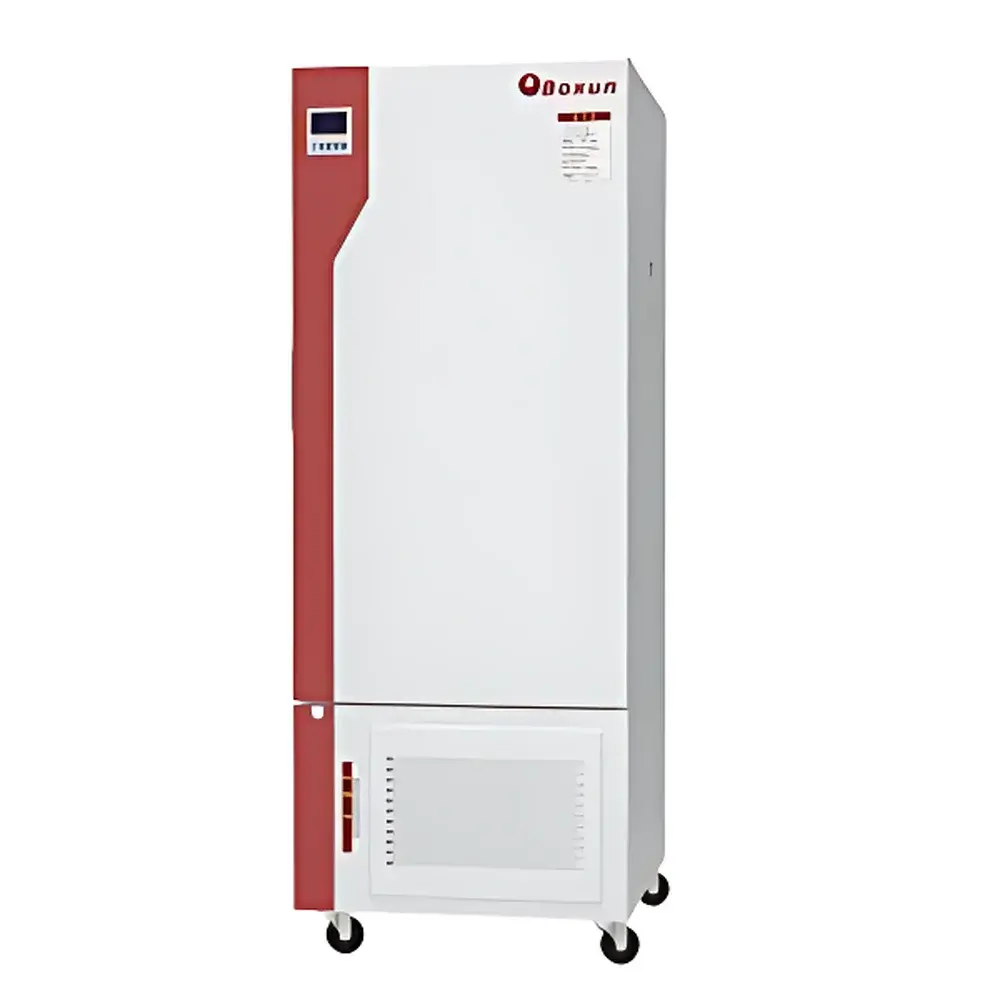
BOXUN BIC-250 Plant Growth Chamber
| Brand | BOXUN |
|---|---|
| Origin | Shanghai, China |
| Manufacturer Type | Direct Manufacturer |
| Region of Origin | Domestic (China) |
| Model | BIC-250 |
| Price Range | USD 1,400–2,800 |
| Temperature Control Range | 0–60°C (without light), 10–60°C (with light) |
| Temperature Resolution | 0.1°C |
| Temperature Uniformity | ±1°C at 37°C |
| Temperature Fluctuation | ±0.5°C |
| Humidity Control Range | 60–90% RH |
| Humidity Fluctuation | ±5% RH |
| Illumination Intensity | 0–15,000 lx (6-level adjustable) |
| Input Power | 1600 W |
| Timer Range | 0–9999 min |
| Inner Chamber Dimensions (W×D×H) | 480×480×1100 mm |
| External Dimensions (W×D×H) | 710×775×1770 mm |
| Shelf Capacity | 4 adjustable stainless-steel shelves |
| Refrigerant | Eco-friendly non-CFC refrigerant |
| Compressor | Internationally branded hermetic compressor |
| Air Circulation | Dual-mode airflow (laminar + vertical convection) |
| Control Interface | LCD with microprocessor-based PID control |
| Communication | RS-485 port for PC/data logger integration |
| Safety Features | Over-temperature alarm, mechanical door lock, auto-diagnostic self-check, energy-efficient defrosting |
| Programmability | Up to 30 segments × 99 cycles |
| Humidification System | Finned electric heating tube + large-capacity external water tank |
| Light Source | Triple-axis distributed LED array |
| Compliance | Designed per ISO 17025 laboratory environmental control principles |
Overview
The BOXUN BIC-250 Plant Growth Chamber is a precision-engineered environmental simulation system designed for controlled plant physiology studies, seed germination trials, photoperiodic response analysis, and long-term microbial culture maintenance under reproducible climatic conditions. Built upon a dual-loop microprocessor-controlled architecture, it integrates independent regulation of temperature, relative humidity, and spectral irradiance—enabling researchers to replicate diurnal cycles, seasonal transitions, or stress-inducing abiotic conditions (e.g., drought, heat shock, or low-light acclimation). Its core thermal management employs a patented integrated refrigeration module featuring an internationally certified hermetic compressor, non-ozone-depleting refrigerant (R134a or equivalent), and passive defrost technology that eliminates thermal disturbance during frost removal—ensuring uninterrupted stability in temperature-sensitive experiments lasting >72 hours. The chamber’s structural integrity derives from cold-rolled steel housing with electrostatic epoxy coating and a mirror-finish 304 stainless-steel interior, resistant to corrosion from repeated sterilization and high-humidity operation.
Key Features
- Triple-parameter independent control: Simultaneous, decoupled regulation of temperature (0–60°C), humidity (60–90% RH), and illumination (0–15,000 lx, six-step intensity grading)
- Dual-mode air distribution system: Laminar horizontal airflow combined with vertical convection lift ensures ±1°C uniformity across all shelf levels at 37°C, validated per ASTM E145-22 Annex A3 for chamber uniformity testing
- Intelligent PID algorithm with real-time adaptive compensation: Compensates for door-opening events, load changes, and ambient fluctuations without manual recalibration
- RS-485 digital interface compliant with Modbus RTU protocol: Enables centralized monitoring via LabVIEW, MATLAB, or custom SCADA systems; supports time-stamped data export in CSV/Excel format
- Fail-safe operational safeguards: Mechanical door lock prevents unauthorized access; over-temperature cut-off with audible/visual alert; automatic power-loss recovery preserving all setpoints and runtime logs
- Eco-conscious engineering: Non-CFC refrigerant, low-GWP insulation materials, and energy-optimized compressor cycling reduce annual power consumption by up to 22% versus legacy models (IEC 60068-3-5 referenced)
Sample Compatibility & Compliance
The BIC-250 accommodates standard tissue culture vessels (e.g., Petri dishes, Magenta boxes, growth pouches), hydroponic trays, and potted seedlings up to 30 cm height per shelf. Its 480 × 480 × 1100 mm internal volume allows stacking of multiple experimental units while maintaining laminar flow integrity. All wetted components—including the finned humidification heater and stainless-steel water reservoir—are autoclavable or compatible with 70% ethanol wipe-downs. The unit conforms to electrical safety standards IEC 61010-1 and EMC directive 2014/30/EU. While not FDA-cleared as a medical device, its parameter logging capability (when used with optional PC software) satisfies basic ALCOA+ data integrity requirements for GLP-regulated botanical research and agricultural biotechnology workflows.
Software & Data Management
The embedded controller stores up to 30 days of minute-interval environmental logs (temperature, humidity, light status) with timestamp and cycle ID. When connected via RS-485 to a host PC running BOXUN’s optional DataBridge™ software (v3.2+), users gain access to graphical trend analysis, deviation alerts, PDF report generation, and 21 CFR Part 11-compliant electronic signatures (with role-based user accounts and audit trail export). Raw serial output is ASCII-formatted and parseable by Python/Pandas for integration into LIMS or statistical modeling pipelines. Optional GPRS telemetry module enables SMS notifications for out-of-spec conditions—critical for unattended overnight or weekend experiments.
Applications
- Photomorphogenesis studies in Arabidopsis thaliana, rice, and maize under programmable day/night cycles
- Pre-sowing stress conditioning of horticultural crops (e.g., priming tomato seeds at 15°C/70% RH for enhanced drought tolerance)
- Standardized fungal culture maintenance (Aspergillus spp., Fusarium spp.) per ISO 7218 microbiological guidelines
- Controlled-environment phenotyping for QTL mapping in breeding programs
- Regulatory-compliant stability testing of botanical extracts per ICH Q1A(R3) guidance (limited to non-sterile storage conditions)
- Teaching laboratories requiring robust, serviceable platforms for undergraduate plant physiology labs
FAQ
What is the maximum load capacity per shelf, and how is weight distribution managed?
Each of the four adjustable 304 stainless-steel shelves supports up to 15 kg uniformly distributed. Shelf rails feature reinforced mounting points and anti-slip grooves to prevent lateral shift during vibration-prone transport or high-airflow operation.
Can the BIC-250 maintain humidity below 60% RH?
No—the system is engineered for high-humidity plant growth applications; dehumidification is not supported. For low-RH studies (e.g., xerophyte adaptation), supplemental desiccant chambers or external dry-air purge systems are recommended.
Is third-party calibration certification available?
Yes—BOXUN provides NIST-traceable calibration reports (temperature/humidity sensors) upon request, performed in accordance with ISO/IEC 17025:2017 by an accredited metrology lab; lead time: 10 business days.
How does the “energy-efficient defrost” mechanism avoid temperature spikes?
It utilizes residual evaporator heat and timed off-cycle dwell periods instead of resistive heating elements—eliminating thermal overshoot and reducing defrost duration by ≥40% compared to conventional hot-gas defrost systems.
Does the RS-485 interface support Modbus TCP/IP conversion?
Yes—when paired with a commercially available RS-485-to-Ethernet gateway (e.g., Moxa EDS-205A), full TCP/IP integration into enterprise IoT architectures is achievable without firmware modification.
Related Products





