
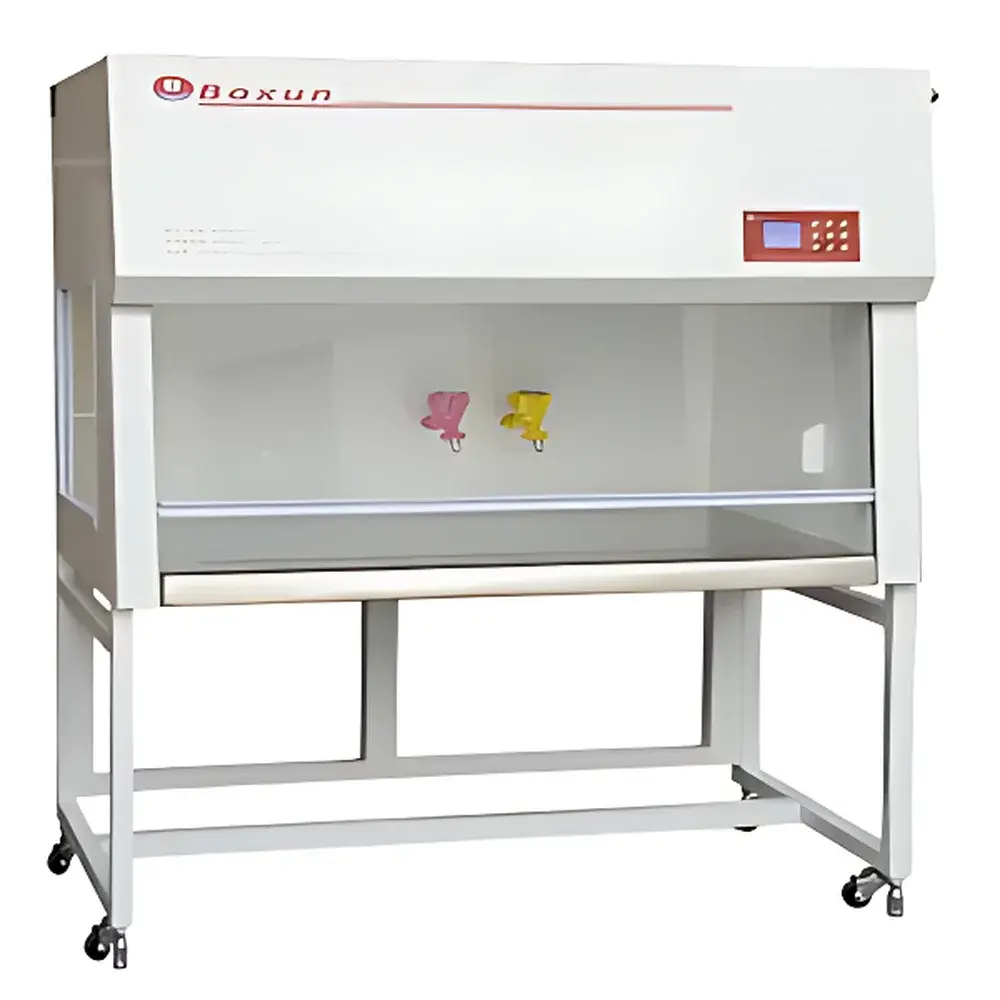
BOXUN BJ-2CD Vertical Laminar Flow Clean Bench
| Brand | BOXUN |
|---|---|
| Origin | Shanghai, China |
| Manufacturer Type | Authorized Distributor |
| Product Category | Domestic |
| Model | BJ-2CD |
| Instrument Type | Vertical Laminar Flow Clean Bench |
| Cleanliness Class | ISO Class 5 (100-level, ≥99.99% filtration efficiency for particles ≥0.5 µm) |
| Noise Level | ≤67 dB(A) |
| User Capacity | Dual-Operator, Single-Face Configuration |
| Airflow Pattern | Vertical Unidirectional Flow |
| Working Surface Dimensions | 1300 × 700 × 495 mm (W × D × H) |
| Overall Dimensions | 1460 × 744 × 1680 mm (W × D × H) |
| HEPA Filter Specification | 1270 × 604 × 50 mm, single unit |
| Illumination | ≥300 lux (fluorescent lamp, 40 W) |
| UV Lamp | 30 W, germicidal |
| Vibration Amplitude | ≤5 µm (peak-to-peak, X/Y/Z axes) |
| Adjustable Air Velocity Range | 0.3–0.6 m/s (6-step digital setpoint with real-time display) |
| Power Supply | AC 220 V ±10%, 50/60 Hz |
| Rated Power | 0.37 kW |
| Net Weight | 205 kg |
| Control Interface | LCD panel with multi-parameter real-time monitoring |
Overview
The BOXUN BJ-2CD Vertical Laminar Flow Clean Bench is an ISO Class 5-certified local containment system engineered to deliver unidirectional, particle-free airflow across a defined work surface. Operating on the principle of vertical laminar flow, ambient air is drawn through a pre-filter (medium-efficiency), then pressurized into a plenum chamber and uniformly distributed downward through a certified HEPA filter (EN 1822-1:2022, H14 grade; ≥99.99% retention for ≥0.5 µm particles). This creates a sterile, low-turbulence environment suitable for non-hazardous microbiological procedures, aseptic material handling, and precision instrumentation assembly where operator protection is not required but product integrity is critical. Unlike biosafety cabinets, the BJ-2CD does not recirculate air nor provide personnel or environmental protection—its design strictly prioritizes sample and process protection in cleanroom-adjacent laboratory spaces.
Key Features
- Vertical laminar airflow architecture compliant with ISO 14644-1 Class 5 (formerly Federal Standard 209E Class 100) performance criteria.
- Real-time digital monitoring via integrated LCD interface: displays instantaneous face velocity (0.3–0.6 m/s, adjustable in six discrete steps), cumulative operating hours, HEPA differential pressure, system clock, and filter service life indicator.
- Dual-stage filtration system: washable polyester pre-filter extends HEPA service life; certified H14 HEPA filter (1270 × 604 × 50 mm) tested per EN 1822.
- Fail-safe interlock logic: UV lamp activation automatically disables fluorescent lighting and vice versa; door position sensors enforce operational safety protocols.
- Ergonomic front sash angled at 5° for optimal visual alignment and reduced operator fatigue during extended use.
- Robust structural assembly: cold-rolled steel outer casing with electrophoretic coating; SUS304 brushed stainless steel work surface resistant to corrosion, chemical exposure, and repeated disinfection.
- Low-vibration centrifugal blower system with speed-stabilized motor ensures consistent airflow uniformity and acoustic compliance (≤67 dB[A] at 1 m).
- Integrated utility interfaces: splash-proof 220 V AC power outlets, compressed air and liquid supply ports recessed within the work surface perimeter.
- Mobile base with dual-locking casters and adjustable leveling feet enables flexible lab reconfiguration without compromising stability.
Sample Compatibility & Compliance
The BJ-2CD is validated for applications involving non-pathogenic microorganisms (BSL-1), cell culture media preparation, pharmaceutical component weighing, electronic component soldering, and optical lens assembly. It meets core requirements of ISO 14644-1:2015 for cleanroom performance verification and supports GLP-aligned documentation practices through timestamped operational logs. While not designed for containment of biohazards or volatile chemicals, its construction materials comply with UL 61010-1 for electrical safety and IEC 60335-1 for general household and similar electrical appliances. All lighting components conform to IEC 62471 photobiological safety standards.
Software & Data Management
The embedded control system provides non-volatile storage of runtime parameters including total operating hours, HEPA delta-P trends, and user-defined velocity setpoints. No external software or PC connectivity is required for routine operation; however, time-stamped event logs (e.g., UV cycle initiation, alarm triggers, filter replacement alerts) are retained locally and accessible via the LCD menu. The system supports audit-ready recordkeeping for laboratories adhering to ISO/IEC 17025 or FDA 21 CFR Part 11-compliant workflows when paired with manual logbook entries or third-party LIMS integration via RS-232 (optional module available upon request).
Applications
- Aseptic transfer of microbial cultures and plant tissue explants in academic and industrial biotechnology labs.
- Weighing and dispensing of active pharmaceutical ingredients (APIs) under controlled particulate conditions per USP <797> guidance.
- Assembly and calibration of high-precision sensors, MEMS devices, and optical components requiring sub-micron particulate control.
- Preparation of standard reference materials and calibration standards for analytical chemistry workflows.
- Environmental monitoring sample processing—including air filter analysis and water microbiology membrane filtration—where background contamination must be minimized.
FAQ
What ISO cleanliness class does the BJ-2CD achieve?
It maintains ISO Class 5 (equivalent to old US FED-STD-209E Class 100) in the work area, verified by particle counting per ISO 21501-4 using a calibrated light-scattering airborne particle counter.
Is the HEPA filter certified to EN 1822?
Yes—the installed filter is H14 grade, independently tested and certified to EN 1822-1:2022 for ≥99.995% efficiency at MPPS (~0.2–0.3 µm), with full test report traceable to the manufacturer’s batch number.
Can the unit be integrated into a facility’s BMS or monitoring network?
Standard configuration includes analog 0–10 V output for face velocity and digital relay outputs for alarm states; Modbus RTU (RS-485) interface is available as a factory-installed option.
Does the BJ-2CD meet any regulatory requirements for pharmaceutical manufacturing?
While not a GMP-certified device per se, it satisfies the environmental control expectations outlined in EU GMP Annex 1 (2022) for Grade A background environments when operated within a Grade B cleanroom, provided qualification (IQ/OQ/PQ) is performed per ISO 14644-3.
What maintenance intervals are recommended for the pre-filter and HEPA filter?
Pre-filter cleaning is advised every 2–4 weeks depending on ambient particulate load; HEPA replacement is typically required every 18–36 months, contingent upon delta-P monitoring and upstream air quality—full replacement records must be retained per ISO 14644-3 Section 8.3.



