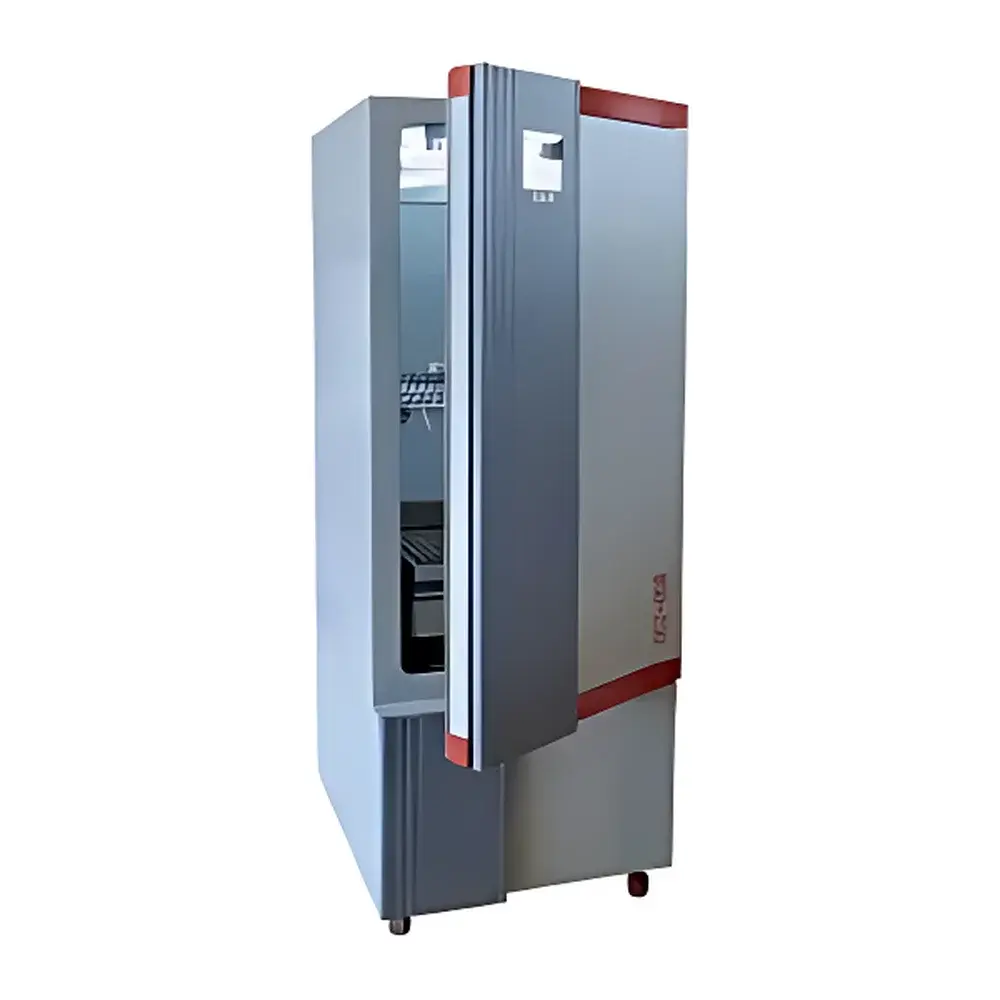
Boxun BSD-400 Shaking Incubator
| Brand | Boxun |
|---|---|
| Origin | Shanghai, China |
| Manufacturer Type | Authorized Distributor |
| Country of Origin | China |
| Model | BSD-400 |
| Price | Upon Request |
| Temperature Range | 0–65 °C |
| Temperature Resolution | 0.1 °C |
| Temperature Uniformity | ±1 °C |
| Temperature Fluctuation | ±0.5 °C |
| Shaking Mode | Orbital |
| Shaking Speed | 30–220 rpm |
| Amplitude | 20 mm |
| Timer Range | 0–9999 min |
| Interior Dimensions (W×D×H) | 600 × 640 × 1050 mm |
| Exterior Dimensions (W×D×H) | 745 × 930 × 1695 mm |
| Power Input | 1350 W |
| Display | LCD |
| Refrigerant | R134a (CFC-free) |
| Interface | RS-485 |
| Shelving | 1 adjustable stainless steel shelf |
| Air Exchange | Independent fresh-air inlet with manual control |
| Defrosting | Energy-free automatic defrost system |
| Safety Features | Power-failure parameter retention, auto-restart on power recovery, over-temperature alarm |
Overview
The Boxun BSD-400 Shaking Incubator is a precision-engineered dual-function environmental chamber designed for simultaneous temperature-controlled incubation and orbital shaking—optimized for aerobic microbial culture, biochemical oxygen demand (BOD) assays, cell suspension propagation, and seed germination studies. Its operational principle integrates Peltier-assisted refrigeration with resistive heating and forced-air convection, enabling stable thermal regulation across a broad range of 0–65 °C. The unit employs a high-efficiency hermetic compressor (R134a refrigerant compliant with Montreal Protocol standards), coupled with an asymmetric airflow path—intake → evaporator → heater → mixing chamber → working chamber—to eliminate thermal stratification. This architecture ensures uniform temperature distribution (±1 °C) and minimal fluctuation (±0.5 °C), critical for reproducible growth kinetics in long-term batch cultures under GLP-compliant conditions.
Key Features
- Microprocessor-based PID temperature control with real-time LCD display of setpoint, actual temperature, elapsed time, and remaining timer duration
- Orbital shaker mechanism with continuously adjustable speed (30–220 rpm) and fixed 20 mm amplitude—engineered for low-vibration, high-stability operation during extended runs
- Double-door observation window with inner tempered glass and outer insulating acrylic layer minimizes heat loss while enabling non-intrusive sample monitoring
- Mirror-finish 304 stainless steel interior with seamless rounded corners eliminates stagnant air zones and facilitates cleaning and decontamination per ISO 14644 cleanroom protocols
- Dedicated fresh-air intake valve allows manual regulation of internal atmospheric exchange—essential for maintaining O2/CO2 balance in aerobic fermentations and preventing CO2 buildup during prolonged BOD testing
- Energy-efficient auto-defrost cycle operates without heater or compressor interruption—ensuring uninterrupted thermal stability during multi-day experiments
- Comprehensive safety architecture includes over-temperature cut-off, power-loss memory retention, and automatic restart with preserved parameters upon grid recovery
Sample Compatibility & Compliance
The BSD-400 accommodates standard laboratory vessels including Erlenmeyer flasks (up to 5 L), culture bottles, multi-well plates, and Petri dish stacks on its single-tier adjustable stainless steel platform. Its sealed chamber design supports both ambient-air and modified-atmosphere applications, making it suitable for ASTM D5210 (BOD5), USP / (microbial enumeration), and ISO 8601 (time-series incubation) workflows. All electrical components meet IEC 61010-1 safety requirements for laboratory equipment. Refrigerant selection (R134a) complies with EU F-Gas Regulation (No. 517/2014) and EPA SNAP program guidelines. The unit’s construction materials are certified non-cytotoxic per ISO 10993-5.
Software & Data Management
Equipped with an RS-485 serial interface (Modbus RTU protocol), the BSD-400 enables bidirectional communication with external PCs or data loggers. Included software provides real-time monitoring, remote parameter adjustment, and time-stamped export of temperature/shaking profiles in CSV format. Audit trail functionality records all user-initiated changes—including setpoint modifications, timer resets, and door-opening events—with timestamps and operator IDs—supporting 21 CFR Part 11 compliance when deployed with validated electronic signature modules. Data logging intervals are configurable from 1 second to 60 minutes.
Applications
- Biochemical Oxygen Demand (BOD) determination in wastewater and surface water analysis per APHA Standard Methods 5210B
- Microbial cultivation of bacteria, yeasts, molds, and algae under controlled aeration and thermal conditions
- Suspension culture of mammalian and insect cells requiring gentle agitation to prevent sedimentation and enhance nutrient/gas transfer
- Seed germination and plant tissue culture studies where synchronized oscillation improves root development and metabolic homogeneity
- Enzyme kinetics assays and protein expression optimization in shake-flask bioreactors
- Environmental simulation for ecotoxicology testing under regulated temperature and motion stressors
FAQ
Does the BSD-400 support programmable ramp-soak temperature profiles?
No—the unit implements single-setpoint PID control only; multi-step thermal programming requires external PLC integration via RS-485.
Can the shaking platform accommodate multiple flask sizes simultaneously?
Yes—flask clamps are not included as standard, but universal rubber-lined platform inserts (optional accessories) allow secure mounting of 125 mL to 5 L vessels without cross-contamination risk.
Is the R134a refrigerant compatible with long-term continuous operation at 4 °C?
Yes—the compressor and condenser are rated for indefinite duty cycle at minimum setpoint; compressor cycling frequency remains below 8 cycles/hour under steady-state 4 °C operation.
What is the maximum allowable load weight on the shaking platform?
The platform supports up to 25 kg evenly distributed; exceeding this limit may compromise amplitude consistency and bearing service life.
How is calibration traceability established for temperature sensors?
Each unit ships with a factory calibration certificate referencing NIST-traceable dry-block calibrators (±0.1 °C uncertainty at 37 °C); field recalibration is supported using DIN 12880-compliant reference thermometers.