
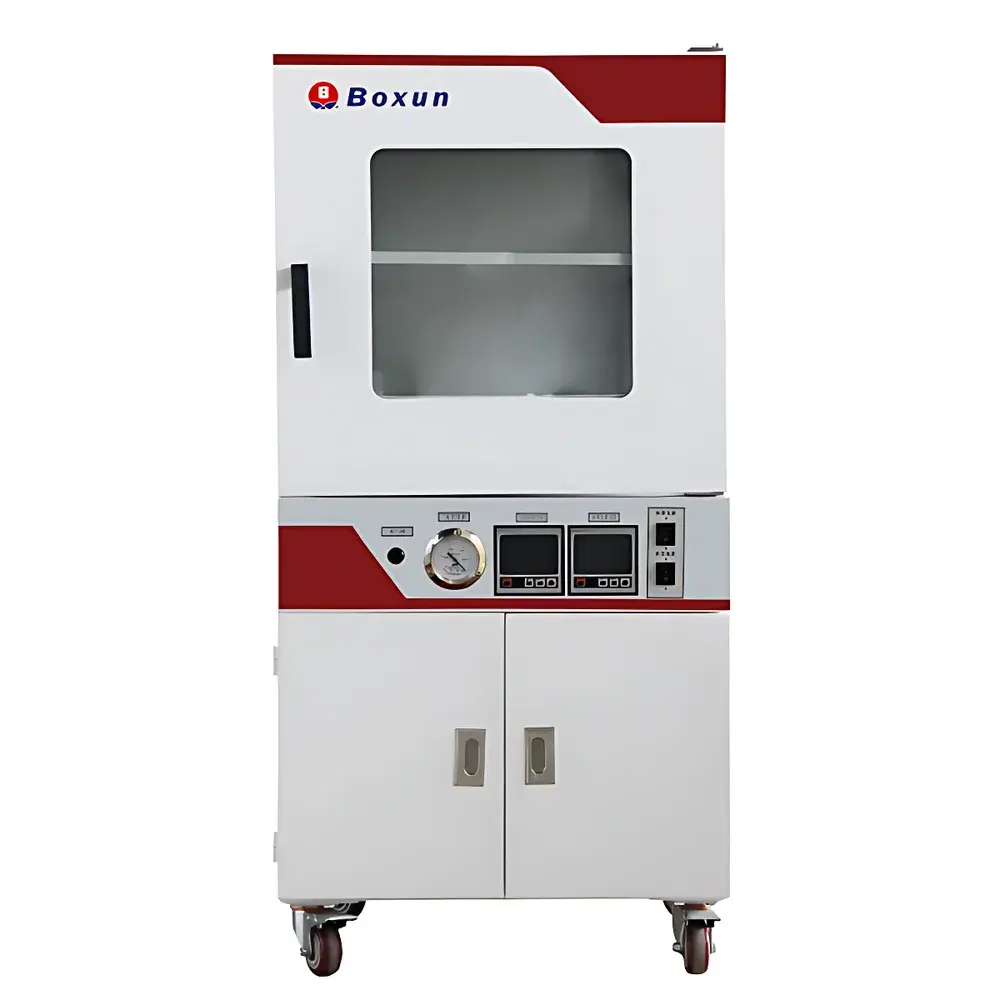
Boxun BXK-50 Vacuum Drying Oven
| Brand | Boxun |
|---|---|
| Origin | Shanghai, China |
| Manufacturer Type | Direct Manufacturer |
| Product Category | Domestic |
| Model | BXK-50 |
| Instrument Type | Vacuum Oven |
| Temperature Range | Ambient +2°C to 250°C |
| Temperature Uniformity | ±0.5°C |
| External Dimensions | 575 × 550 × 1060 mm |
| Internal Chamber Dimensions | 415 × 370 × 345 mm |
| Chamber Material | Stainless Steel (SUS304) |
| Heating Method | Bottom-Mounted Heated Shelving with Independent Shelf Temperature Control |
| Vacuum Level | ≤133 Pa |
| Pump Flow Rate | 2 L/s |
| Chamber Volume | 53 L |
| Power Supply | AC 220 V ±10%, 50/60 Hz |
| Rated Power | 900 W |
| Timer Range | 0–9999 minutes |
| Shelving | 2 pcs, independently temperature-controlled |
| Door | Double-layer tempered glass with silicone gasket seal |
Overview
The Boxun BXK-50 Vacuum Drying Oven is an engineered solution for precise, low-temperature dehydration of thermolabile, oxidation-sensitive, and structurally complex samples under controlled reduced-pressure conditions. Operating on the principle of vacuum-assisted thermal desorption, it lowers the boiling point of volatile solvents and moisture—enabling effective drying at significantly reduced temperatures compared to atmospheric convection ovens. This physical principle is particularly critical in applications where sample integrity must be preserved: pharmaceutical active ingredients, enzyme preparations, polymer composites, botanical extracts, and precision-engineered components requiring residue-free surface conditioning. The BXK-50 integrates a sealed stainless steel chamber, microprocessor-based PID temperature regulation, and a built-in 2 L/s vacuum pump housed within an acoustically damped cabinet—ensuring stable operation at ≤133 Pa while minimizing laboratory noise exposure.
Key Features
- Stainless steel (SUS304) interior chamber with radius-rounded corners for seamless cleaning and compliance with GLP hygiene standards
- Bottom-mounted heated shelving system—heat elements embedded beneath each shelf—improves thermal transfer efficiency by >50% versus conventional jacketed heating, especially under high vacuum where convective heat transfer is negligible
- Two independently controllable shelves, each with dedicated temperature display and setpoint adjustment—enabling simultaneous processing of dissimilar samples at optimized drying profiles
- Double-layer tempered glass observation door with integrated silicone gasket, maintaining vacuum integrity while permitting real-time visual monitoring without process interruption
- Microcomputer PID controller with LCD interface, offering programmable ramp-soak cycles, over-temperature cut-off protection, and auto-recovery after power failure or system reset
- Integrated vacuum pump housed in a sound-dampened enclosure—reducing operational noise by up to 40 dB(A) versus external pump configurations and eliminating benchtop clutter
Sample Compatibility & Compliance
The BXK-50 accommodates diverse sample formats including powders, granules, lyophilized matrices, ceramic substrates, microfluidic devices, and sterilized glassware. Its inert stainless steel chamber and absence of airflow prevent particle displacement—critical for nanoparticle suspensions or chromatographic stationary phases. The unit meets structural and safety requirements aligned with IEC 61010-1 (Electrical Safety for Laboratory Equipment) and supports audit-ready documentation workflows compatible with ISO/IEC 17025-accredited laboratories. While not certified for medical device sterilization per ISO 17665, its validated vacuum stability and temperature uniformity support process development in accordance with USP (Sterility Assurance) and FDA 21 CFR Part 11-compliant data logging when paired with Boxun’s optional PC interface module.
Software & Data Management
The BXK-50 features embedded non-volatile memory capable of retaining up to 10 user-defined drying protocols, including multi-step temperature ramps, dwell times, and vacuum hold sequences. All operational parameters—including actual chamber temperature, setpoint, elapsed time, vacuum pressure, and alarm events—are timestamped and stored locally. Optional RS485/USB connectivity enables integration with LabArchives, Empower, or custom LIMS platforms via Modbus RTU protocol. Audit trail functionality records operator ID (via optional RFID badge reader), parameter changes, and system status transitions—supporting 21 CFR Part 11 electronic record requirements when deployed with validated software configuration.
Applications
- Drying heat-sensitive APIs and excipients without degradation or polymorphic transition
- Dehydrating biological tissues prior to SEM sample preparation
- Removing residual solvents from thin-film coatings and printed electronics substrates
- Conditioning hygroscopic reference standards in metrology labs
- Post-cleaning drying of precision-machined aerospace components to eliminate trapped moisture in blind holes or porous surfaces
- Accelerated aging studies of battery electrode materials under controlled thermal-vacuum stress
FAQ
What is the maximum allowable vacuum level, and how is it verified?
The BXK-50 achieves and maintains ≤133 Pa (1 Torr) under standard operating conditions. Vacuum performance is factory-verified using a calibrated Pirani gauge traceable to NIST standards.
Can the oven operate without vacuum for standard hot-air drying?
Yes—the vacuum pump can be disabled via front-panel control; however, the heating system remains fully functional for ambient-pressure thermal processing.
Is the stainless steel chamber electropolished or passivated?
The interior uses standard mill-finish SUS304 stainless steel. Electropolishing is available as a factory-installed option (model suffix “-EP”) upon request.
How does independent shelf temperature control improve drying reproducibility?
By decoupling thermal zones, each shelf compensates for load-dependent thermal mass variation—eliminating vertical temperature gradients common in single-zone ovens and ensuring consistent drying kinetics across stacked trays.
What maintenance intervals are recommended for the integrated vacuum pump?
Oil change every 500 operating hours; inlet filter inspection every 100 hours; full pump service recommended annually or after 2000 hours—per manufacturer’s technical bulletin TB-BXK-VAC-2023.



