
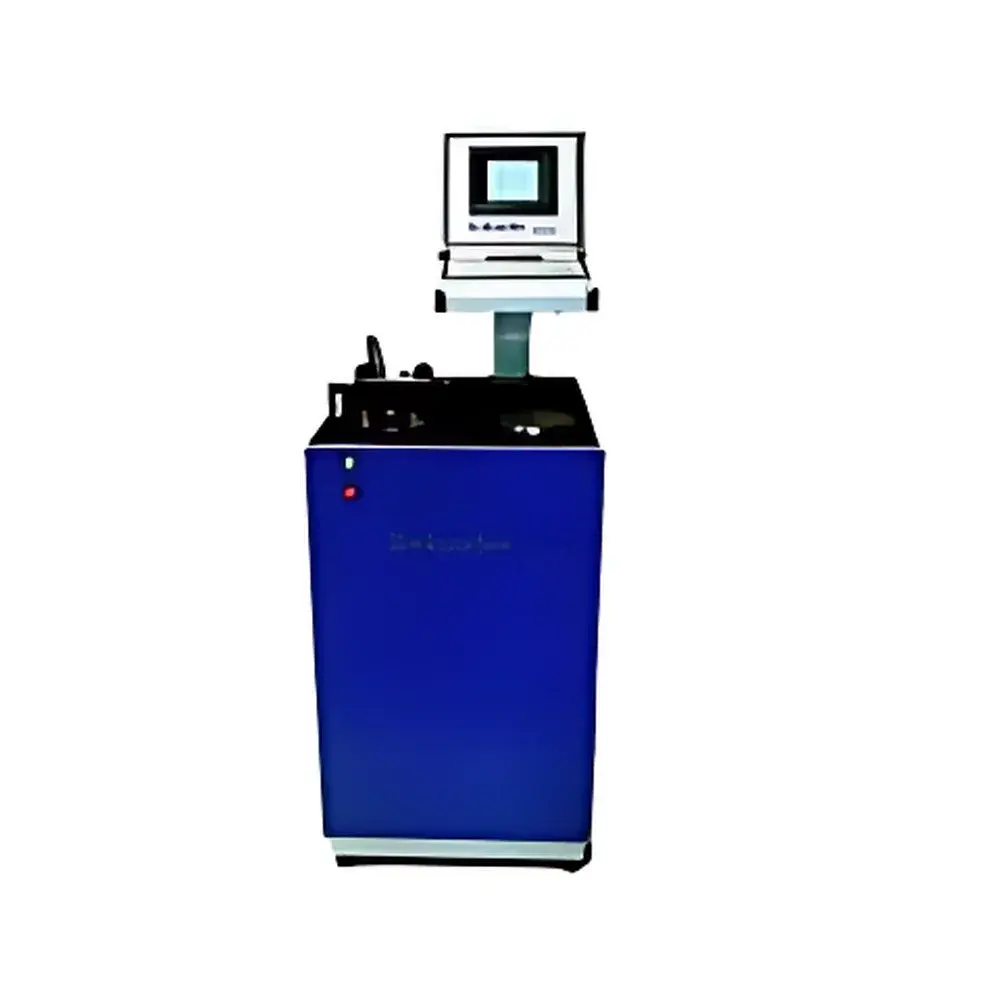
Brabender Elatest Density Analyzer
| Brand | Brabender |
|---|---|
| Origin | Germany |
| Model | Elatest |
| Application | Density measurement of uncured rubber compounds and polymers |
| Measurement Principle | Piston-compression volumetric displacement method |
| Compliance | Designed for ISO 2781, ASTM D792, and DIN 53479-compliant density determination |
| Software Interface | Integrated touchscreen control with automated calculation engine |
| Data Output | Digital density (g/cm³) with traceable measurement logs |
Overview
The Brabender Elatest Density Analyzer is a precision-engineered instrument designed specifically for the volumetric density determination of uncured rubber compounds, thermoplastic elastomers, and other polymeric materials. Unlike conventional buoyancy-based or pycnometric methods, the Elatest employs a controlled piston-compression technique within a calibrated cylindrical chamber. During measurement, a precisely weighed sample is introduced into the measurement cylinder and subjected to a defined axial compressive force via a motor-driven piston. As compression proceeds, entrapped air is expelled from the material matrix—ensuring full densification without void artifacts. The final stabilized piston position is captured by a high-resolution linear displacement sensor, enabling accurate volume derivation from the known cylinder cross-sectional area and measured stroke length. Density is then calculated in real time as ρ = m/V, where mass (m) is entered manually or via optional integrated balance interface, and volume (V) is derived from geometric and displacement data. This principle ensures high reproducibility (< ±0.002 g/cm³ typical inter-laboratory CV), minimal operator dependency, and compliance with core standards governing elastomer characterization.
Key Features
- Motorized precision piston actuation with programmable compression force profiles (up to 10 kN, adjustable in 0.1 kN increments)
- Stainless-steel measurement cylinder with polished internal bore (Ø 30 mm × 100 mm L) ensuring dimensional stability and thermal homogeneity
- High-accuracy linear displacement transducer (resolution: 0.1 µm; repeatability: ±0.5 µm)
- Integrated 7-inch industrial-grade capacitive touchscreen HMI with intuitive workflow navigation and multilingual UI support (English, German, French, Spanish)
- Onboard data storage (≥10,000 measurement records) with timestamp, operator ID, and environmental metadata (ambient temperature & humidity)
- RS-232 and USB-C interfaces for external balance integration and PC-based data export (CSV, XML)
- Modular design compliant with CE, EMC Directive 2014/30/EU, and RoHS II (2011/65/EU)
Sample Compatibility & Compliance
The Elatest accommodates raw rubber stocks (natural rubber, SBR, EPDM, NBR, CR), masterbatches, pelletized TPEs, and compounded elastomer preforms with particle sizes ≤ 8 mm and Shore A hardness < 90. Samples must be free of surface moisture and macroscopic contaminants prior to loading. The system meets the physical test requirements of ISO 2781 (rubber—determination of density), ASTM D792 (standard test methods for density and specific gravity of plastics), and DIN 53479 (density determination of rubber). Its operational protocol supports GLP-aligned documentation practices, including user-access-controlled measurement sessions, electronic signature capability, and audit-trail-enabled data logging—facilitating readiness for FDA 21 CFR Part 11–governed environments when deployed with validated software configuration.
Software & Data Management
The Elatest Control Suite runs on a real-time Linux OS embedded within the instrument’s industrial controller. It provides guided measurement workflows—from sample weighing and chamber loading to compression cycle execution and result validation. All density calculations are performed using fixed-point arithmetic to eliminate floating-point rounding errors. Raw sensor data, intermediate values (piston displacement, applied load, dwell time), and final results are stored with immutable timestamps and checksum-protected file integrity. Export options include CSV (for LIMS integration), PDF reports (with configurable company header and QA stamp), and XML schemas compatible with enterprise MES platforms. Optional software modules enable statistical process control (SPC) charting, trend analysis across shifts/batches, and automated out-of-specification (OOS) alerting based on user-defined control limits.
Applications
- R&D formulation screening: Rapid comparative density profiling across rubber compound variants during cure system optimization
- Raw material incoming inspection: Verification of polymer grade consistency against supplier specifications
- In-line QC during calendering/extrusion: Spot-checking compound density to detect filler dispersion anomalies or moisture ingress
- Process validation studies: Correlating density shifts with mixing energy input, shear history, or devolatilization efficiency
- Regulatory submission support: Generating auditable density datasets for ISO/TS 16949, IATF 16949, or medical-grade elastomer dossiers
FAQ
What types of rubber compounds can be measured with the Elatest?
Uncured natural rubber, synthetic elastomers (SBR, NBR, EPDM, CR, FKM), thermoplastic vulcanizates (TPVs), and filled/unfilled polymer pellets—provided they compress uniformly under axial load and contain no volatile solvents.
Is calibration required before each measurement?
No routine recalibration is needed between measurements; however, daily verification using certified reference cylinders (included) is recommended per ISO/IEC 17025 quality protocols.
Can the Elatest interface with our existing LIMS system?
Yes—via configurable CSV export or direct serial communication using ASCII command protocol; custom API integration is supported under NDA for enterprise deployments.
Does the system comply with FDA 21 CFR Part 11 requirements?
Out-of-the-box functionality supports ALCOA+ principles; full Part 11 compliance requires validated software configuration, role-based access controls, and electronic signature implementation—available through Brabender’s GxP Services package.
What maintenance is required for long-term reliability?
Quarterly inspection of piston seal integrity, annual verification of displacement sensor linearity, and biannual cleaning of cylinder bore with ethanol and lint-free swabs—documented in the onboard maintenance log.







