
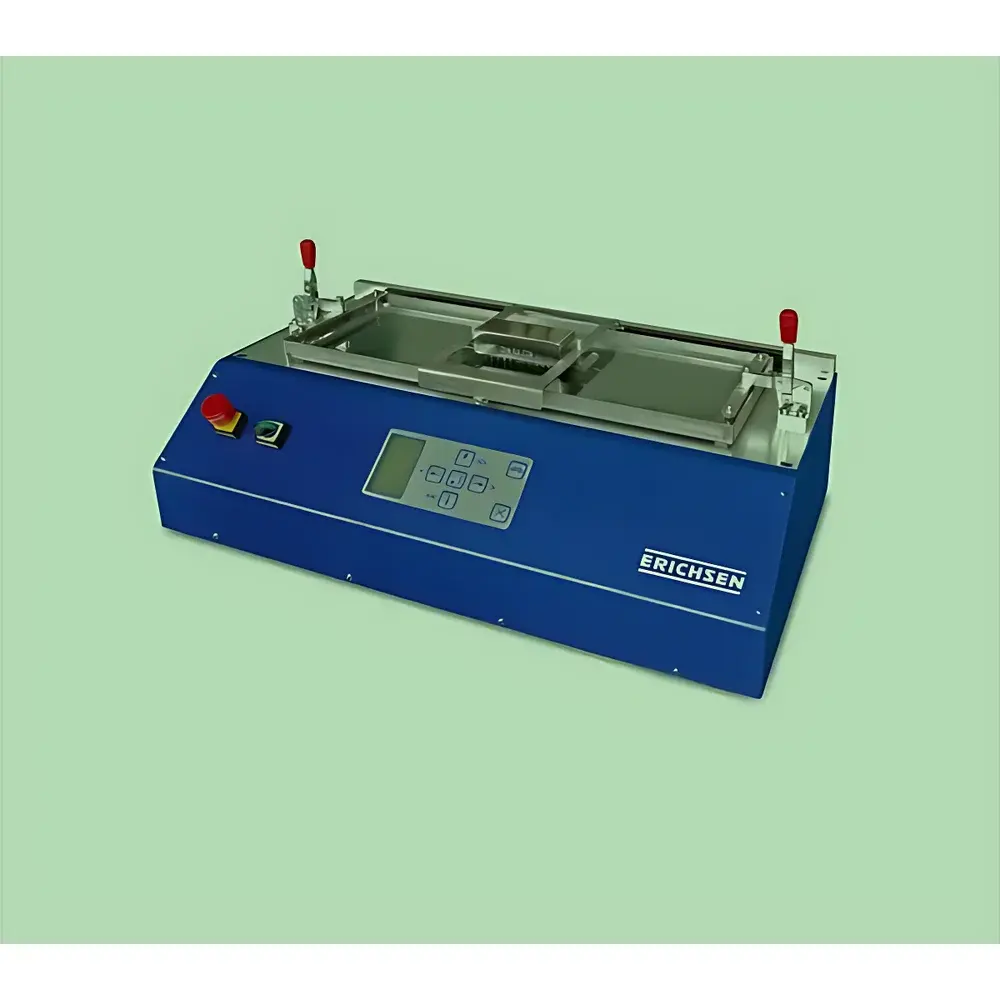
Erichsen 494 MC Scrub Resistance Tester
| Brand | ERICHSEN (Germany) |
|---|---|
| Origin | Germany |
| Model | Erichsen 494 MC |
| Compliance | DIN EN ISO 11998, ASTM D 2486, DIN 53778-2 (withdrawn) |
| Scrub Media Options | Pig bristle brush (250 g), nylon brush (454 g), abrasive pad (135 g, e.g., 3M Scotch-Brite™ No. 7448) |
| Load Application | Motorized micro-dosing pump (DIN/ISO) or manual dosing (ASTM) |
| Stroke Control | Adjustable stroke length & speed via stepper motor & microprocessor |
| Sample Fixation | Dual-side clamping system with steel test trough |
| Brush Holder | Rotatable triple-brush mount (enables concurrent 3-sample testing) |
| User Interface | Keypad + 6-digit LED display |
| Programmability | Up to 20 stored test methods |
| Leveling | Adjustable leveling feet |
Overview
The Erichsen 494 MC Scrub Resistance Tester is a precision-engineered laboratory instrument designed for quantitative evaluation of coating durability under mechanical abrasion and wet cleaning conditions. It operates on the principle of controlled linear reciprocating motion, applying standardized mechanical stress—via defined scrub media (brushes or abrasive pads)—to coated substrates immersed in or exposed to specified washing fluids. The instrument complies with internationally recognized test standards including DIN EN ISO 11998 (replacing DIN 53778-2), ASTM D 2486, and legacy DIN protocols, enabling traceable, inter-laboratory comparable results essential for R&D, QC/QA, and regulatory documentation in paint, coatings, architectural finishes, and industrial surface treatment industries.
Key Features
- Triple-scrub configuration: Rotatable brush holder accommodates three identical scrub bodies simultaneously—enabling parallel testing of replicate samples or comparative assessment across formulation variants without sequential run delays.
- Standard-compliant load application: Integrated micro-dosing pump ensures precise, continuous delivery of washing fluid per DIN EN ISO 11998; manual dosing mode supports ASTM D 2486 requirements with repeatable volume intervals.
- High-reproducibility drive system: Closed-loop stepper motor coupled with real-time microprocessor control guarantees consistent stroke velocity (adjustable range: 1–60 double strokes/min), stroke length (10–100 mm), and total cycle count (up to 99,999 double strokes).
- Modular scrub media support: Interchangeable mounting fixtures accept standardized pig bristle brushes (250 g load), nylon brushes (454 g load), or pre-moistened abrasive pads (135 g, e.g., 3M Scotch-Brite™ No. 7448), each calibrated to respective standard specifications.
- Robust sample handling: Precision-machined stainless-steel test trough with dual independent clamping mechanisms secures rigid or flexible substrates (e.g., coated panels, PVC foils, metal sheets) without slippage or edge deformation during extended testing.
- Full method programmability: Store up to 20 complete test configurations—including speed, stroke, cycles, fluid dose, and media type—with recall via numeric keypad and 6-digit LED interface; no PC dependency required for routine operation.
Sample Compatibility & Compliance
The Erichsen 494 MC accepts flat, rigid, or semi-flexible specimens up to 150 × 70 mm, including painted steel, aluminum, wood composites, plastic laminates, and coated paperboard. Substrate thickness tolerance spans 0.5–5 mm. All test modes align with mandatory quality assurance frameworks: data integrity meets GLP audit requirements; electronic parameter logging supports FDA 21 CFR Part 11 readiness when integrated with compliant LIMS or ELN systems. Compliance documentation includes full traceability to DIN EN ISO 11998 Annex A (abrasive pad calibration), ASTM D 2486 Section 7 (brush conditioning protocol), and ISO/IEC 17025-accredited validation procedures.
Software & Data Management
While standalone operation requires no software, optional Erichsen TestControl Suite (v3.2+) enables remote configuration, real-time stroke monitoring, automated pass/fail threshold evaluation, and CSV/PDF report generation. All test logs include timestamped metadata: operator ID, ambient temperature/humidity (via optional sensor input), media lot number, fluid batch ID, and cycle-by-cycle position tracking. Audit trails record parameter changes, user logins, and firmware updates—fully aligned with GMP Annex 11 and ISO 13485 documentation expectations for medical device coating validation.
Applications
- Formulation development: Screening binder-resin ratios, pigment dispersion stability, and additive efficacy (e.g., silicone surfactants, rheology modifiers) under simulated cleaning regimes.
- Quality conformance: Routine release testing of architectural paints, coil coatings, and automotive OEM primers against ISO 11998 Class 1–5 performance tiers.
- Substrate-coating interaction studies: Quantifying interfacial adhesion loss via mass loss (mg/cm²) and layer thickness reduction (µm) post-scrubbing per ISO 11998 Clause 9.
- Cleaning agent compatibility: Evaluating detergent aggressiveness on functional coatings (e.g., antimicrobial, anti-graffiti, self-cleaning TiO₂ systems) using ASTM D 2486’s metal-strip enhancement protocol.
- Accelerated weathering correlation: Establishing empirical relationships between scrub resistance cycles and QUV/QUV-SPRAY exposure hours for predictive service-life modeling.
FAQ
What scrub media are supplied as standard with the Erichsen 494 MC?
The base configuration includes one set of DIN-compliant pig bristle brushes (250 g). Nylon brushes (454 g) and 3M Scotch-Brite™ No. 7448 abrasive pads are available as optional accessories.
Can the instrument be validated per ISO/IEC 17025 requirements?
Yes—Erichsen provides a Factory Calibration Certificate (traceable to DAkkS-accredited standards) and optional IQ/OQ/PQ documentation packages supporting accredited laboratory implementation.
Is the micro-dosing pump compatible with aggressive solvents or high-pH cleaners?
The pump head uses chemically resistant PTFE and sapphire components; compatibility must be verified per fluid MSDS—standard calibration applies to aqueous surfactant solutions (pH 6–10, viscosity < 10 mPa·s).
How is stroke accuracy verified during routine maintenance?
A certified optical encoder and reference laser displacement sensor are used during annual service; users may perform quick verification using the included calibration template and digital caliper per Operation Manual Section 6.4.
Does the triple-brush holder affect test repeatability between positions?
No—each brush mount is independently tension-calibrated and mechanically isolated; inter-position CV% remains ≤1.8% (n=12, ISO 11998, acrylic emulsion paint on steel).






