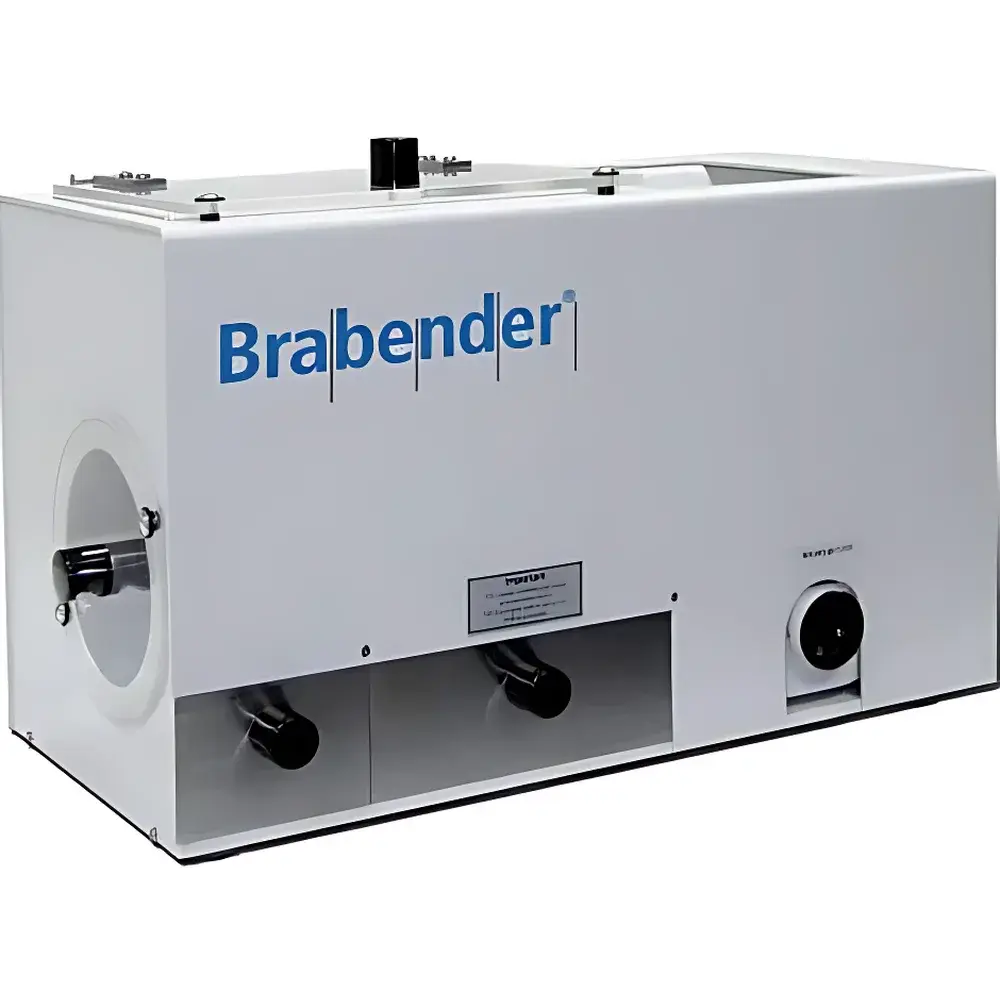
Brabender® Quadrumat Senior Flour Sieving and Bran Purification System
| Brand | Brabender |
|---|---|
| Origin | Germany |
| Manufacturer Type | Authorized Distributor |
| Origin Category | Imported |
| Model | Quadrumat Senior |
| Pricing | Upon Request |
| Rotation Speed | 2880 rpm (50 Hz), 3400 rpm (60 Hz) |
| Sieve Aperture | 200 µm (customizable mesh options available) |
Overview
The Brabender® Quadrumat Senior Flour Sieving and Bran Purification System is a precision-engineered laboratory-scale instrument designed to simulate industrial bran purification and flour recovery processes. It operates on the principle of mechanical impact separation: a rotating impeller with adjustable radial bars subjects bran particles to controlled centrifugal acceleration and repeated inertial impact against a stationary cylindrical sieve wall. This action dislodges adhering flour particles from bran surfaces—particularly those trapped in crevices or bound by surface moisture or protein films—enabling quantitative recovery of fine flour fractions that would otherwise remain entrained in the bran stream. Unlike passive sieving, the Quadrumat Senior introduces kinetic energy into the separation process, replicating the dynamic conditions found in commercial purifiers (e.g., plansifters and centrifugal purifiers) used downstream of roller mills. Its design conforms to established cereal science methodologies referenced in ICC Standard Method No. 171 and AACC International Method 26–50A for flour yield and ash content evaluation.
Key Features
- High-speed impeller assembly operating at 2880 rpm (50 Hz) or 3400 rpm (60 Hz), delivering consistent mechanical energy input across voltage standards.
- Interchangeable cylindrical sieve cylinder with standard 200 µm aperture—compliant with ISO 3310-1 specifications—and optional mesh configurations (e.g., 150 µm, 250 µm, 300 µm) for method-specific calibration.
- Stainless steel construction (AISI 304) for all product-contact surfaces, ensuring corrosion resistance, cleanability, and compliance with food-grade equipment requirements (EC 1935/2004).
- Integrated dust extraction port compatible with laboratory vacuum systems (ISO 16000-7 compliant), minimizing airborne flour dispersion and supporting occupational exposure limit (OEL) adherence.
- Adjustable feed rate via gravity-fed hopper with flow regulator, enabling reproducible sample introduction (typical load: 100–500 g per cycle).
- Robust cast-aluminum housing with vibration-dampening feet and CE-marked electrical safety architecture.
Sample Compatibility & Compliance
The Quadrumat Senior accommodates milled wheat, rye, spelt, and durum semolina samples—both straight-grade and re-ground fractions—from laboratory milling systems including Brabender’s Chopin Micro-Miller, Buhler MLU-202, and Perten LM-200. It is validated for use with flour moisture contents ranging from 12.5% to 14.5% (wb), as specified in ISO 712. The system supports GLP-aligned workflows through traceable operation logs (when paired with Brabender LabSoft software) and meets mechanical safety requirements per EN 61000-6-2 (EMC) and EN 61000-6-4. It is routinely employed in mill quality control laboratories undergoing ISO/IEC 17025 accreditation audits and serves as a reference tool in collaborative studies coordinated by the International Association for Cereal Science and Technology (ICC).
Software & Data Management
When integrated with Brabender LabSoft v5.x or higher, the Quadrumat Senior enables automated cycle logging—including timestamp, rotation speed, sieve ID, and operator ID—with export to CSV or XML formats. Audit trails comply with FDA 21 CFR Part 11 requirements when configured with electronic signatures and role-based access controls. Raw mass data (bran residue, recovered flour, total yield) can be linked directly to parallel analyses performed on Brabender Farinograph, Extensograph, or Amylograph systems, facilitating multivariate correlation of purification efficiency with rheological and enzymatic parameters. All firmware updates are delivered via secure Brabender Service Portal authentication.
Applications
- Optimizing experimental milling protocols by increasing flour yield up to 10% compared to static sieving alone—critical for small-batch evaluations where material scarcity limits replication.
- Correcting ash content deviation: By recovering flour-bound minerals from bran fines, the system reduces apparent ash values toward levels observed in commercial bulk flour (typically lowering ash by 0.03–0.08% ash dry basis).
- Validating new wheat varieties for milling performance under standardized purification stress conditions.
- Training millers and cereal scientists in bran fraction behavior, particle adhesion mechanics, and sieve efficiency modeling.
- Supporting R&D for functional flour development, including pre-sifted fractions for gluten isolation or starch extraction studies.
FAQ
What is the typical throughput per cycle?
Standard operation uses 250 g ± 10 g of milled sample; cycle duration is 60 seconds, yielding reproducible separation with RSD < 1.2% for flour recovery (n = 10, same operator, same batch).
Can the Quadrumat Senior be used for non-wheat cereals?
Yes—validated for rye, triticale, and oat groats; adjustments to impeller speed or sieve mesh may be required for high-fiber or low-density grains.
Is calibration required before each use?
No routine calibration is mandated; however, annual verification of rotational speed (via optical tachometer) and sieve aperture (via micrometer and certified gauge wire) is recommended per ISO/IEC 17025 Clause 6.5.
Does Brabender provide application support for method development?
Yes—Brabender Application Laboratories (Dortmund, Germany) offer remote and on-site method optimization services, including sieve selection matrices and yield/ash regression modeling.