
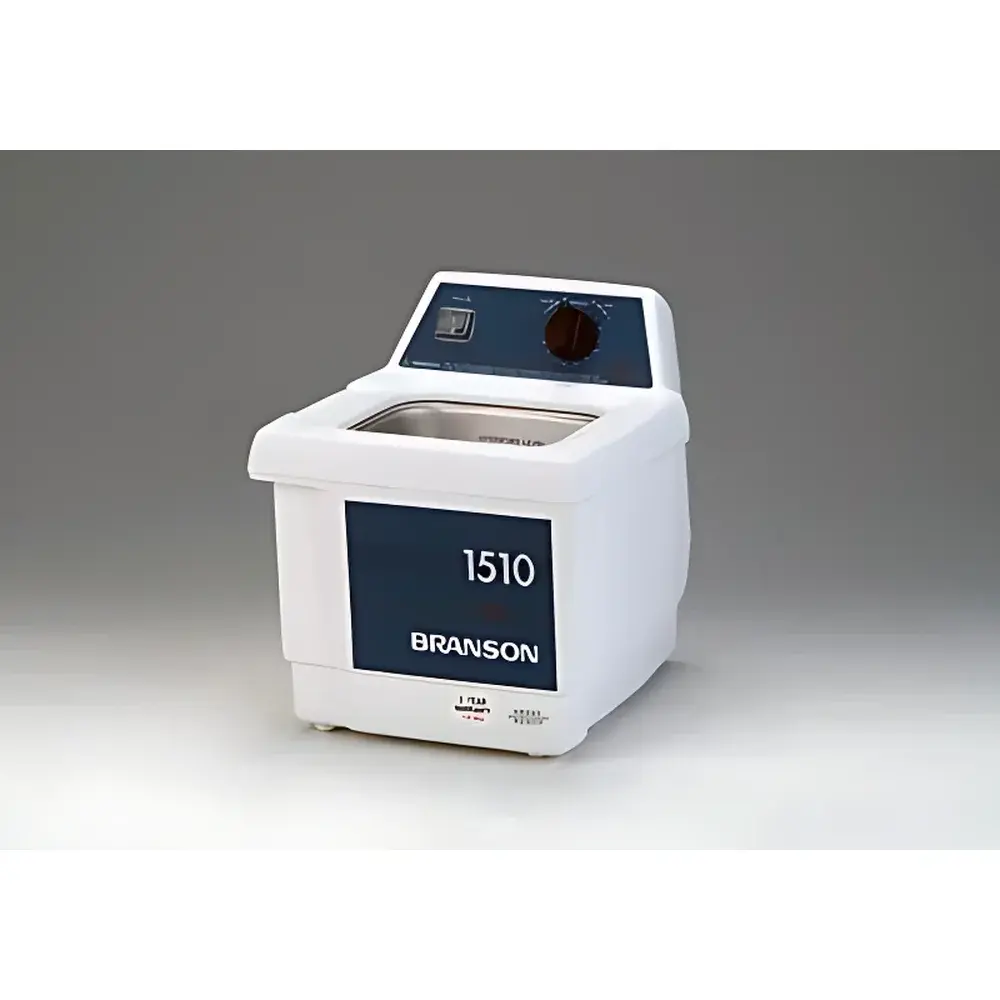
Branson B1510E-MTH Ultrasonic Cleaner
| Brand | Branson |
|---|---|
| Origin | USA |
| Model | B1510E-MTH |
| Tank Volume | 1.9 L |
| Internal Dimensions | 152 × 139 × 101 mm |
| Ultrasonic Frequency | 40 kHz |
| Heating Range | Ambient to 70 °C |
| Timer Range | 0–99 min (digital) |
| Heating Power | 63 W |
| Total Power | 143 W |
| Input Voltage | 220 V, 50/60 Hz |
| Construction Material | Polypropylene (PP) tank and housing |
| Transducer Type | Langevin-type piezoelectric transducer (metal/ceramic composite) |
| Sweep Frequency Function | Yes |
| Display | Digital temperature readout (actual & setpoint) |
| Drain Valve | Integrated |
| Lid | Hinged, dual-function (sound-dampening cover + drip tray) |
Overview
The Branson B1510E-MTH Ultrasonic Cleaner is a compact, precision-engineered benchtop cleaning system designed for routine laboratory applications requiring consistent, non-abrasive removal of particulate, organic, and light inorganic contaminants from delicate instrumentation, glassware, surgical tools, and micro-components. It operates on the principle of ultrasonic cavitation—where high-frequency mechanical energy (40 kHz) generates microscopic vacuum bubbles in the cleaning solution that collapse violently upon contact with surfaces, producing localized shockwaves and microstreaming effects. This physical mechanism enables effective cleaning without mechanical scrubbing or thermal degradation, making it ideal for sensitive substrates such as optical lenses, semiconductor wafers, chromatography columns, and calibration standards. Engineered for reliability in regulated environments, the unit complies with general electrical safety requirements per IEC 61010-1 and incorporates design features aligned with GLP-compliant lab workflows—including sealed electronics, moisture-resistant layout, and stable thermal control.
Key Features
- Polypropylene (PP) construction for full resistance to common aqueous solvents, mild acids, and alkaline detergents—ensuring long-term chemical compatibility and structural integrity.
- Langevin-type piezoelectric transducers mounted via advanced adhesive bonding directly to the tank bottom, delivering uniform energy distribution and minimizing delamination risk over extended operational cycles.
- Digital microprocessor-controlled heating and timing system with dual-display readout: real-time bath temperature and user-set target temperature, enabling precise thermal management within ±1.5 °C accuracy.
- Integrated frequency sweep function continuously modulates the drive signal across a narrow band around 40 kHz to prevent standing wave formation and ensure homogeneous cavitation throughout the tank volume.
- Vertically oriented internal PCB architecture with conformal coating provides enhanced protection against condensation and incidental liquid ingress—a critical design consideration for humid laboratory settings.
- Ergonomic top-mounted control panel with tactile, rubberized power switch and intuitive push-button interface minimizes exposure to splash hazards and simplifies operation under gloved conditions.
- Hinged acoustic lid serves dual roles: sound attenuation during operation and functional drip tray post-cycle; integrated drain valve allows rapid, controlled emptying without disassembly.
- Optimized water-level indicator ensures operation at the manufacturer-specified fill height (1.9 L), maximizing energy transfer efficiency and reproducibility across successive cleaning batches.
Sample Compatibility & Compliance
The B1510E-MTH accommodates standard laboratory vessels including beakers, vials, Petri dishes, pipette tips, and small-volume filtration assemblies. Its 152 × 139 × 101 mm chamber supports most ISO-standard test samples up to 130 mm in height. The unit is compatible with deionized water, ethanol, isopropanol, aqueous alkaline cleaners (e.g., Alconox®), and low-concentration citric acid solutions—provided pH remains within 2–12 to preserve PP integrity. While not certified to UL or CE for medical device reprocessing, it meets baseline performance expectations outlined in ASTM D2603 (Standard Test Method for Sonic Shear Stability of Lubricating Oils) and supports validation protocols referenced in USP (Cleaning Validation of Laboratory Equipment). Routine maintenance logs and temperature/timer calibration records may be retained to support internal QA audits.
Software & Data Management
This model operates via embedded firmware without external software dependency. All operational parameters—including elapsed time, set temperature, and current bath temperature—are displayed in real time on a high-contrast LCD screen. No data export capability or network connectivity is provided; however, the digital timer and temperature controller maintain traceable settings suitable for batch documentation in paper-based or LIMS-integrated workflows. For laboratories subject to 21 CFR Part 11 compliance, manual entry of cycle parameters into electronic lab notebooks (ELNs) is recommended, with timestamped operator signatures applied post-run. Firmware updates are not field-serviceable and require factory-level intervention.
Applications
- Cleaning of HPLC and GC sample vials, syringe filters, and autosampler components prior to analysis.
- Preparation of metallographic specimens and electron microscopy grids requiring particle-free surfaces.
- Removal of flux residues from printed circuit board (PCB) prototypes during R&D prototyping.
- Decontamination of reusable pipette tips and microcentrifuge tubes in molecular biology labs.
- Routine maintenance of viscometer spindles, density meters, and refractometer prisms.
- Supporting ASTM E1669 (Standard Guide for Cleaning and Degreasing of Metal Parts) in quality assurance laboratories.
FAQ
What is the maximum recommended operating temperature for this unit?
The heater is rated for continuous operation up to 70 °C. Exceeding this limit may accelerate polymer aging and compromise seal integrity.
Can I use flammable solvents such as acetone or hexane in this cleaner?
No. The B1510E-MTH is not explosion-proof and lacks solvent vapor monitoring or ignition suppression systems. Only aqueous or low-volatility, non-flammable cleaning agents are permitted.
Is the tank depth sufficient for submerging standard 15-mL conical tubes?
Yes—the 101-mm tank depth accommodates upright placement of 15-mL centrifuge tubes with ~20 mm of clearance below the lid.
Does the unit include a degas function?
No dedicated degas mode is implemented; however, initiating ultrasonication at ambient temperature for 5–10 minutes before heating achieves effective dissolved gas removal in most aqueous media.
How often should the transducer bond integrity be inspected?
Visual inspection of the tank bottom for signs of adhesive discoloration or micro-cracking is advised every 6 months under daily use; no scheduled replacement interval is specified by the manufacturer.



