
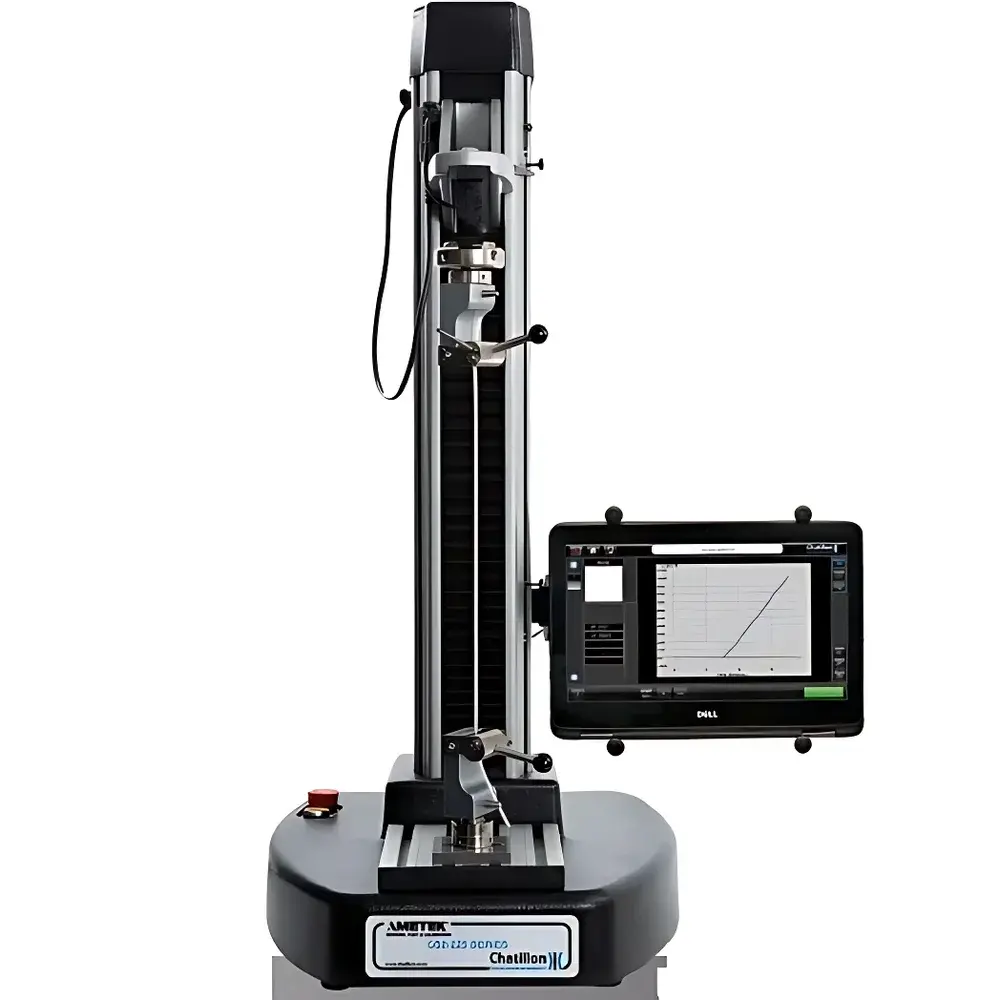
Chatillon CS2 Series Digital Force Testing System
| Brand | Chatillon |
|---|---|
| Origin | USA |
| Model | CS2-225, CS2-1100 |
| Instrument Type | Electromechanical Universal Testing System |
| Compliance | ISO 7500-1, ASTM E4, ASTM D638, ASTM D790, ASTM D1876, ISO 179, ISO 527 |
| Controller | Integrated Android-based Tablet (Dual-Function Touchscreen Interface) |
| Load Capacity Options | 225 N (CS2-225), 1100 N (CS2-1100) |
| Accuracy | ±0.5% of full scale (per ISO 7500-1 Class 1) |
| Resolution | 1/10,000 of full scale |
| Test Speed Range | 0.01–2000 mm/min (adjustable in 0.01 mm/min increments) |
| Data Output | CSV, PDF, XML via USB, Wi-Fi, or Bluetooth |
| Environmental Rating | IP54 (dust and splash resistant) |
Overview
The Chatillon CS2 Series Digital Force Testing System is an electromechanical universal testing platform engineered for precision mechanical property evaluation of materials and finished products across industrial quality control and R&D environments. Based on a servo-controlled linear actuation architecture with high-resolution load cell feedback and closed-loop position control, the CS2 delivers traceable, repeatable force–displacement data under tension, compression, peel, shear, bend, and multi-step cyclic protocols. Unlike traditional PC-dependent test systems, the CS2 integrates a purpose-built Android-based tablet controller—eliminating external computing hardware, proprietary software licenses, or programming expertise. Its design adheres to international metrological standards including ISO 7500-1 (Class 1 verification), ASTM E4 (verification of force-measuring instruments), and supports method-specific compliance with ASTM D638 (tensile properties of plastics), ASTM D790 (flexural properties), ASTM D1876 (peel resistance), ISO 527 (tensile testing of plastics), and ISO 179 (impact testing of rigid plastics). The system is calibrated at the factory using NIST-traceable standards and provides audit-ready calibration certificates.
Key Features
- Integrated dual-function touchscreen tablet controller running a dedicated, intuitive Android OS interface—no external PC, software installation, or coding required
- Two scalable load capacity models: CS2-225 (225 N maximum force) and CS2-1100 (1100 N maximum force), both supporting interchangeable load cells and fixtures
- Precision electromechanical drive with speed range from 0.01 to 2000 mm/min, adjustable in 0.01 mm/min increments for fine-grained protocol definition
- High-fidelity load measurement accuracy of ±0.5% of full scale per ISO 7500-1 Class 1, with 1/10,000 internal resolution and real-time digital filtering
- Robust aluminum frame construction with vertical column travel up to 600 mm (standard), compatible with optional height extensions and environmental enclosures
- IP54-rated enclosure for operation in production-floor conditions—resistant to dust ingress and water splashing during routine cleaning or humid ambient exposure
- Onboard data storage (16 GB internal memory), plus export options via USB 2.0, Wi-Fi 5 (802.11ac), and Bluetooth 5.0 to networked drives or LIMS
Sample Compatibility & Compliance
The CS2 Series accommodates a broad spectrum of specimen geometries and material classes without reconfiguration: medical device components (catheters, syringe plungers, suture anchors), polymer films and molded thermoplastics, laminated packaging substrates, elastomeric seals, textile webbing, adhesive tapes, and PCB-mounted connectors. Fixture adaptability includes standard wedge grips, pneumatic clamps, bend supports, peel jigs (90° and 180°), and custom-machined tooling interfaces (M6 and ¼”-20 threaded mounting). All preconfigured test methods—including tensile modulus, yield strength, elongation at break, puncture force, and loop strength—are aligned with ISO and ASTM standard templates. Full compliance documentation—including traceable calibration reports, uncertainty budgets, and GxP-relevant metadata (operator ID, timestamp, environmental conditions)—is generated automatically and supports FDA 21 CFR Part 11 readiness when deployed with optional electronic signature modules.
Software & Data Management
The embedded tablet OS hosts a native application that enables full test method creation, execution, visualization, and reporting without third-party dependencies. Users define multi-stage tests (e.g., preload → ramp → hold → return → post-test analysis) via drag-and-drop sequence builders. Real-time force–displacement curves are rendered with configurable axes, annotation overlays, and auto-identified event markers (yield point, peak load, fracture). Data exports include timestamped CSV (for statistical process control), print-ready PDF (with logo, company header, and QA sign-off fields), and XML (for automated ingestion into ELN or MES platforms). Audit trails record all user actions—including method edits, calibration events, and result overrides—with immutable timestamps and operator authentication. Optional cloud synchronization enables centralized method libraries and cross-site comparative analytics.
Applications
- Medical device validation: tensile strength of balloon catheters, compression testing of orthopedic foam, peel adhesion of sterile barrier packaging
- Plastics & polymers: flexural modulus of injection-molded housings, impact resistance of automotive interior trim, tear propagation in TPE gaskets
- Consumer electronics: button actuation force profiling, flex circuit bending endurance, connector retention force verification
- Textiles & nonwovens: seam slippage resistance, yarn tenacity, filtration membrane burst pressure
- Food & pharma packaging: seal integrity of blister packs, puncture resistance of pouch lidding, delamination force of multilayer laminates
FAQ
Does the CS2 require a dedicated computer or external software license?
No. The integrated tablet controller runs a self-contained application—no PC, Windows OS, or third-party software is needed.
Can test methods be exported and shared across multiple CS2 units?
Yes. Methods are saved as encrypted .cs2m files and can be transferred via USB or cloud sync for consistent deployment across labs or production lines.
Is the system suitable for GLP or GMP-regulated environments?
Yes. With optional electronic signatures and audit trail activation, it meets core requirements for 21 CFR Part 11 and ISO/IEC 17025 documentation integrity.
What maintenance is required beyond periodic calibration?
Routine maintenance is limited to visual inspection of grips and drive belt tension; no lubrication or alignment tools are required. Annual recalibration is recommended per ISO/IEC 17025 guidelines.
Are custom fixtures supported?
Yes. The system features standardized M6 and ¼”-20 mounting interfaces, and Chatillon provides engineering support for fixture design and validation per ISO 14727.



