
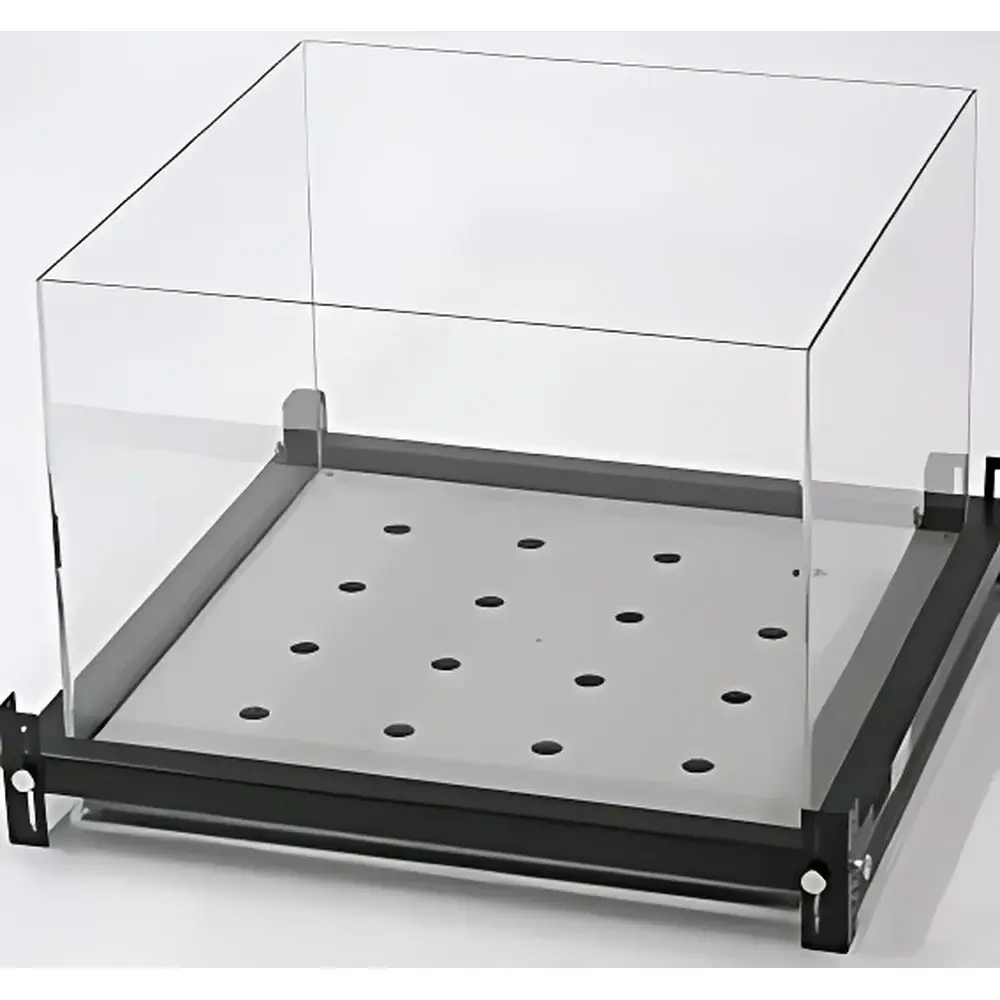
TSE Systems Hole Board System for Rodent Behavioral Phenotyping
| Brand | TSE Systems |
|---|---|
| Origin | Germany |
| Model | Hole Board System |
| Animal Compatibility | Mice and Rats |
| Configuration Options | 2×2 or 4×4 hole arrays (custom inserts available) |
| Hole Count | Up to 16 holes |
| Hole Diameter | Species-specific (mouse-optimized and rat-optimized) |
| Detection Method | Dual-layer infrared sensor array (floor-mounted for hole entries |
| Data Output | Hole entries count, dwell time per hole, total path length, user-defined time binning |
| File Format | Excel-compatible CSV export |
| Software Integration | Fully compatible with ActiMot2 behavioral analysis platform and PhenoMaster® metabolic phenotyping suite |
| Regulatory Context | Designed for GLP-compliant behavioral phenotyping workflows |
Overview
The TSE Systems Hole Board System is a standardized, non-invasive behavioral phenotyping platform engineered for quantitative assessment of spontaneous exploratory behavior in laboratory rodents—primarily mice and rats. Rooted in ethologically grounded paradigms, the system leverages natural curiosity-driven head-dipping into apertures as a robust proxy for investigatory motivation, anxiety-related inhibition, and sensorimotor integration. Unlike operant or reward-based assays, the hole board test requires no pre-training, food/water deprivation, or reinforcement contingencies—minimizing confounding stressors and enabling repeated longitudinal measurements within the same cohort. The core measurement principle relies on infrared beam interruption: each aperture is equipped with a vertically aligned IR emitter-detector pair beneath the floor plate, precisely registering head-dip onset, duration, and frequency. Concurrently, an overhead IR grid monitors gross locomotor activity—including distance traveled, velocity profiles, and spatial distribution—allowing orthogonal normalization of exploration metrics against general motility. This dual-sensor architecture ensures discriminative sensitivity to neuropharmacological modulation across multiple neurotransmitter systems, including dopaminergic, serotonergic, cholinergic, and GABAergic pathways.
Key Features
- Dual-layer infrared detection: Independent tracking of hole entries (via sub-floor sensors) and whole-body movement (via ceiling-mounted grid), enabling decoupling of directed exploration from general locomotion.
- Species-optimized hardware: Interchangeable floor plates with calibrated hole diameters—3.5 cm for mice and 5.0 cm for rats—aligned with published anatomical and behavioral norms (e.g., according to OECD Test Guideline 426 and NIH Mouse Phenome Database standards).
- Configurable array geometry: Standard 2×2 (4-hole) and 4×4 (16-hole) layouts; modular insert system permits rapid reconfiguration for dose-response studies or strain comparisons without hardware replacement.
- Adjustable mechanical parameters: Vertical position of the sensor frame is motorized and software-controllable; individual hole depth is mechanically variable (range: 2–8 cm), allowing systematic manipulation of perceived novelty or aversion thresholds.
- Real-time visual feedback: On-screen per-hole status indicators (LED or GUI-based) enable immediate experimenter monitoring during trial execution—critical for protocol adherence and outlier identification.
- Time-resolved data capture: User-definable binning intervals (from 1 second to 5 minutes) support both fine-grained temporal analysis (e.g., habituation kinetics) and summary-statistic generation for high-throughput screening.
Sample Compatibility & Compliance
The system is validated for use with C57BL/6, BALB/c, CD-1, Sprague-Dawley, and Wistar strains under standard vivarium conditions (22 ± 2°C, 45–65% RH, 12-h light/dark cycle). All components comply with IEC 61000-6-3 (EMC emission standards) and carry CE marking for research-use-only (RUO) applications in the EU. When integrated with ActiMot2 v4.2+ and configured with electronic signature and audit trail modules, the full workflow meets documentation requirements for GLP-compliant neurobehavioral studies per OECD Principles of Good Laboratory Practice (ENV/MC/CHEM(98)17) and supports traceability under ISO/IEC 17025:2017 for accredited testing laboratories.
Software & Data Management
Data acquisition and analysis are managed through the ActiMot2 software platform, which provides synchronized timestamping across all sensor channels, automated event classification (e.g., distinguishing brief dips vs. prolonged investigation), and batch-processing pipelines for multi-session datasets. Export formats include tab-delimited CSV files fully compatible with Prism, R, Python (pandas), and MATLAB. Metadata fields—such as animal ID, genotype, treatment group, trial start time, ambient light level, and operator ID—are embedded directly into output files. For regulated environments, optional 21 CFR Part 11 compliance packages include role-based access control, electronic signatures, and immutable audit logs recording every parameter change, file export, or report generation event.
Applications
- Neuropharmacology: Quantification of anxiolytic, anxiogenic, stimulant, or sedative effects via dose-dependent shifts in hole-entry latency, total entries, and spatial bias patterns.
- Genetic phenotyping: High-resolution behavioral profiling of transgenic, knockout, or CRISPR-edited rodent lines to identify endophenotypes linked to psychiatric disease models (e.g., schizophrenia, depression, OCD).
- Toxicology screening: Early detection of CNS-active off-target effects during compound safety assessment, particularly for molecules targeting ion channels or synaptic proteins.
- Longitudinal behavioral monitoring: Repeated-measures design capability enables tracking of age-related cognitive decline, neurodegenerative progression, or recovery post-intervention.
- Multi-modal phenotyping: Seamless integration with PhenoMaster® allows concurrent acquisition of metabolic parameters (oxygen consumption, CO₂ production, respiratory exchange ratio) alongside behavioral metrics—enabling mechanistic correlation between energy metabolism and exploratory drive.
FAQ
Is the Hole Board System suitable for both mice and rats?
Yes—the system includes interchangeable floor plates with species-specific hole diameters and depth ranges optimized for murine and rat neuroanatomy and exploratory biomechanics.
Can data from multiple animals be acquired simultaneously?
No—each unit is designed for single-animal testing to ensure unambiguous sensor attribution and minimize olfactory cross-contamination; however, up to eight systems can be networked and controlled in parallel via ActiMot2’s multi-device orchestration module.
Does the system require calibration before each experiment?
No routine recalibration is needed; factory calibration is stable over time. Users perform daily verification using the built-in diagnostic mode that validates beam integrity and timing synchronization across all 16 channels.
How is exploratory behavior differentiated from random movement?
ActiMot2 applies a dual-threshold algorithm: a head-dip event is only registered if (a) the sub-floor IR beam is interrupted for ≥100 ms and (b) the animal’s center-of-mass remains within a 5-cm radius of the hole for ≥200 ms—effectively filtering incidental crossings.
Is validation documentation available for regulatory submissions?
Yes—TSE Systems provides Instrument Qualification (IQ), Operational Qualification (OQ), and Performance Qualification (PQ) protocols upon request, along with raw test data and uncertainty budgets compliant with ISO/IEC 17025 and FDA guidance for computerized systems used in nonclinical laboratory studies.




