
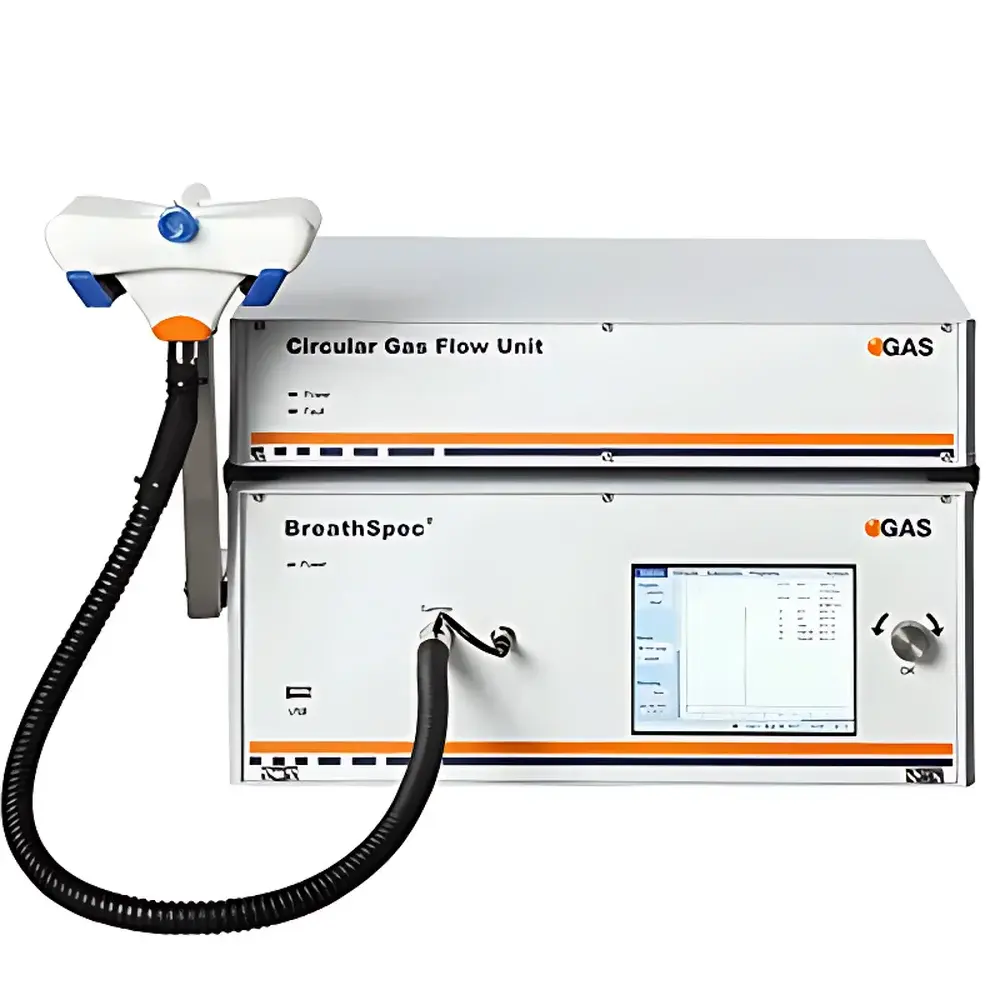
BreathSpec® Breath Analysis System by G.A.S.
| Brand | G.A.S. |
|---|---|
| Origin | Germany |
| Model | BreathSpec® |
| Inlet | 6-port valve direct injection |
| Sensitivity | sub-ppb (parts-per-trillion detectable) |
| Library | VOC-specific GC×IMS spectral library |
| Mobility Resolution | TOF-IMS with 5 kV/10 cm drift field |
| Weight | 20 kg |
| Integrated Components | Onboard computer, internal gas supply, spirometer for CO₂/O₂ flow monitoring |
| Sampling Modes | Direct exhaled breath, static headspace (oral/nasal cavity), dermal micro-sampling |
Overview
The BreathSpec® Breath Analysis System by G.A.S. is a benchtop-integrated gas chromatography coupled with time-of-flight ion mobility spectrometry (GC×TOF-IMS) platform engineered specifically for non-invasive, real-time analysis of volatile organic compounds (VOCs) in human exhaled breath and other biological headspace matrices. Unlike conventional GC-MS systems requiring extensive sample preparation and controlled humidity conditioning, the BreathSpec® employs a robust dual-separation architecture: high-resolution capillary gas chromatography provides compound retention separation, while high-field asymmetric waveform ion mobility spectrometry (FAIMS) or time-of-flight IMS delivers orthogonal mobility-based discrimination under ambient pressure and near-ambient temperature. This orthogonal detection principle enables unambiguous identification of isomeric and structurally similar VOCs—such as aldehydes, ketones, sulfur compounds, and short-chain hydrocarbons—even in highly humid (≥95% RH), particulate-laden, and CO₂-rich exhaled air without cryogenic trapping or derivatization. The system operates with intrinsic ppm-level water vapor tolerance and achieves detection limits routinely below 100 pptv (parts-per-trillion by volume) for key biomarker VOCs including acetone, isoprene, hexanal, and 2-butanone.
Key Features
- Zero-sample-prep workflow: Direct injection of raw exhaled breath via integrated 6-port valve eliminates need for sorbent tubes, thermal desorption units, or humidity traps.
- Integrated physiological monitoring: Built-in spirometer measures real-time CO₂ and O₂ concentration and flow rate during breath collection—ensuring traceable, volume-normalized sampling per ASTM E2937-22 guidelines for breath biomarker quantification.
- Modular GC column selection: Swappable fused-silica capillary columns (e.g., DB-5ms, Stabilwax, or custom chiral phases) enable method optimization for targeted VOC classes or broad-spectrum profiling.
- Self-contained operation: Onboard computing unit (Windows OS), internal zero-air generator, and battery-compatible power management allow deployment in mobile labs, clinical wards, or field studies without external gas cylinders or network dependency.
- CGFU compatibility: Optional Circulating Gas Flow Unit (CGFU) recirculates and conditions sampled breath—extending measurement window for kinetic profiling or low-concentration analyte accumulation.
Sample Compatibility & Compliance
The BreathSpec® is validated for direct analysis of undiluted human exhaled breath, oral/nasal cavity headspace, and dermal emission gases collected via micro-sampling adapters. Its design conforms to ISO 16000-6:2011 (indoor air VOC analysis) and supports GLP-compliant workflows through full audit trail logging in LAV software. All spectral acquisition and processing routines comply with FDA 21 CFR Part 11 requirements when deployed with electronic signature-enabled configurations. Data integrity is maintained via immutable .mea binary file format, with SHA-256 checksums generated at acquisition. Instrument calibration follows NIST-traceable standards using certified VOC gas mixtures (e.g., Scott Specialty Gases BTEX + Aldehyde Standard).
Software & Data Management
Data acquisition and interpretation are managed through the proprietary LAV (Laboratory Analytical Viewer) software suite, fully compatible with Windows 10/11 and exportable to CSV, TXT, and MATLAB (.mat) formats. Core modules include:
- LAV Reporter Plugin: Enables pairwise or multigroup comparison of normalized peak intensities across samples—highlighting statistically significant VOC differences (p < 0.05, ANOVA/FDR-corrected) between control and disease cohorts.
- Gallery-Plot Visualization: Generates heat-mapped 2D retention time–drift time matrices, facilitating rapid pattern recognition across large sample sets (n > 500) for biomarker discovery or diagnostic classification.
- GC×IMS Library Search: Combines NIST GC retention index database with G.A.S.-curated IMS drift time library (calibrated against >1,200 pure VOC standards), achieving compound identification confidence scores ≥92% (cross-validated).
- GC×IMS Library Edit: Allows users to curate proprietary spectral libraries—including retention indices, drift times, collision cross-sections (CCS), and clinical metadata—for domain-specific applications (e.g., wound infection VOC signatures).
Applications
The BreathSpec® serves as a translational research platform across multiple biomedical domains:
- Pulmonary & metabolic disease phenotyping: Discrimination of COPD, asthma, and lung cancer subtypes via breath VOC fingerprinting; longitudinal monitoring of diabetic ketosis through acetone/isoprene ratio dynamics.
- Critical care toxicology: Rapid detection of volatile toxins (e.g., chloroform, benzene, methanol metabolites) in ICU patients presenting with unexplained encephalopathy or metabolic acidosis.
- Dermatology & wound diagnostics: Identification of bacterial VOC profiles (e.g., Pseudomonas aeruginosa pyocyanin markers, Staphylococcus aureus dimethyl disulfide) from chronic ulcer headspace—supporting antibiotic stewardship decisions.
- Anesthesiology research: Real-time tracking of sevoflurane, isoflurane, and desflurane metabolism kinetics and elimination half-lives in postoperative recovery.
- Pharmacokinetic monitoring: Non-invasive assessment of cytochrome P450 activity via breath VOC probe substrates (e.g., caffeine metabolites, limonene oxidation products).
FAQ
Does the BreathSpec® require carrier gas cylinders?
No—integrated zero-air generator and optional CGFU eliminate dependence on external compressed gas supplies.
Can it be used outside a laboratory environment?
Yes—the 20 kg footprint, onboard computing, and battery-ready power architecture support deployment in clinics, mobile health units, or field epidemiology studies.
How is data traceability ensured for regulatory submissions?
LAV software provides full ALCOA+ compliant audit trails, electronic signatures, and immutable raw data storage meeting FDA 21 CFR Part 11 and EU Annex 11 requirements.
Is method validation support available?
G.A.S. provides IQ/OQ documentation templates, system suitability test protocols, and SOP development assistance aligned with ICH M10 and CLSI EP26-A guidelines.
What VOC classes are covered in the default library?
The standard GC×IMS library includes >850 compounds: aldehydes, ketones, alcohols, esters, terpenes, sulfur volatiles, nitrogen-containing bases, and halogenated organics—prioritized for human breath relevance per the Human Volatolome Project.





