
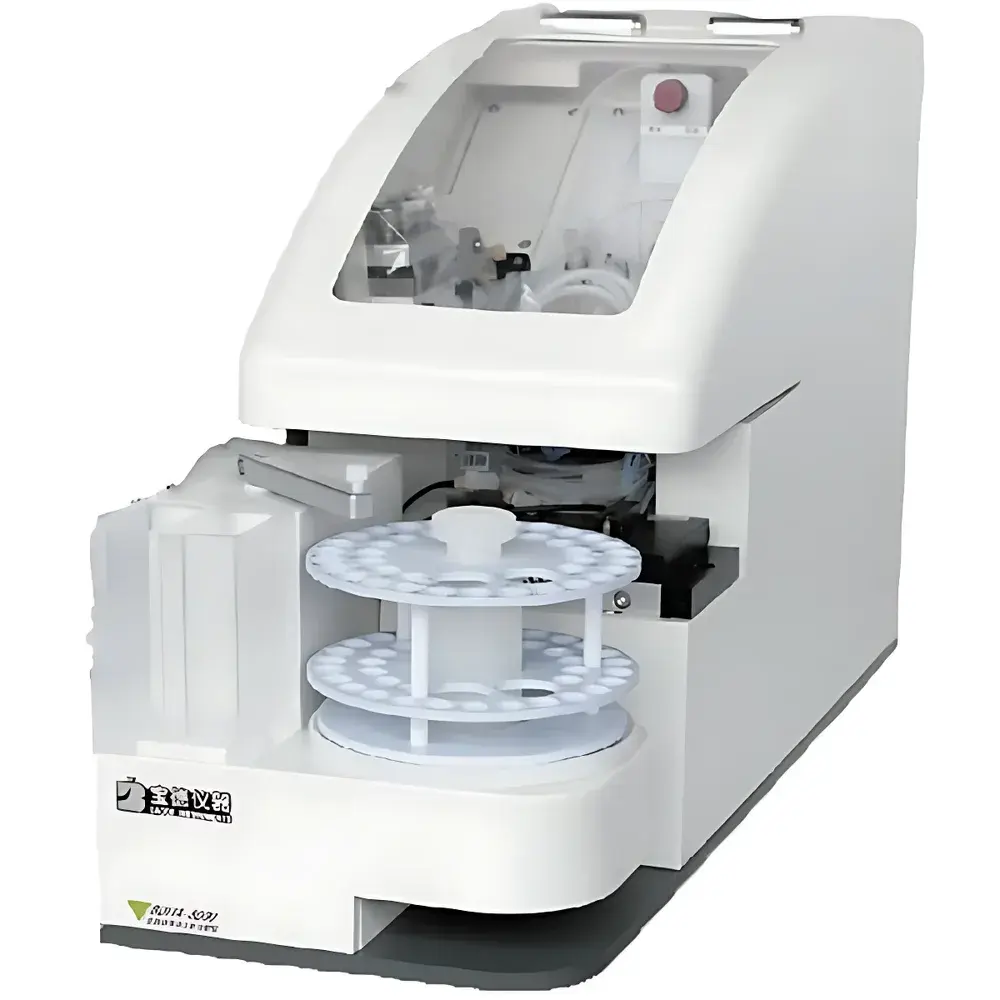
Brookdale Instruments BDFIA-9000 Fully Automated Flow Injection Analyzer for Cyanide in Baijiu and Alcoholic Beverages
| Brand | Brookdale Instruments |
|---|---|
| Model | BDFIA-9000 |
| Origin | Beijing, China |
| Manufacturer Type | Original Equipment Manufacturer (OEM) |
| Regional Classification | Domestic (China) |
| Pricing | Upon Request |
Overview
The Brookdale Instruments BDFIA-9000 is a fully automated flow injection analyzer (FIA) engineered for the quantitative determination of total cyanide (CN⁻) in alcoholic beverages—particularly baijiu (Chinese distilled spirit), flavored liquors, food-grade ethanol, packaged drinking water, and natural mineral water. It implements standardized segmented flow injection analysis with spectrophotometric detection at 638 nm following acid distillation and pyridine-barbituric acid colorimetric derivatization. This methodology complies strictly with GB 5009.36–2023, the current Chinese National Food Safety Standard for Cyanide Determination in Foods. The system operates on a robust, closed-tube manifold architecture that minimizes reagent consumption, suppresses cross-contamination, and ensures high analytical reproducibility (RSD < 3.0% at 0.02 mg/L CN⁻). Thermal stabilization of reaction zones and precision peristaltic pumping enable rapid system equilibration (<15 min post-power-on) and consistent baseline stability across extended runs.
Key Features
- Fully integrated 72-position autosampler with programmable syringe-based aspiration, enabling unattended batch processing of up to 72 samples without manual intervention.
- Modular flow path design featuring chemically resistant PTFE and polyether ether ketone (PEEK) tubing, corrosion-resistant valves, and temperature-controlled reaction coil (45 ± 0.5 °C) for optimized derivatization kinetics.
- Onboard acid distillation module compliant with GB 5009.36–2023 requirements, incorporating precise steam generation control and condensate collection management to ensure quantitative cyanide recovery from volatile matrices.
- High-sensitivity dual-beam photometer with tungsten-halogen light source and interference filter (638 nm ± 2 nm), delivering linear dynamic range from 0.005 to 0.50 mg/L CN⁻ (as KCN).
- Optional external high-capacity autosampler support (up to 192 positions) via RS-485/Modbus RTU interface, facilitating scalability for QC laboratories handling >200 samples per day.
- Embedded industrial-grade controller with real-time pressure monitoring, flow-rate calibration logging, and automatic fault diagnostics—including air bubble detection and pump occlusion alerts.
Sample Compatibility & Compliance
The BDFIA-9000 is validated for use with undiluted or pre-diluted liquid samples exhibiting pH 3.5–7.0 and turbidity <5 NTU. It accommodates standard 16 mm × 100 mm borosilicate glass vials and supports matrix-matched calibration with spiked baijiu reference materials. Method performance meets GB 5009.36–2023 validation criteria for accuracy (recovery 85–115%), repeatability (intra-day RSD ≤ 4.0%), and limit of quantitation (LOQ = 0.005 mg/L). Instrument design adheres to IEC 61010-1 safety standards for laboratory equipment. Data integrity features—including electronic audit trails, user access levels, and instrument method versioning—support alignment with GLP principles and internal QA/QC protocols.
Software & Data Management
Control and data acquisition are managed through FIA-Studio v3.2 software (Windows 10/11 compatible), offering ISO/IEC 17025-aligned workflow templates, customizable report generation (PDF/CSV/XLSX), and built-in calibration curve fitting (linear, quadratic, or weighted least squares). All raw absorbance traces, method parameters, and operator actions are time-stamped and stored with SHA-256 hash verification. Software supports optional 21 CFR Part 11 compliance modules, including digital signature capture, role-based permissions, and immutable electronic records retention for ≥10 years.
Applications
- Regulatory testing of cyanide in baijiu and other traditional Chinese spirits during production release and shelf-life monitoring.
- Quality assurance screening of food-grade ethanol used in flavor compound synthesis and beverage formulation.
- Compliance verification for bottled water manufacturers subject to GB 8537 (Mineral Water) and GB 19298 (Packaged Drinking Water) cyanide limits (≤0.002 mg/L).
- Method transfer and routine analysis in third-party food testing laboratories accredited to CNAS-CL01 (equivalent to ISO/IEC 17025).
- Research applications involving cyanogenic glycoside hydrolysis kinetics in fermented grain matrices.
FAQ
Does the BDFIA-9000 comply with international cyanide testing standards beyond GB 5009.36–2023?
Yes—the flow injection protocol is technically compatible with ISO 6439:1984 (water) and ASTM D7511–17 (wastewater), though method adaptation and matrix-specific validation are required prior to implementation.
Can the system analyze solid or semi-solid food matrices?
No—sample introduction is limited to aqueous or low-viscosity alcoholic liquids; solid samples must undergo prior extraction and filtration per GB 5009.36–2023 Section 7.1.
What maintenance intervals are recommended for long-term operational reliability?
Peristaltic pump tubing should be replaced every 3 months under continuous operation; distillation chamber descaling is advised after every 200 sample injections; annual photometer wavelength verification using NIST-traceable filters is recommended.
Is remote monitoring or integration with LIMS supported?
Yes—via OPC UA server integration and configurable CSV export triggers; direct LIMS connectivity requires customer-provided middleware conforming to HL7 or ASTM E1384 messaging standards.




