
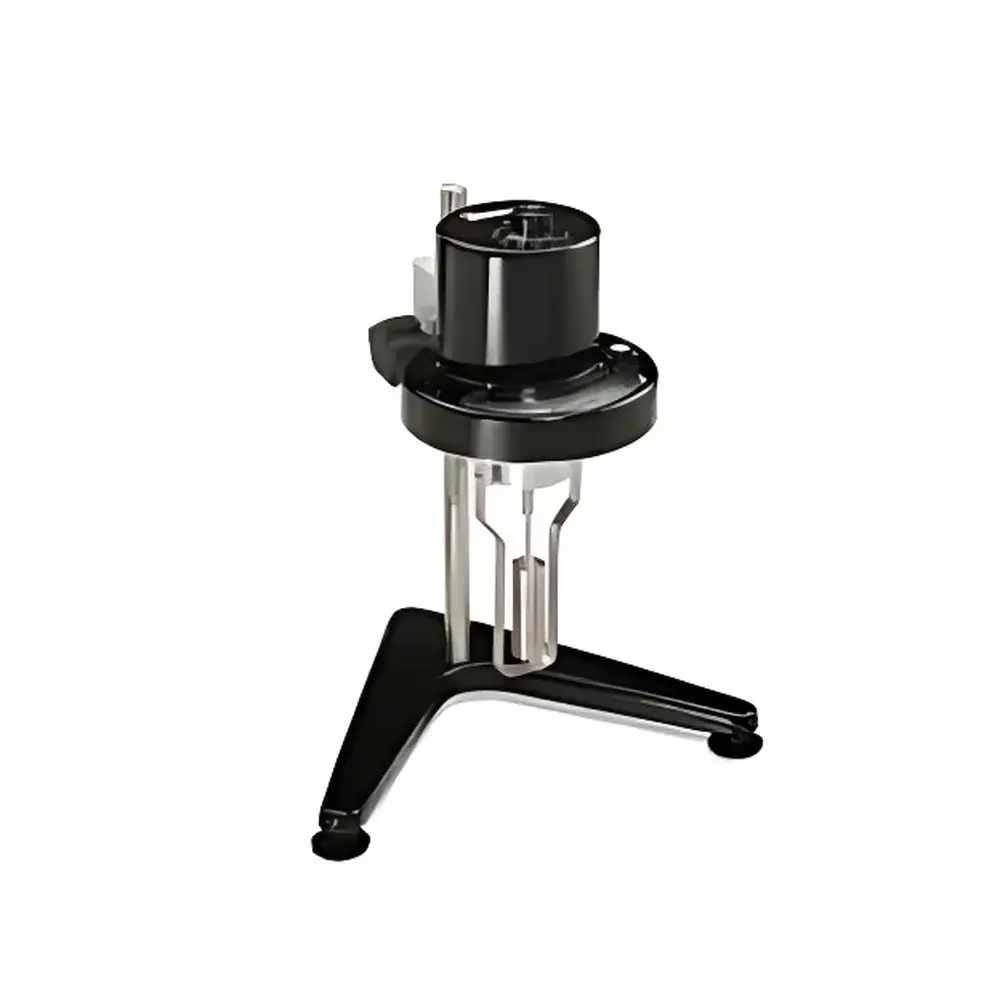
Brookfield Dial-Reading Rotational Viscometer (LV/RV/HA/HB Series)
| Brand | Brookfield |
|---|---|
| Origin | USA |
| Model | LV/RV/HA/HB Series |
| Viscosity Range | 1 cP to 64 × 10⁶ cP (64 MPa·s) |
| Speed Range | 5–100 rpm (LV: 3–60 rpm) |
| Speed Increments | 8–10 steps |
| Accuracy | ±1% of full-scale range |
| Repeatability | ±0.2% |
| Compliance | UL Class 1, Group D (explosion-proof variant available without motor) |
Overview
The Brookfield Dial-Reading Rotational Viscometer (LV/RV/HA/HB Series) is a mechanically driven, analog torque-measurement instrument engineered for robust, repeatable viscosity characterization of Newtonian and mildly non-Newtonian fluids across industrial R&D, QC, and production environments. Based on the classical Couette principle—where torque generated by fluid resistance between a rotating spindle and stationary sample cup is measured via calibrated spring deflection—the instrument delivers direct analog readout in % torque, convertible to centipoise (cP) using spindle-specific calibration constants. Designed for operational simplicity and long-term mechanical stability, this series serves as a foundational benchmark in viscosity metrology, particularly where digital infrastructure is limited or legacy protocol compliance is required. Its modular architecture supports interchangeable spindles and accessories, enabling adaptation to diverse sample rheological profiles without software dependency.
Key Features
- Mechanically actuated, gear-driven motor with precision speed control (5–100 rpm standard; LV models: 3–60 rpm), delivering low-noise operation and high rotational stability.
- Analog dial display showing % torque—directly translatable to viscosity (cP) using Brookfield’s published spindle calibration factors.
- Four model families optimized for distinct viscosity domains: LV (1–2 × 10⁶ cP), RV (100–8 × 10⁶ cP), HA (200–16 × 10⁶ cP), and HB (800–64 × 10⁶ cP).
- Standard spindle sets: 4 spindles for LV models; 6 spindles for RV/HA/HB models—each traceably calibrated per ASTM D2196 and ISO 2555.
- Optional explosion-proof configuration (UL Class 1, Group D) available for hazardous locations—achieved by eliminating the internal motor and coupling externally via explosion-rated drive shaft.
- Integrated protective guard leg prevents spindle wobble and ensures consistent immersion depth; A-frame stand provides rigid vertical alignment.
- Full compatibility with Brookfield’s accessory ecosystem—including UL Adapter (down to 1 cP), Small Sample Adapter (0.5–2 mL), Thermosel heating system (up to 250 °C), and DIN/ISO-compliant fixtures.
Sample Compatibility & Compliance
The LV/RV/HA/HB viscometers accommodate a broad spectrum of sample types—from volatile solvents and aqueous emulsions to thermally sensitive gels and highly filled pastes—provided minimum sample volume and thermal equilibration requirements are met. LV models are routinely deployed for coatings, pharmaceutical suspensions, and cosmetic bases; RV units support asphalt binders (per AASHTO T 315/SHRP protocols), paper coatings, and starch slurries; HA/HB variants meet ASTM D1092 for mastics, sealants, and polymer melts. All instruments comply with GLP documentation requirements when used with manual logbooks and calibrated reference oils (e.g., NIST-traceable Brookfield Standard Fluids). While not inherently 21 CFR Part 11 compliant due to analog output, audit trails may be established through procedural SOPs and external data capture systems.
Software & Data Management
As an analog instrument, the dial viscometer does not incorporate embedded firmware or digital connectivity. However, it integrates seamlessly into regulated workflows via manual recording aligned with ISO/IEC 17025 documentation practices. Users may digitize readings using Brookfield’s optional ViscoQC 200 data logger (for serial-output-capable versions) or third-party acquisition hardware. Calibration records, spindle history, and environmental logs (temperature, humidity) must be maintained per internal QA policy. Reference fluid verification is recommended before each analytical session, especially when operating near measurement extremes or after spindle replacement.
Applications
- Quality control of solvent-based adhesives, latex dispersions, and ink formulations (LV series).
- Rheological screening of hot-melt adhesives, bituminous binders, and ceramic slips (RV series).
- Consistency testing of toothpaste, peanut butter, epoxy pastes, and roofing mastics (HA/HB series).
- Batch release verification for pharmaceutical ointments and topical gels under USP & Ph. Eur. monographs.
- Educational demonstration of Newtonian flow behavior, shear-thinning onset, and temperature-dependent viscosity trends.
- Field-deployable viscosity checks in paint manufacturing, food processing, and chemical distribution facilities.
FAQ
What is the lowest measurable viscosity with the LV model?
Using the Ultra-Low Viscosity Adapter (ULA), the LV series achieves reliable measurement down to 1 cP; with standard LV spindles, the lower limit is 15 cP.
Can this instrument measure non-Newtonian fluids?
Yes—though it reports apparent viscosity at discrete shear rates defined by spindle geometry and rotational speed. For full flow curve analysis, a programmable digital rheometer is recommended.
Is calibration traceable to national standards?
All Brookfield spindles are calibrated against NIST-traceable reference oils; certificate of calibration is provided with each new instrument and spindle set.
How often should I verify calibration?
Daily verification with a certified reference fluid is advised for QC-critical applications; annual recalibration by an accredited lab is recommended.
Are spare parts and service available globally?
Yes—Brookfield maintains authorized service centers in over 50 countries, with spindle replacements, torque spring kits, and motor assemblies stocked regionally.



