
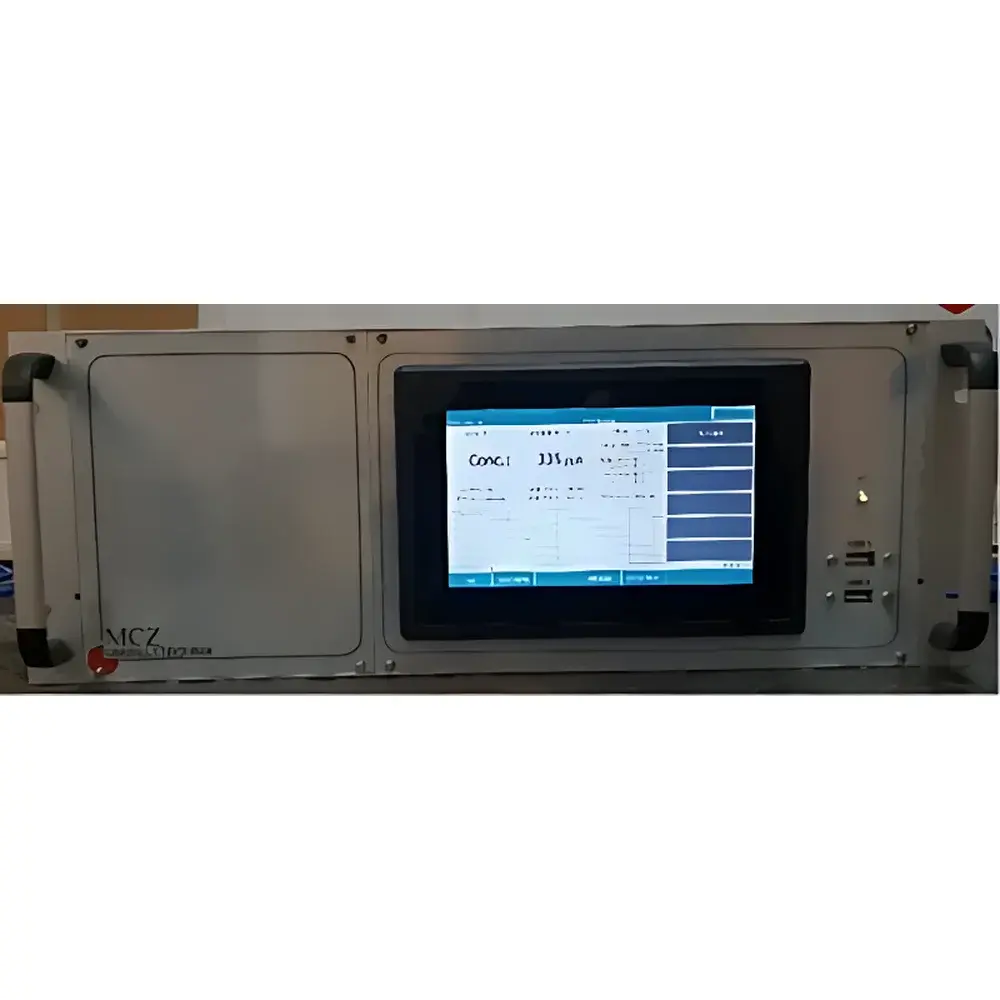
Brookfield GC-2020 Ethylene Gas Analyzer
| Origin | Germany |
|---|---|
| Manufacturer Type | Authorized Distributor |
| Origin Category | Imported Instrument |
| Model | GC-2020 |
| Pricing | Upon Request |
| Detector Type | Photoionization Detector (PID), 10.6 eV |
| Measurement Range | 0–50 ppm (C₂H₄) |
| Column Configuration | Dual packed columns with backflush capability |
| Carrier Gas | Nitrogen (N₂), regulated flow control |
| Sample Introduction | Six-port multi-position valve with 1 mL sample loop |
| Cycle Time | 420 s typical |
| Data Storage | >2 GB internal flash memory |
| Display Interface | 7-inch capacitive touchscreen LCD (1024 × 600) |
| Rack Mount | 19-inch, 4 HU |
| Analog Output | 4–20 mA / 0–10 V (isolated) |
| Digital Interface | RS-232/RS-485 serial, parallel I/O for PLC integration |
| Auto-Diagnostics | Built-in system self-test with event logging |
| Standby Mode | Low-power operational state with wake-on-trigger capability |
| Compliance | Designed per IEC 61000-6-3 (EMC), EN 61010-1 (Safety), compatible with GLP/GMP data integrity requirements |
Overview
The Brookfield GC-2020 Ethylene Gas Analyzer is a dedicated benchtop gas chromatograph engineered for trace-level quantification and qualitative identification of ethylene (C₂H₄) in ambient and process air streams. It operates on the principle of temperature-programmed gas chromatography coupled with photoionization detection (PID), enabling selective, stable, and reproducible measurement of ethylene at sub-ppm resolution. Unlike broad-spectrum electrochemical or metal-oxide sensors, the GC-2020 leverages retention time specificity and PID spectral selectivity—particularly advantageous for distinguishing C₂H₄ from co-eluting hydrocarbons such as methane, ethane, or propylene. Its primary application domain includes post-catalytic scrubber monitoring in greenhouse CO₂ enrichment systems, exhaust stream analysis downstream of catalytic converters in biogas engines, and continuous environmental surveillance in controlled-atmosphere fruit storage facilities. The instrument’s architecture is purpose-built for long-term unattended operation in agricultural research stations, ecological monitoring networks, and postharvest physiology laboratories where low-concentration ethylene dynamics directly influence ripening kinetics and shelf-life modeling.
Key Features
- Compact 19-inch rack-mountable design (4 HU height) optimized for integration into existing environmental monitoring cabinets or mobile lab platforms.
- Integrated dual-column backflush GC module: one analytical column for C₂H₄ separation and one pre-column for trapping high-boiling interferents (e.g., C₆+ hydrocarbons), minimizing carryover and cycle time.
- Stable 10.6 eV PID detector with <1.5% RSD repeatability over 72-hour continuous operation; calibrated traceable to NIST-traceable ethylene standards.
- Automated six-port multi-position valve with precision-machined PTFE rotor seals, ensuring <0.1% dead volume and 500,000 cycles.
- Onboard embedded controller with real-time OS, supporting autonomous method execution, automatic baseline correction, and peak integration using first-derivative thresholding.
- Full-system self-diagnostic suite—including carrier gas pressure validation, detector lamp intensity monitoring, column oven thermal ramp verification, and valve actuation feedback—logged with timestamps and severity codes.
- 7-inch industrial-grade capacitive touchscreen interface with intuitive icon-driven navigation, configurable alarm thresholds, and user-accessible method templates.
Sample Compatibility & Compliance
The GC-2020 accepts gaseous samples within the temperature range of 5–40 °C and relative humidity up to 85% non-condensing. It is compatible with ambient air, filtered exhaust gas, and headspace samples drawn via optional integrated sampling pump (flow rate: 0.1–1.0 L/min, adjustable). Sample introduction uses a fixed-volume 1 mL stainless steel loop, eliminating syringe-based variability. All wetted materials—including sample lines, valves, and column fittings—are electropolished 316L stainless steel or fused silica-lined, ensuring minimal adsorption of polar analytes. The system conforms to IEC 61000-6-3 (industrial EMC immunity), EN 61010-1 (electrical safety for laboratory equipment), and supports audit-ready data handling per FDA 21 CFR Part 11 when operated with validated software extensions. Raw chromatograms, integration reports, and system logs are timestamped, digitally signed, and stored with immutable file attributes—meeting GLP and ISO/IEC 17025 documentation requirements for environmental testing laboratories.
Software & Data Management
Data acquisition and instrument control are managed by the embedded GC Control Suite v3.2 firmware, which stores all chromatographic runs, calibration records, and diagnostic logs internally on a 2.1 GB industrial-grade NAND flash array. Each dataset includes full metadata: injection time, column temperature profile, detector gain setting, valve sequence log, and ambient sensor readings (optional external temperature/humidity input). Export options include CSV (peak area, RT, concentration), PDF (annotated chromatogram + report), and XML (for LIMS ingestion). Serial communication (RS-232/RS-485) enables bidirectional command protocol support—including remote start/stop, method upload, and status polling—while the parallel I/O port provides TTL-level trigger inputs and discrete status outputs for integration with SCADA systems or programmable logic controllers (PLCs). No proprietary drivers or runtime dependencies are required for PC connectivity.
Applications
- Real-time monitoring of ethylene accumulation in CA (controlled atmosphere) fruit storage rooms to optimize O₂/CO₂ setpoints and delay climacteric respiration.
- Verification of catalytic converter efficiency in agricultural biogas generators by quantifying residual C₂H₄ in engine exhaust prior to flue gas release.
- Validation of ethylene scrubber performance in commercial greenhouses using CO₂ fertilization, where concentrations >0.1 ppm can inhibit photosynthetic activity.
- Field-deployable research tool for plant ecophysiology studies assessing ethylene emission rates from stressed vegetation under drought or pathogen challenge.
- Calibration reference system for validating lower-cost ethylene sensor arrays used in smart agriculture IoT deployments.
FAQ
What carrier gas is required for routine operation?
Nitrogen (N₂) with purity ≥99.999% and dew point ≤−40 °C is mandatory; helium or hydrogen are not supported due to PID ionization efficiency constraints and column compatibility.
Can the GC-2020 quantify other volatile organic compounds (VOCs) besides ethylene?
Yes—when reconfigured with alternate column chemistries (e.g., DB-1 or PLOT Al₂O₃/KCl), it can resolve and quantify C₂–C₅ alkenes and selected oxygenates; however, factory calibration and method validation are required per compound.
Is remote firmware update supported over the network?
No—firmware updates require local USB flash drive loading and manual initiation via the touchscreen interface to maintain system integrity and regulatory compliance.
What maintenance intervals are recommended for sustained accuracy?
PID lamp replacement every 12 months (or after 8,000 hours), column bake-out monthly, and full system leak check quarterly; all procedures are documented in the included Maintenance Manual (EN/DE/FR editions).
Does the instrument meet explosion-proof certification for hazardous area installation?
No—the GC-2020 is rated for Class I, Division 2 (non-hazardous location); for Zone 1/2 deployment, an external purged enclosure meeting ATEX/IECEx standards must be used.
Related Products







