
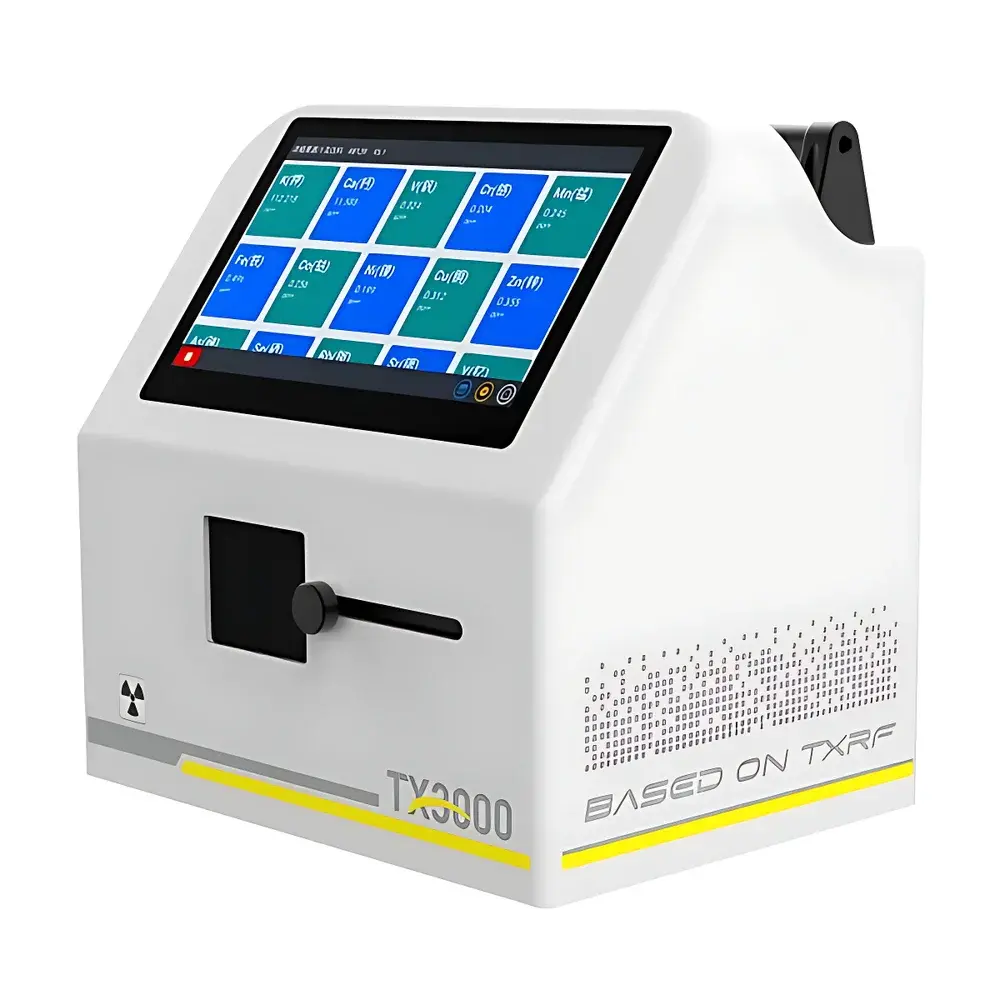
Brookfield LANScientific TX3000 Portable Total-Reflection X-Ray Fluorescence (TXRF) Spectrometer for Soil Trace Element Analysis
| Brand | LANScientific |
|---|---|
| Origin | Jiangsu, China |
| Manufacturer Type | Direct Manufacturer |
| Regional Classification | Domestic (China) |
| Model | TX3000 |
| Application | Field-Portable |
| Instrument Type | Total-Reflection X-Ray Fluorescence (TXRF) |
| Industry-Specific Use | Soil & Atmospheric Environmental Monitoring |
| Sample Form Compatibility | Liquid, Suspension, Solid, Filter-Collected Particulates |
| Detection Principle | Grazing-Incidence Excitation with Multilayer Monochromator and Silicon Drift Detector (SDD) |
| Key Performance | Sub-pg Absolute Detection Limits for Heavy Metals (e.g., Cr, Pb, As, Cd, Hg, Ni, Cu, Zn), Simultaneous Multi-Element Quantification (up to 30 elements), Minimal Sample Requirement (<10 µL liquid or <1 mg solid) |
Overview
The LANScientific TX3000 is a field-deployable, benchtop-compatible total-reflection X-ray fluorescence (TXRF) spectrometer engineered for quantitative trace elemental analysis in environmental matrices—particularly soil, airborne particulate matter (PM2.5/PM10 filters), sediment, and leachates. Unlike conventional energy-dispersive XRF (ED-XRF) systems, the TX3000 employs a precisely controlled grazing-incidence geometry (99.5%, enabling detection limits in the low picogram (pg) range for key heavy metals—including Cr, Pb, As, Cd, Hg, Ni, Cu, and Zn—without matrix-matched calibration standards. The instrument operates on fundamental parameter (FP) quantification principles validated per ISO 20578:2020 (XRF — Quantitative analysis using total-reflection geometry) and supports semi-quantitative screening per ASTM D7721–19 (Standard Guide for Field Screening of Soils Using Portable XRF).
Key Features
- True TXRF Architecture: Integrated quartz carrier stage with automated tilt control ensures consistent <0.08° incidence angle across all measurements—critical for reproducible excitation efficiency and background suppression.
- Monolithic Opto-Mechanical Design: All-optical path components—including monochromator, sample stage, and SDD detector—are rigidly mounted within a thermally stabilized aluminum housing, eliminating alignment drift during transport or field use.
- Zero-Gas, Zero-Cryogen Operation: No He purge, Peltier cooling only; no liquid nitrogen or compressed gas required—enabling continuous operation in remote locations with ambient temperature range of 5–40 °C.
- Minimal Sample Consumption: Supports direct analysis of ≤10 µL aqueous extracts or ≤1 mg dried soil residue on Si wafers—eliminating acid digestion, reducing lab waste, and complying with EPA Method 6200 revision requirements for field screening.
- Regulatory-Ready Software: Firmware includes audit-trail logging, user access levels (admin/operator), electronic signature support, and data export compliant with FDA 21 CFR Part 11 Annex 11 for GLP/GMP environments.
Sample Compatibility & Compliance
The TX3000 accepts filter-collected aerosols (Teflon®, quartz fiber), digested soil extracts (HNO₃/HF microwave digestates), suspended sediments, and homogenized plant tissues. It complies with ISO/IEC 17025:2017 (Clause 7.2.2) for method validation documentation and meets performance criteria outlined in EU Council Directive 2004/35/EC (Environmental Liability Directive) Annex III for soil metal screening. For regulatory reporting, results are traceable to NIST SRM 2710a (Montana Soil) and BCR-701 (Aquatic Sediment) via certified reference material (CRM) calibration protocols embedded in the firmware.
Software & Data Management
The bundled TX3000 Control Suite v4.2 provides real-time spectral deconvolution using IUPAC-recommended peak fitting algorithms (Gaussian-Lorentzian hybrid), automatic inter-element correction (e.g., Pb L-lines interfering on As Kα), and built-in uncertainty propagation per GUM (JCGM 100:2008). Data files (.txf) include full metadata (GPS coordinates, humidity, operator ID, acquisition time) and are exportable as CSV, PDF analytical reports, or XML for LIMS integration. Cloud synchronization (optional) enables centralized QA/QC review across multi-site monitoring networks.
Applications
- Soil contamination mapping for brownfield redevelopment (ASTM E1527–21 Phase I ESA support)
- Atmospheric deposition studies via PM filter analysis (EN 14902:2005 compliance)
- Leachate monitoring from landfill caps per TCLP (US EPA Method 1311)
- Geochemical baseline surveys in agricultural land (ISO 11466:2022)
- Forensic soil provenance analysis using rare-earth element (REE) fingerprinting
- Compliance verification for EU REACH SVHC thresholds in topsoil
FAQ
Does the TX3000 require external vacuum or helium purge for light element analysis?
No. Its optimized TXRF geometry and SDD detector enable reliable detection of P, S, Cl, and K without vacuum assistance—though Na and Mg require optional ultra-thin polymer window activation.
Can it quantify speciation (e.g., Cr(III) vs Cr(VI))?
No. TX3000 performs total elemental quantification only. Speciation requires coupling with HPLC-ICP-MS or XANES, though sequential extraction data can be imported for correlation modeling.
What is the typical measurement time per sample for soil extracts?
60 seconds for screening mode (detection limit ~50 pg); 300 seconds for quantification mode (detection limit ~5 pg) at 50 kV/1 mA tube settings.
Is CRM-based calibration mandatory for regulatory submittal?
Yes. While FP mode supports rapid screening, accredited environmental testing labs must validate with ≥3 matrix-matched CRMs per analyte per batch, per ISO/IEC 17025 Clause 7.7.2.
How is radiation safety ensured during field deployment?
The system incorporates dual interlocks (door sensor + beam shutter), 0.02°—exceeding IAEA Safety Standards Series No. SSG-46 for portable XRF devices.
Related Products






