
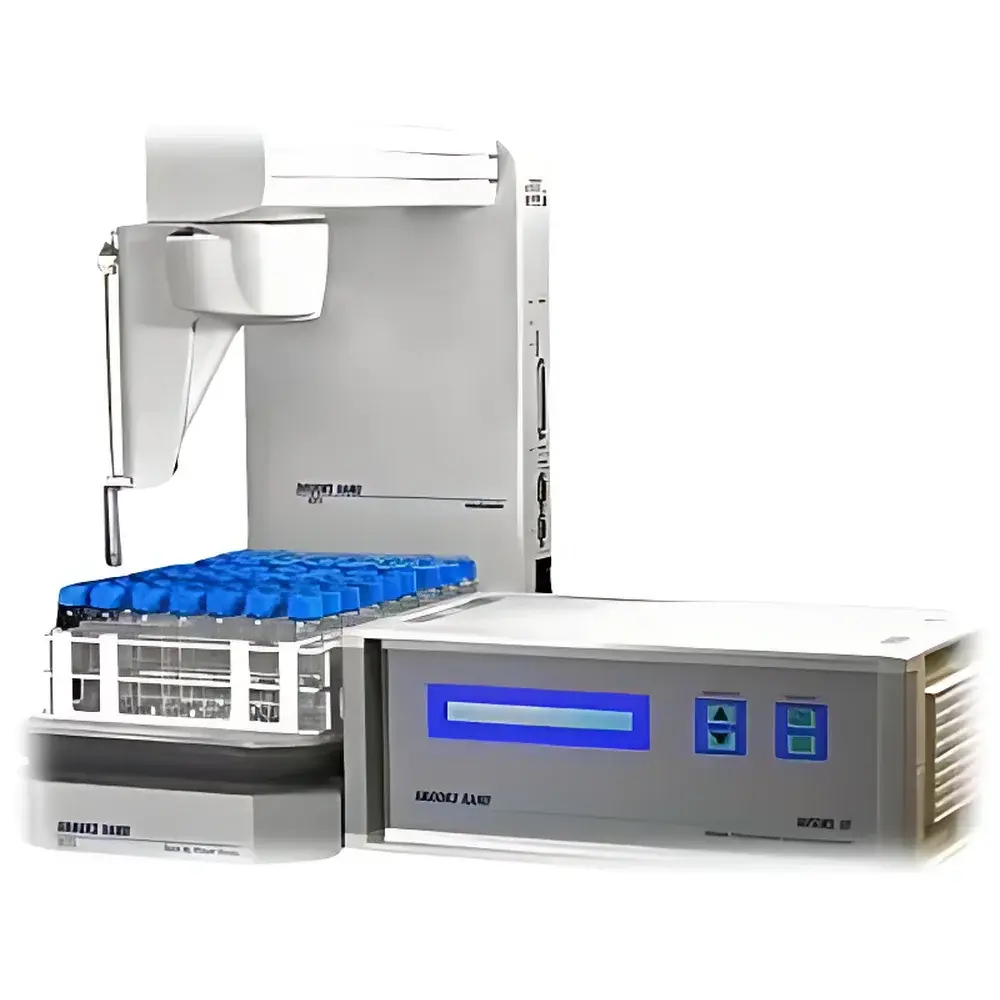
Brookfield MERX THg 245.7 Cold Vapor Atomic Fluorescence Mercury Analyzer
| Brand | Brooks Rand Labs |
|---|---|
| Origin | USA |
| Instrument Type | Benchtop Laboratory Analyzer |
| Principle | Cold Vapor Atomic Fluorescence Spectrometry (CVAFS) |
| Detection Limit | <8 pg absolute (equivalent to <0.3 ng/L in 25 mL sample) |
| Precision | RSD <1% at 100 pg |
| Linear Dynamic Range | 0–10,000 pg |
| Analysis Time | 1–2 minutes per sample |
| Compliance | Fully conforms to U.S. EPA Method 245.7 for total mercury determination |
| Sample Throughput | High-throughput parallel multi-channel operation |
| Upgrade Path | Compatible with integrated methylmercury (MeHg) speciation module using shared autosampler and detector |
Overview
The Brookfield MERX THg 245.7 is a benchtop cold vapor atomic fluorescence spectrometry (CVAFS) analyzer engineered for rapid, trace-level quantification of total mercury (THg) in aqueous, digested solid, and biological matrices. Designed explicitly to meet the performance and procedural requirements of U.S. Environmental Protection Agency (EPA) Method 245.7, the system delivers sub-picogram detection sensitivity with high reproducibility and minimal operator intervention. CVAFS detection leverages the selective excitation of mercury atoms in the vapor phase at 253.7 nm, followed by measurement of emitted fluorescence intensity — a technique offering superior specificity over atomic absorption and electrochemical methods, particularly in complex environmental and regulatory samples. The MERX platform is not a generic mercury analyzer but a purpose-built instrument architecture validated for compliance-driven laboratories performing routine monitoring under Clean Water Act, Safe Drinking Water Act, and RCRA programs.
Key Features
- Patented modular hardware design enabling field-upgradable functionality without system recalibration or downtime
- Dual-stage gold amalgamation trap with rapid thermal desorption kinetics, ensuring >95% recovery efficiency across matrix types
- Parallel multi-channel sample processing architecture supporting up to 60 samples per hour in unattended operation
- Integrated reagent delivery and reaction manifold optimized for EPA 245.7 oxidation, reduction, and purging protocols
- Ultra-low-noise CVAFS detector with thermoelectrically stabilized photomultiplier tube and background-compensated signal acquisition
- Pre-aligned optical path and factory-validated lamp alignment reducing maintenance frequency and drift-related recalibrations
Sample Compatibility & Compliance
The MERX THg 245.7 accepts liquid samples directly — including filtered surface water, wastewater effluent, acid-digested soil/sediment extracts, tissue homogenates, and preserved biological fluids — without dilution or pre-concentration in most cases. It supports sample volumes from 5 to 50 mL with automated volume calibration. All operational parameters, data acquisition sequences, and report templates are preconfigured to satisfy the method validation criteria outlined in EPA Method 245.7, including spike recovery acceptance (85–115%), method detection limit (MDL) verification, and continuing calibration verification (CCV) frequency. The system meets GLP/GMP data integrity requirements through audit-trail-enabled software, electronic signatures, and secure user-role management aligned with FDA 21 CFR Part 11.
Software & Data Management
MERX Control Software (v5.2+) provides full method execution control, real-time signal visualization, and automated QC flagging per EPA 245.7 criteria. Raw spectral data, peak integration parameters, and calibration history are stored in a relational SQLite database with immutable timestamps. Export formats include ASTM E1447-compliant .csv, LIMS-ready XML, and PDF analytical reports containing metadata such as analyst ID, instrument serial number, calibration date, and raw/processed signal traces. Data backups are configurable to network drives or NAS endpoints with SHA-256 hash verification. Remote diagnostics and firmware updates are supported via encrypted TLS 1.2 connections without exposing internal network infrastructure.
Applications
- Regulatory compliance testing for drinking water utilities under the U.S. EPA Lead and Copper Rule revisions incorporating mercury monitoring
- Wastewater treatment plant discharge reporting per NPDES permits requiring monthly THg analysis
- Environmental site assessment (ESA) projects involving sediment and porewater characterization at Superfund sites
- Pharmaceutical and biotech manufacturing QA/QC for mercury catalyst residue screening in APIs and intermediates
- Academic and government research labs conducting mercury biogeochemistry studies requiring high temporal resolution across large sample sets
- Food safety laboratories validating low-level mercury content in fish tissue and dietary supplements per FDA Action Levels
FAQ
Does the MERX THg 245.7 require daily calibration?
No — the system employs a stable, long-life mercury lamp and self-referencing baseline correction; calibration verification is required only before each analytical batch per EPA 245.7.
Can it analyze solid samples directly?
No — solids must undergo EPA-approved digestion (e.g., EPA 3050B, 3051A, or 3052) prior to analysis; the instrument accepts only liquid-phase samples.
Is method validation documentation provided?
Yes — a complete IQ/OQ/PQ protocol package, including installation checklist, operational qualification test scripts, and performance verification data against NIST SRM 1641d, is supplied with each system.
What maintenance intervals are recommended?
Gold trap replacement every 6 months under typical use; quartz cell cleaning every 200 runs; annual PM service includes lamp output verification and optical alignment check.
How is data security enforced during remote access?
All remote sessions use certificate-based authentication and end-to-end AES-256 encryption; no credentials or raw data traverse unsecured channels.





