
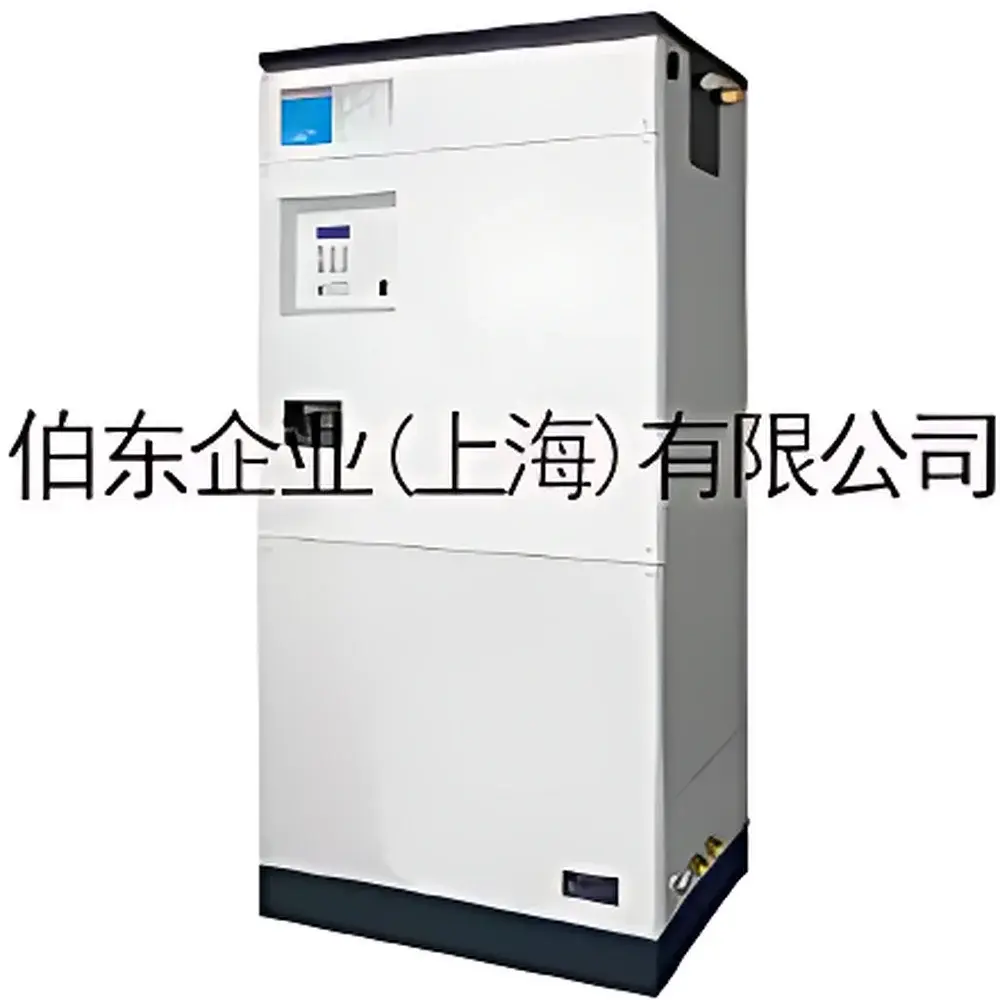
Brookfield Polycold MaxCool 2500 L Cryogenic Water Vapor Pump (Refrigerated Cryopump)
| Brand | Polycold |
|---|---|
| Origin | USA |
| Model | MaxCool 2500 L |
| Cooling Medium | Eco-friendly non-toxic refrigerant |
| Operating Temperature Range | –120 °C to –145 °C |
| Maximum Load Capacity | 2500 W |
| Water Vapor Pumping Speed (actual) | 140,000 L/s |
| Ultimate Vacuum | 1 × 10⁻⁹ mbar |
| Startup Pressure Limit | 1 atm |
| Defrost Time | 4.0 min |
| Cold Surface Area | 1.4 m² |
| Single-Loop Configuration | 16 mm OD × 27.9 m coil |
| Cooling Water Flow Rate (at 13 °C/26 °C/29 °C) | 13.6 / 27.3 / 54.1 L/min |
| Noise Level (max) | 68 dB(A) |
| Footprint (min) | 0.403 m³ |
| Weight | 544 kg |
| Compliance | Designed for integration with ISO/IEC 17025-compliant vacuum systems |
Overview
The Brookfield Polycold MaxCool 2500 L Cryogenic Water Vapor Pump is a high-performance, closed-cycle refrigerated cryopump engineered for ultra-high vacuum (UHV) and extreme high-vacuum (XHV) applications in semiconductor fabrication, thin-film deposition (PVD, CVD, sputtering), and advanced materials research. Unlike liquid nitrogen (LN₂)-based cryogenic trapping, the MaxCool 2500 L employs a proprietary, non-toxic, environmentally compliant refrigerant cycle to achieve stable cold surface temperatures between –120 °C and –145 °C. At these temperatures, water vapor condenses and adsorbs irreversibly onto the polished stainless-steel cryocoil surface—removing 65–95% of residual gas load in vacuum chambers dominated by H₂O partial pressure. With a verified water vapor pumping speed of 140,000 L/s and sustained performance down to 1 × 10⁻⁹ mbar, the system significantly reduces pump-down time (by up to 75%) and improves process repeatability in production-scale vacuum tools.
Key Features
- Stable cryosurface operation at –120 °C to –145 °C using a hermetically sealed, oil-free refrigeration circuit
- High-efficiency cold coil geometry with 1.4 m² effective condensing area; optimized for rapid water vapor capture
- Configurable single-loop (16 mm OD × 27.9 m) or dual-loop cryocoil options for flexible integration into existing vacuum manifolds
- Low-power, high-load architecture: rated for continuous operation at up to 2500 W thermal load without performance degradation
- Automated defrost cycle completed in ≤4.0 minutes, minimizing process downtime and enabling high-throughput batch processing
- No LN₂ dependency—eliminates logistics, safety hazards, and operational variability associated with cryogen supply chains
- Robust mechanical design compliant with SEMI S2/S8 safety standards; integrated vibration isolation and acoustic damping
Sample Compatibility & Compliance
The MaxCool 2500 L is designed for direct integration with turbomolecular pumps (e.g., Pfeiffer HiPace series), dry scroll pumps, roots blowers, and Kaufman-type ion sources—common in semiconductor etch, ALD, and optical coating platforms. It does not require sample contact; instead, it functions as a passive, non-intrusive vacuum enhancement device installed on the chamber’s foreline or directly on the main vacuum port. The system meets electromagnetic compatibility (EMC) requirements per IEC 61000-6-3 and is constructed from vacuum-compatible 316L stainless steel and oxygen-free copper components. All control electronics conform to UL 61010-1 and CE marking directives. Its closed-loop refrigerant system complies with EPA SNAP program guidelines and contains zero ozone-depleting substances (ODP = 0, GWP < 15).
Software & Data Management
The MaxCool 2500 L operates via an embedded industrial-grade controller with RS-485 Modbus RTU and optional Ethernet/IP interface. Real-time monitoring includes cold head temperature, refrigerant pressure, cooling water flow rate, coil surface temperature, and defrost status—all logged with timestamped metadata. Data export supports CSV and XML formats for traceability in FDA 21 CFR Part 11–aligned environments. Optional integration with LabVIEW™, SECS/GEM, or MES platforms enables automated vacuum recipe synchronization and audit-ready event logging—including start/stop cycles, thermal excursions, and maintenance alerts. Firmware updates are performed securely over HTTPS with SHA-256 signature verification.
Applications
- Semiconductor wafer processing: moisture suppression during plasma etch, implant, and epitaxial growth to prevent oxide regrowth and particle nucleation
- Optical thin-film deposition: reduction of H₂O partial pressure to improve film stoichiometry, adhesion strength, and refractive index uniformity in AR, HR, and filter coatings
- Surface science instrumentation: UHV systems for XPS, AES, and STM where sub-monolayer water contamination compromises spectral fidelity
- Accelerator and fusion research: beamline vacuum conditioning and synchrotron front-end pumping where hydrocarbon and water outgassing must be minimized
- Industrial R&D vacuum furnaces: enabling reproducible high-purity sintering and diffusion bonding under controlled residual gas composition
FAQ
What vacuum levels can the MaxCool 2500 L sustain while actively pumping water vapor?
It maintains stable water vapor pumping performance down to 1 × 10⁻⁹ mbar, with no measurable decline in capture efficiency across the 10⁻² to 10⁻⁹ mbar operating range.
Is the system compatible with corrosive process gases such as Cl₂ or NF₃?
Yes—when used downstream of a suitable chemical trap or scrubber, the stainless-steel cold surface and sealed refrigeration loop resist corrosion from common etchant byproducts.
Does the MaxCool 2500 L require periodic refrigerant replenishment?
No—the refrigerant circuit is hermetically sealed for life; no scheduled refills or leak checks are required under normal operation.
Can it be retrofitted to legacy vacuum systems originally designed for LN₂ cryopanels?
Yes—standard CF-150 and ISO-K 250 flanges are available; mechanical and thermal interface drawings are provided for engineering review prior to installation.
How does its energy consumption compare to LN₂-based cryotrapping?
At full load, power draw is ≤5.2 kW (including chiller and controller); over a 24-hour cycle, this represents >80% reduction in total cost of ownership versus daily LN₂ consumption of ~120 L.



