
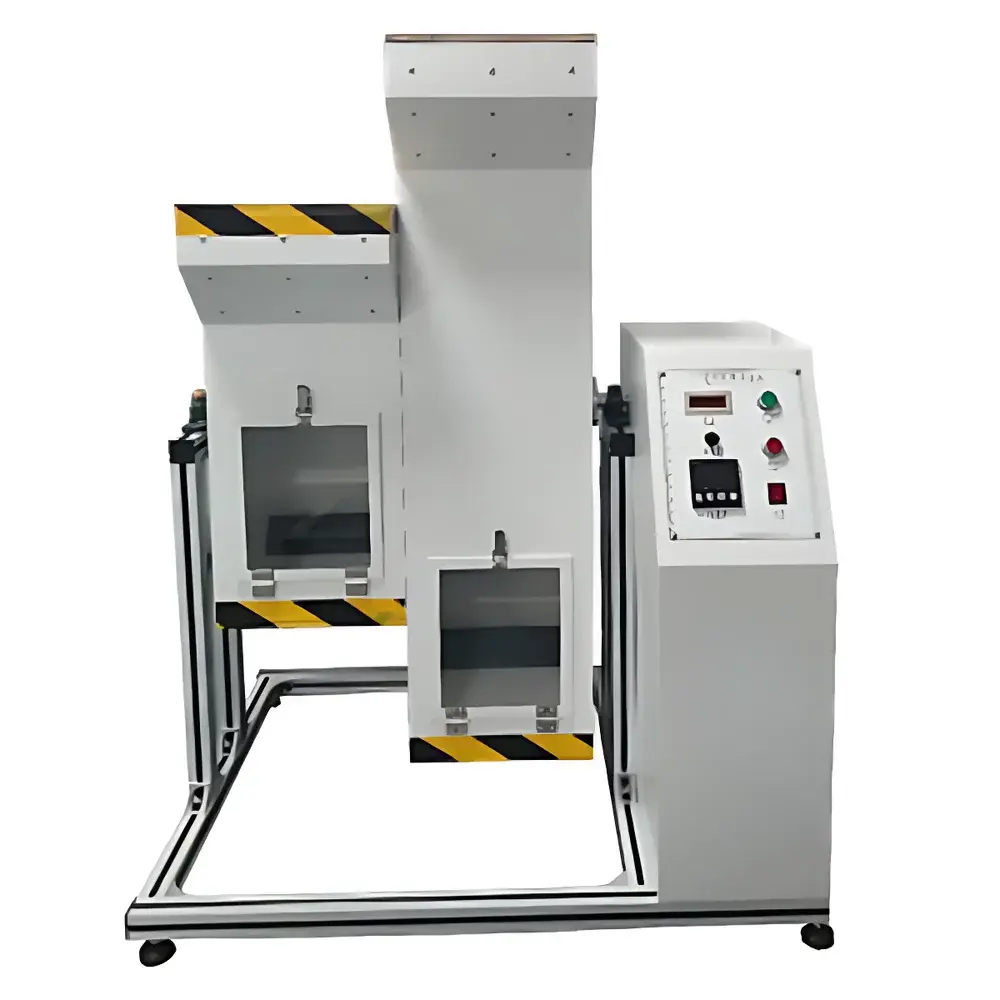
Brookfield PW-DR2 Dual-Drum Drop Tester
| Brand | PW |
|---|---|
| Origin | Guangdong, China |
| Model | PW-DR2 |
| Drop Height | 1000 mm (dual-height configuration: 500 mm & 1000 mm) |
| Max Sample Weight | 5 kg |
| Test Speed | 5–20 cycles/min |
| Cycle Count Range | 1–999,999 (6-digit LCD with power-loss memory) |
| Drum Quantity | 2 |
| Test Surface | 15 mm hardwood board + 3 mm steel plate |
| Power Supply | AC 220 V / 380 V, single-phase |
| Dimensions (W×H×D) | 1300 × 780 × 1420 mm |
| Net Weight | ~120 kg |
Overview
The Brookfield PW-DR2 Dual-Drum Drop Tester is an electromechanically controlled physical testing instrument engineered for standardized mechanical durability evaluation of portable electronic devices and compact components under repeated tumbling impact conditions. It operates on the principle of controlled rotational drop—where test specimens are secured inside two independently configurable cylindrical drums, each elevated to a defined vertical height (500 mm or 1000 mm), then released to free-fall onto a rigid, calibrated impact surface composed of 15 mm hardwood overlaid with a 3 mm steel plate. This methodology replicates real-world handling stresses—including accidental drops, packaging transport vibration, and repetitive orientation shifts—enabling quantitative assessment of structural integrity, housing deformation, connector retention, and functional continuity after mechanical shock exposure. The system complies with the mechanical shock and free-fall requirements specified in IEC 60068-2-32 (Environmental testing – Part 2-32: Tests – Test Ed: Free fall) and aligns with the drum-type drop test methodology outlined in GB/T 2423.8–1995 (Environmental testing for electric and electronic products – Part 2: Test methods – Test Eb and guidance: Falling and tumbling).
Key Features
- Dual-drum architecture with independent height selection (500 mm and 1000 mm), enabling comparative fatigue analysis across impact energy levels;
- Precision-adjustable test speed (5–20 cycles per minute) via servo-controlled AC motor, ensuring repeatable angular acceleration and consistent kinetic energy delivery per cycle;
- 6-digit LCD counter with non-volatile memory—retains accumulated cycle count during power interruption and auto-stops upon reaching user-defined termination threshold (1–999,999 cycles);
- Transparent polycarbonate viewing windows with hinge-mounted locking latches—secured during rotation yet accessible for pre-test verification and post-cycle inspection without tooling;
- Surface-treated enclosure (baked enamel finish, matte white) with ISO-compliant safety labeling applied to all hazard zones including drum access points and drive mechanisms;
- Programmable stop-on-demand functionality: halts motion immediately after any individual drop event to facilitate intermediate visual or functional inspection;
- Rigid base frame anchored to a flat, level concrete floor; impact surface meets ASTM E1223-21 dimensional stability and hardness specifications for standardized drop test platforms.
Sample Compatibility & Compliance
The PW-DR2 accommodates specimens up to 5 kg mass and dimensions compatible with internal drum clearance (standard drum inner diameter: Ø350 mm, length: 500 mm). It is routinely deployed for qualification testing of mobile phones, smartphone batteries, PDAs, e-dictionaries, portable audio players (CD/MP3), USB adapters, wireless remote controls, and board-level connectors. All test configurations adhere to traceable calibration protocols aligned with ISO/IEC 17025:2017 requirements for testing laboratories. The apparatus satisfies mechanical validation criteria referenced in IEC 60068-2-32 Ed. 3.0 (2020), and its drum geometry and release mechanism conform to the dimensional tolerances and rotational inertia parameters defined in GB/T 2423.8–1995 Annex A. Optional third-party verification reports (e.g., SGS or TÜV-certified calibration certificates) may be provided upon request to support GLP/GMP audit readiness.
Software & Data Management
While the PW-DR2 operates via embedded microcontroller-based logic (no external PC dependency), it supports full data traceability through its integrated LCD interface: real-time display of current speed (cycles/min), cumulative count, and remaining cycles. All parameter settings—including target count, selected drum height, and operational speed—are stored in EEPROM with battery-backed retention. For laboratory information management systems (LIMS) integration, optional RS-232 or USB-to-serial interface modules enable automated logging of start/stop timestamps, cycle completion events, and fault codes (e.g., motor stall, lid-open interrupt) into compliant audit trails. Data export conforms to ASTM E2500-22 guidelines for electronic records in regulated environments and supports 21 CFR Part 11-compliant signature workflows when paired with validated software extensions.
Applications
- Pre-production design validation of consumer electronics housings and latch mechanisms;
- Quality assurance screening for incoming PCB assemblies and modular subcomponents;
- Comparative lifecycle benchmarking between competing material formulations (e.g., polycarbonate vs. glass-filled nylon enclosures);
- Supplier qualification testing per OEM technical specifications (e.g., Apple MFi, Samsung QCT, or Huawei HiCar hardware compliance programs);
- Root-cause analysis of field return failures linked to mechanical shock sensitivity;
- Supporting documentation for IEC 60950-1 / IEC 62368-1 safety certification submissions requiring mechanical robustness evidence.
FAQ
What standards does the PW-DR2 explicitly comply with?
The system fulfills the mechanical configuration and procedural requirements of IEC 60068-2-32 and GB/T 2423.8–1995. Full compliance documentation—including dimensional verification reports and impact surface characterization—is available upon request.
Can the drum height be adjusted mid-test?
No—height selection (500 mm or 1000 mm) is fixed prior to test initiation and requires manual reconfiguration using calibrated height stops. This ensures repeatability and eliminates in-cycle variability.
Is external software required to operate the tester?
No. All core functions—including cycle programming, real-time monitoring, and automatic shutdown—are fully self-contained within the onboard controller and LCD interface.
What maintenance intervals are recommended?
Lubrication of drum bearing assemblies every 6 months; visual inspection of belt tension and motor coupling alignment prior to each quarterly calibration verification; annual torque verification of all structural fasteners per ISO 1219-1 hydraulic/pneumatic circuit documentation practices.
Does the unit include calibration certification?
A factory-issued calibration certificate covering drum height tolerance (±1 mm), cycle timing accuracy (±0.2 s), and counter resolution (1 cycle) is supplied standard. NIST-traceable recalibration services are available through authorized service centers.



