
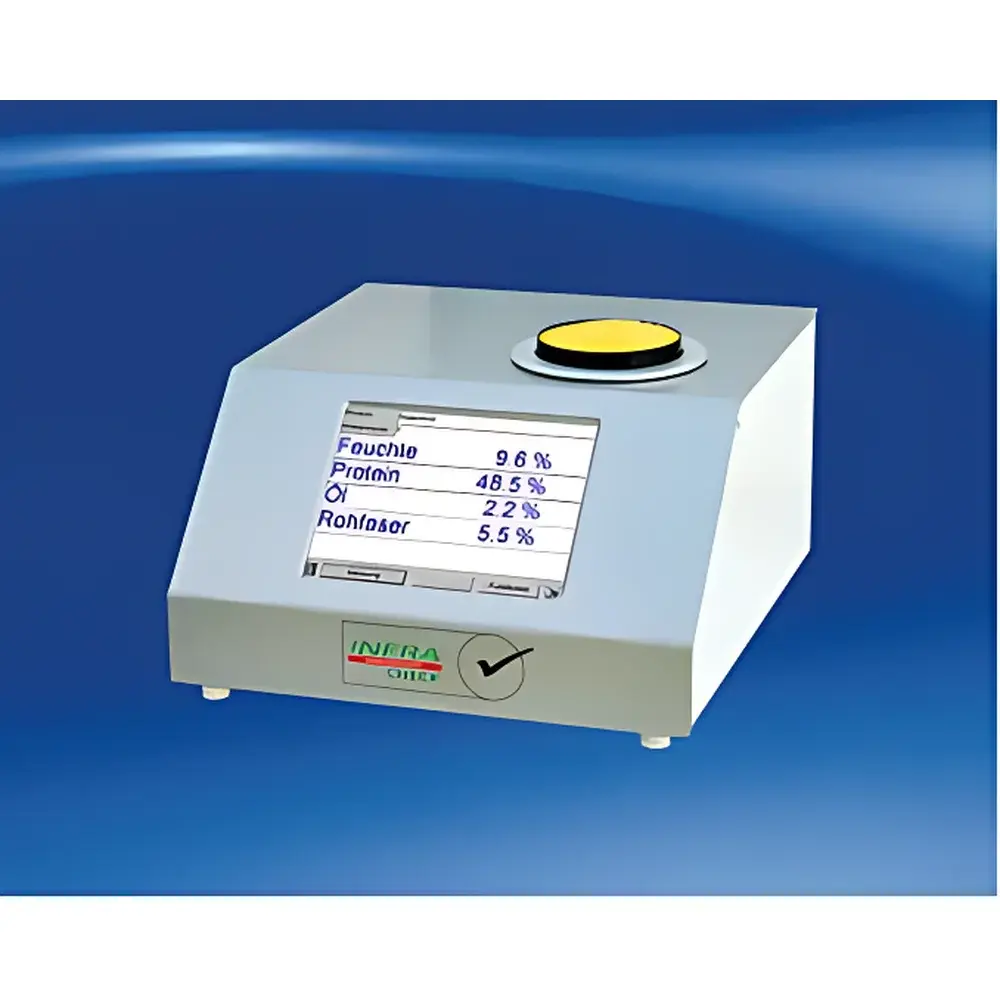
Bruins InfraCheck Near Infrared Spectrometer
| Brand | Bruins |
|---|---|
| Origin | Germany |
| Model | InfraCheck |
| Instrument Type | Laboratory NIR Spectrometer |
| Optical Principle | Grating-based, Non-scanning Array Detector |
| Wavelength Range | 730–1100 nm (primary) / 1400–2500 nm (extended, per spec sheet) |
| Wavelength Resolution | 0.5 nm |
| Sampling Interval | 1 s |
| Measurement Modes | Diffuse Reflectance & Transmission |
| Chemometrics Software | RIMP |
| Dimensions | 345 × 385 × 200 mm |
| Weight | 16 kg |
| Power Supply | 220–240 V / 50 Hz |
| Power Consumption | 30 W |
| Sample Volume | ~60 mL |
| Analysis Time | ~50 s |
| Sample Handling | Manual loading with rotating sample carousel |
| Interfaces | USB, Ethernet, Parallel Port |
| Environmental Protection | Dust- and moisture-resistant enclosure |
Overview
The Bruins InfraCheck Near Infrared Spectrometer is a compact, laboratory-grade, non-scanning array-based NIR instrument engineered for rapid, non-destructive quantitative analysis of heterogeneous solid and semi-solid materials. Operating on the principle of diffuse reflectance and transmission spectroscopy in the short-wave (730–1100 nm) and extended near-infrared (1400–2500 nm) regions, the InfraCheck leverages a patented dual-beam grating monochromator with linear array detection to deliver high photometric stability and spectral reproducibility. Its optical architecture eliminates mechanical scanning components—reducing maintenance requirements and enhancing long-term wavelength fidelity. Designed as the smallest footprint model within the Bruins AgriCheck XL series, the InfraCheck is optimized for routine quality control in feed mills, grain processing facilities, food R&D labs, and agricultural testing centers where space efficiency, operator independence, and method transferability are critical.
Key Features
- Patented dual-beam grating monochromator with linear array detector ensures high linearity, low stray light, and exceptional signal-to-noise ratio across the full spectral range.
- Integrated rotating sample carousel enables consistent presentation of powdered, granular, pasty, or liquid samples—minimizing operator-induced variability and supporting GLP-compliant measurement protocols.
- Robust dust- and moisture-resistant enclosure (IP54-equivalent design) ensures operational reliability in industrial laboratory environments without climate-controlled housing.
- Large-format color touchscreen interface running native Windows OS provides intuitive navigation, real-time spectral preview, and one-touch method execution—requiring no prior spectroscopy training.
- Standard Ethernet and USB connectivity support remote diagnostics, centralized data aggregation via LIMS integration, and over-the-air firmware updates without physical access to the instrument.
- RIMP chemometrics software includes prebuilt calibration transfer utilities, enabling seamless application database migration between InfraCheck, AgriCheck XL, and other Bruins NIR platforms—preserving method integrity during instrument replacement or fleet expansion.
Sample Compatibility & Compliance
The InfraCheck accommodates a broad spectrum of agricultural and food-related matrices—including milled cereals (wheat flour, corn meal), oilseed meals (soybean meal, sunflower meal), forage powders (alfalfa, beet pulp), confectionery intermediates (cocoa powder, chocolate mass), spices, tea leaves, and animal feed formulations. Sample presentation is standardized via 60 mL manual loading into the rotating carousel, ensuring repeatable optical path geometry for both diffuse reflectance and transmission measurements. All hardware and software components comply with IEC 61000-6-3 (EMC emissions) and IEC 61010-1 (safety for electrical equipment). The RIMP software supports audit trail generation, electronic signatures, and user-level access control—enabling alignment with FDA 21 CFR Part 11 requirements when deployed in regulated QA/QC workflows under GMP or ISO/IEC 17025 frameworks.
Software & Data Management
RIMP (Robust Intelligent Multivariate Platform) is Bruins’ proprietary chemometrics suite, delivering full lifecycle calibration management—from spectral preprocessing (SNV, MSC, derivatives) and outlier detection to PLS regression modeling, cross-validation, and performance monitoring. Calibration models are stored as encrypted, versioned objects with metadata logging (operator, date, reference method, standard deviation). Data export options include CSV, XML, and direct SQL insertion; all reports conform to ASTM E1655-22 (standard practices for NIR quantitative analysis). Network-enabled instruments synchronize calibration updates and spectral libraries automatically across local area networks, eliminating manual file transfer and version drift. Optional LIMS connectors support HL7 and ASTM E1384 message formatting for bidirectional sample tracking and result posting.
Applications
The InfraCheck is routinely deployed for rapid quantification of moisture, crude protein, total fat/oil, starch, crude fiber, ash, wet gluten, sedimentation value (Zeleny), amylose content, and free fatty acid levels in raw and processed agricultural commodities. Method development services include collaborative calibration using customer-supplied reference analytics (e.g., AOAC 992.15 for protein, AOCS Am 5-04 for oil) and validation against ISO 12099:2017 (animal feeding stuffs) or ISO 21542:2020 (cereal grains). Applications extend to incoming raw material verification, in-process blend uniformity assessment, and finished product release testing—supporting throughput of >100 samples per shift with <2% RSD inter-day precision.
FAQ
Does the InfraCheck require annual recalibration by the manufacturer?
No. Bruins provides a 12-month complimentary calibration support package—including remote model refinement using customer-collected spectra and certified reference data—upon initial installation.
Can RIMP models developed on other Bruins NIR systems be loaded directly onto the InfraCheck?
Yes. All Bruins instruments share a common spectral format and calibration object structure; models built on AgriCheck XL or LabCheck systems are fully interoperable without conversion.
Is the 730–1100 nm range sufficient for protein and moisture analysis in cereal grains?
Yes. This SW-NIR region contains strong first-overtone C–H, N–H, and O–H absorption bands; combined with advanced preprocessing in RIMP, it delivers performance comparable to full-range (1400–2500 nm) instruments for major macronutrients in milled matrices.
What sample preparation is required prior to analysis?
Minimal preparation: samples must be homogenized and dried to ambient moisture equilibrium; no grinding beyond standard milling is necessary for most feed and flour applications.
Does the InfraCheck support 21 CFR Part 11 compliance out-of-the-box?
RIMP includes configurable audit trail, role-based permissions, and electronic signature modules; full Part 11 compliance requires site-specific validation documentation and network policy alignment, which Bruins supports via IQ/OQ documentation packages.





