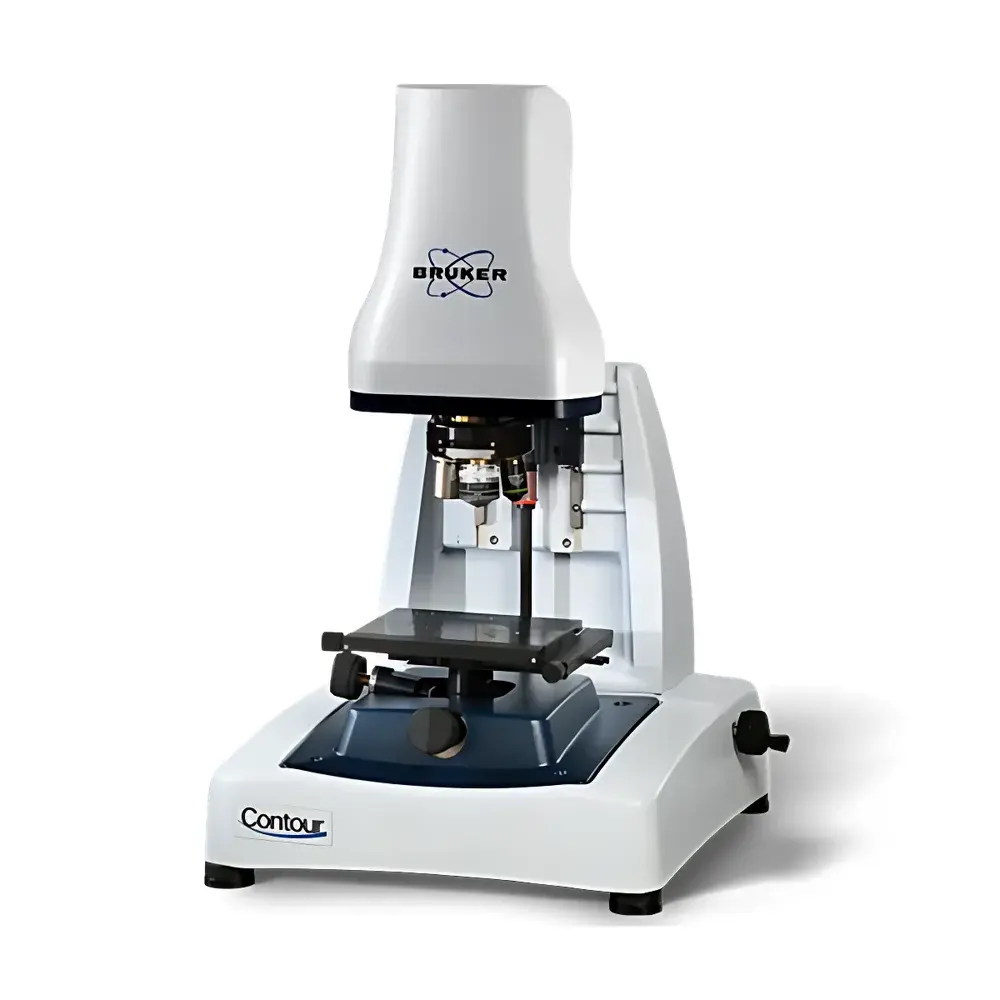
Bruker ContourX-100 White Light Interferometric 3D Optical Profilometer
| Brand | Bruker |
|---|---|
| Origin | USA |
| Model | ContourX-100 |
| Product Type | Non-contact Profilometer / Surface Roughness Analyzer |
| Operating Principle | White Light Interferometry (WLI) |
| Camera Resolution | 5 MP |
| Compliance Standards | ISO 25178, ASME B46.1, ISO 4287 |
| Interface | VisionXpress™ and Vision64® software platforms |
| Vibration Isolation | Integrated passive damping architecture |
| Z-axis Resolution | Sub-nanometer (independent of magnification) |
| Field of View | Maximum standard FOV among benchtop WLI systems |
| Surface Reflectivity Range | 0.05% to 100% |
Overview
The Bruker ContourX-100 is a benchtop white light interferometric (WLI) 3D optical profilometer engineered for high-precision, non-contact surface topography measurement. Leveraging Bruker’s four-decade heritage in proprietary WLI technology, the system delivers traceable, repeatable, and magnification-independent Z-axis resolution—enabling quantitative characterization of surface roughness, step heights, form errors, thin-film thickness, and micro-structural features across diverse material classes. Unlike confocal or focus-variation instruments, WLI operates on the principle of spatial coherence modulation: broadband illumination generates localized interference fringes at the point of best focus, allowing pixel-level height reconstruction with sub-nanometer vertical resolution. This physics-based approach ensures metrological integrity without reliance on empirical calibration curves or edge-detection algorithms. The ContourX-100 is purpose-built for environments demanding compliance with international surface metrology standards—including ISO 25178 (areal surface texture), ISO 4287 (profile-based roughness), and ASME B46.1—making it suitable for R&D laboratories, quality control labs, and production-integrated metrology cells operating under GLP, GMP, or ISO/IEC 17025 frameworks.
Key Features
- Sub-nanometer Z-axis resolution, maintained consistently across all objective magnifications (no scaling artifacts)
- Integrated 5-megapixel scientific-grade camera for enhanced lateral sampling density and improved signal-to-noise ratio in low-reflectivity measurements
- Motorized precision XYZ stage with programmable positioning repeatability < ±0.5 µm
- Passive vibration isolation platform embedded within the instrument chassis, eliminating need for external optical tables in typical lab environments
- Multi-modal acquisition engine supporting both full-field WLI and high-speed 2D intensity imaging in a single workflow
- Automated objective turret with up to five parfocal objectives (ranging from 2.5× to 100×), enabling seamless transition between large-area survey scans and high-magnification defect analysis
- Real-time fringe contrast optimization and dynamic focus tracking for robust measurement on surfaces with extreme reflectivity variation (0.05%–100%)
Sample Compatibility & Compliance
The ContourX-100 accommodates a broad spectrum of sample geometries and optical properties without requiring conductive coating or vacuum environments. It measures polished metals, silicon wafers, optical coatings, MEMS devices, biomedical implants, polymer films, and matte-ceramic substrates with equal fidelity. Its wide dynamic range supports step heights from 1 mm and lateral dimensions up to 200 mm × 200 mm (with optional motorized stage extension). All surface texture parameters—including Sa, Sq, Sz, Sdr, and functional indices such as Sk, Spk, and Svk—are computed per ISO 25178-2 and reported in audit-ready formats compliant with FDA 21 CFR Part 11 requirements when paired with Vision64®’s electronic signature and audit trail modules. System validation documentation—including IQ/OQ protocols and uncertainty budgets aligned with EURAMET cg-19 guidelines—is available upon request.
Software & Data Management
ContourX-100 is operated via Bruker’s dual-software ecosystem: VisionXpress™ for rapid pass/fail inspection and Vision64® for advanced research-grade analysis. VisionXpress™ provides guided workflows, one-click ISO-compliant reporting, and customizable pass/fail thresholds for shop-floor deployment. Vision64® offers over 1,000 configurable analysis functions—including power spectral density (PSD), bearing ratio curve (Abbott-Firestone), motif analysis, grain segmentation, and custom scripting via Python API. Raw interferogram data, reconstructed height maps (in .sur, .xyz, and .tif formats), and metadata are stored in a structured project database with version control, user access logging, and export capabilities compatible with LIMS and MES integration. Both platforms support automated report generation in PDF, Excel, and HTML, with embedded traceability to instrument configuration, environmental conditions, and operator ID.
Applications
- Quantitative evaluation of CMP process uniformity and dishing/erosion in semiconductor wafer manufacturing
- Characterization of anti-reflective, hydrophobic, and biocompatible thin-film coatings on medical devices
- Form and waviness analysis of precision-machined optics and aerospace components
- Wear scar depth and volume quantification in tribological testing per ASTM G133
- Defect identification and dimensional verification of microfluidic channel structures and microlens arrays
- Surface texture correlation with adhesion, friction, and sealing performance in automotive gasket development
- Validation of additive manufacturing surface finish against design intent per ISO/ASTM 52900
FAQ
Does the ContourX-100 require external vibration isolation?
No—the system incorporates a fully integrated passive damping base designed to suppress floor-borne vibrations typical of standard laboratory environments. External optical tables are unnecessary unless operating in high-acceleration industrial settings.
Can it measure transparent or semi-transparent thin films?
Yes—by leveraging phase-shifting WLI and multi-wavelength analysis modes, the ContourX-100 resolves film thickness and interface topography simultaneously for single- and multi-layer dielectric stacks up to ~10 µm thick.
Is the software compliant with FDA 21 CFR Part 11?
Vision64® supports 21 CFR Part 11 compliance when configured with electronic signatures, audit trails, role-based access control, and secure data archiving—subject to site-specific validation protocols.
What surface reflectivity ranges are supported without adjustment?
The system automatically adapts exposure and gain across the full 0.05%–100% reflectivity range, including black anodized aluminum, bare silicon, gold mirrors, and diffusely scattering polymers—no manual parameter tuning required.
How is measurement traceability ensured?
Bruker provides NIST-traceable step-height reference standards (e.g., SiO₂-on-Si wafers) and documented uncertainty budgets per ISO/IEC 17025. Optional on-site calibration services include interferometric verification of Z-scale linearity and repeatability.