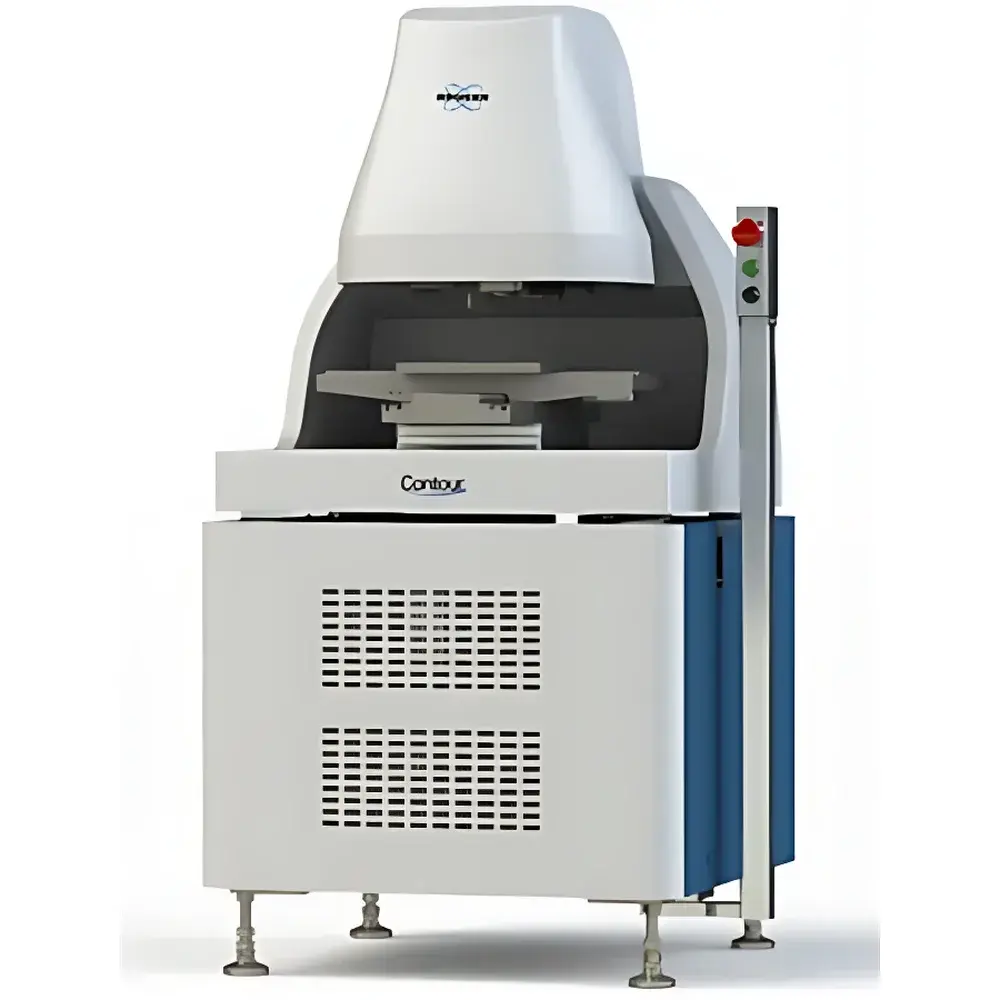
Bruker ContourX-1000 White Light Interferometric Profilometer
| Brand | Bruker |
|---|---|
| Origin | USA |
| Model | ContourX-1000 |
| Type | Non-contact 3D Optical Profilometer / Surface Roughness Analyzer |
| Principle | White Light Interferometry (WLI) |
| Optical Head | Motorized Tilt & Pitch Adjustment |
| Illumination | Dual-source (broadband white light) |
| Automation | Auto-focus, Auto-surface detection (Advanced Find Surface™), Adaptive USI mode |
| Calibration | Integrated self-calibrating laser reference |
| Vibration Isolation | Built-in active/passive vibration isolation platform |
| Software | VisionXpress™ with guided workflows and ISO-compliant analysis modules |
| Compliance | Fully supports ISO 25178 (areal surface texture), ISO 4287/4288 (profile roughness), ASTM E2926, and GLP/GMP data integrity requirements |
Overview
The Bruker ContourX-1000 is a floor-standing, non-contact 3D optical profilometer engineered for high-precision areal surface topography and roughness characterization using white light interferometry (WLI). Unlike contact stylus profilers or confocal microscopes, the ContourX-1000 leverages coherence-controlled interference fringes generated by broadband white light reflected from both the sample surface and a reference mirror. This principle enables sub-nanometer vertical resolution (10 mm²—without mechanical scanning or tip wear. Designed for integration into production metrology labs, R&D cleanrooms, and quality control environments, the system delivers traceable, ISO 25178-compliant surface texture parameters—including Sa, Sq, Sz, Sdr, and functional indices such as Spk, Sk, and Svk—across diverse materials including silicon wafers, medical implants, precision optics, MEMS devices, and coated automotive components.
Key Features
- Motorized tilt-and-pitch optical head enabling rapid, distortion-free measurement of angled or curved surfaces without repositioning the sample.
- Dual-source white light illumination system optimized for high signal-to-noise ratio across low-reflectivity (e.g., black anodized aluminum) and high-reflectivity (e.g., polished stainless steel) surfaces.
- Advanced Find Surface™ technology—an AI-assisted auto-surface detection algorithm that eliminates manual Z-height search prior to acquisition, reducing setup time by up to 70% in multi-sample workflows.
- Unified Sampling Imaging (USI) mode dynamically adjusts lateral sampling density based on local surface gradient, ensuring optimal resolution without oversampling flat regions or undersampling steep features.
- Integrated self-calibrating HeNe laser reference and thermally stabilized interferometric cavity maintain long-term measurement stability under ambient lab conditions (20–25 °C, ±1 °C/h drift).
- Built-in hybrid vibration isolation platform combining passive elastomeric damping and active inertial cancellation, certified to meet SEMI S2/S8 specifications for semiconductor metrology floors.
Sample Compatibility & Compliance
The ContourX-1000 accommodates samples up to 300 mm × 300 mm × 150 mm (L×W×H) on its motorized XYZ stage with 100 mm travel range and 50 nm closed-loop positioning resolution. It measures surfaces with reflectivity from 0.5% to 100%, including transparent thin films (via phase-shifting WLI), structured ceramics, electroplated metals, and polymer-molded parts. All surface texture calculations comply with ISO 25178-2:2012 (areal parameters), ISO 4287:2015 (profile-based roughness), and ASTM E2926-22 (standard guide for 3D surface characterization). Data audit trails, electronic signatures, and user-access controls align with FDA 21 CFR Part 11 and EU Annex 11 requirements for regulated industries.
Software & Data Management
VisionXpress™ software provides a role-based, wizard-driven interface with preconfigured measurement templates for common applications—e.g., “Wafer Edge Profile,” “Implant Surface Finish,” or “Coating Uniformity Map.” Raw interferograms and reconstructed height maps are stored in vendor-neutral .tif and .xyz formats; analysis reports export to PDF, CSV, or XML with embedded metadata (timestamp, operator ID, instrument serial, calibration certificate ID). The software includes built-in statistical process control (SPC) dashboards, batch comparison tools, and automated pass/fail flagging against user-defined GD&T tolerances. Full audit trail logging—including parameter changes, report revisions, and login/logout events—is retained for ≥10 years per GLP/GMP archival policies.
Applications
- Semiconductor manufacturing: Quantifying CMP uniformity, trench depth, and via profile geometry on 200 mm and 300 mm wafers.
- Medical device QA: Validating surface finish of orthopedic implants per ISO 14644-1 and ASTM F2792 for bone-interfacing topographies.
- Optics & photonics: Measuring form error and mid-spatial-frequency errors on aspheric lenses and diffractive optical elements.
- Automotive powertrain: Assessing honing patterns, bearing raceway textures, and thermal barrier coating porosity distribution.
- Academic research: Correlating 3D surface metrics (e.g., Sdq, Ssc) with tribological performance in boundary lubrication studies.
FAQ
What vertical resolution can the ContourX-1000 achieve under standard operating conditions?
Vertical resolution is specified at <0.1 nm RMS noise (1σ) over a 1 Hz bandwidth, validated using NIST-traceable step-height standards.
Does the system support automated measurement of multiple sites on a single wafer or PCB?
Yes—via programmable stage navigation with fiducial-based alignment and recipe-driven batch acquisition across up to 999 locations.
Is VisionXpress™ compliant with 21 CFR Part 11 for electronic records and signatures?
Yes—full implementation includes role-based access control, biometric or PKI-based e-signatures, immutable audit logs, and electronic record retention protocols.
Can the ContourX-1000 measure transparent or semi-transparent thin films?
Yes—using phase-shifting WLI mode with adjustable coherence length, it resolves film thickness and substrate topography simultaneously for layers ≥50 nm thick.
What maintenance is required to sustain measurement accuracy over time?
Annual calibration using Bruker-certified artifacts is recommended; no routine optical alignment or lamp replacement is needed due to solid-state illumination and self-calibrating laser reference.