
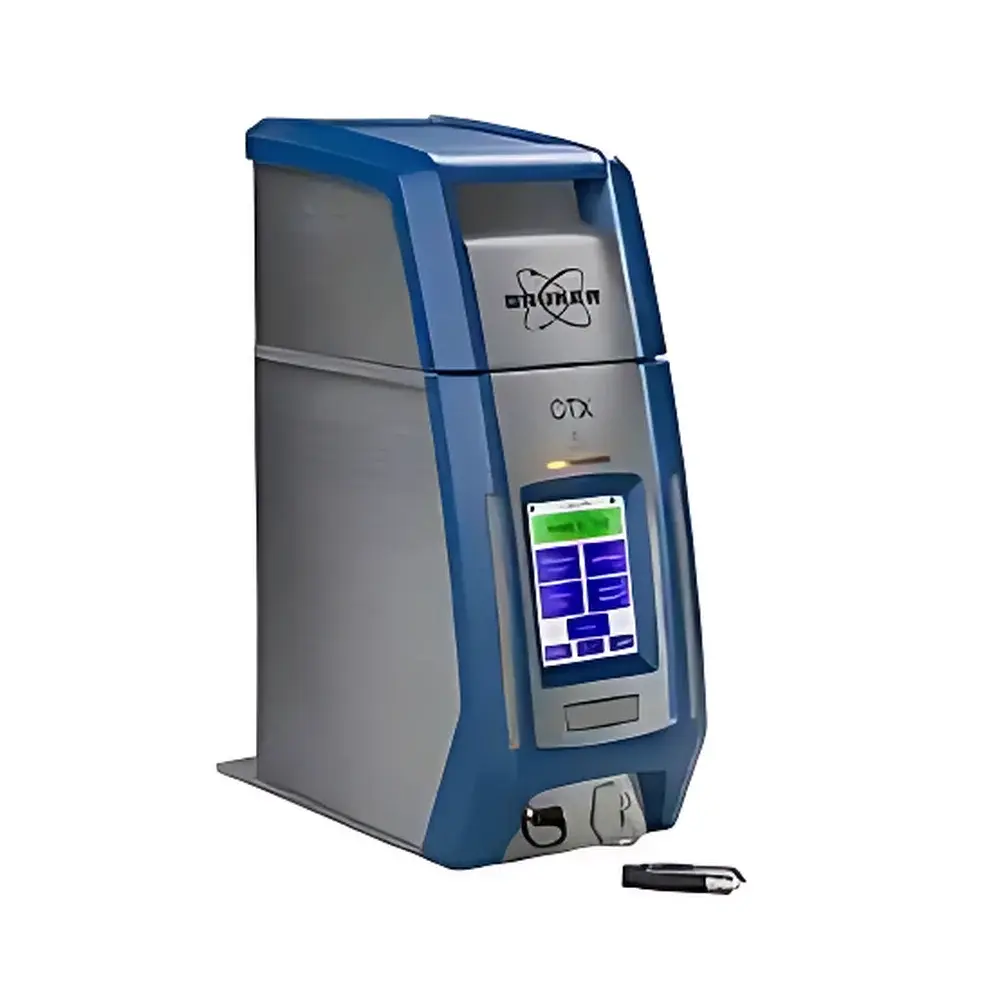
Bruker CTX Portable Benchtop Energy Dispersive X-Ray Fluorescence Spectrometer
| Brand | Bruker |
|---|---|
| Origin | Germany |
| Model | CTX |
| Form Factor | Portable Benchtop |
| Elemental Range | Mg–U (standard), Ti–U (optimized), Cl–U (liquid/powder mode) |
| Energy Resolution | 145 eV (at Mn Kα) |
| Detector | Silicon Drift Detector (SDD) |
| Operating Temperature | –10 °C to +40 °C |
| Safety Features | Dual Interlock System, Visual Status Indicators (Amber/Red LEDs), Sample Presence Sensor, Password Protection, Pre-Start Radiation Alert |
| Power Options | Rechargeable Li-ion battery or 110/220 VAC adapter |
| Compliance | Designed for IEC 61010-1, IEC 62471, and aligned with ALARA principles for radiation safety |
Overview
The Bruker CTX is a self-contained, portable benchtop Energy Dispersive X-Ray Fluorescence (ED-XRF) spectrometer engineered for high-fidelity elemental analysis outside the conventional laboratory environment. Unlike handheld XRF devices, the CTX integrates a shielded sample chamber, motorized collimation optics, and an integrated SDD detector within a compact, ergonomic benchtop architecture. Its measurement principle relies on primary X-ray excitation of sample atoms, followed by detection of characteristic secondary (fluorescent) X-rays emitted during electron relaxation. The energy-dispersive detection system resolves photon energies with 145 eV resolution at Mn Kα, enabling reliable discrimination of adjacent elements across the Mg–U range — including light elements (Mg, Al, Si, P, S, Cl) under optimized vacuum or helium purge conditions. Designed for operational flexibility, the CTX supports both rapid screening and longer dwell-time quantitative analysis, making it suitable for applications where sample preparation, containment, or regulatory compliance preclude open-beam configurations.
Key Features
- Shielded benchtop configuration with dual mechanical interlocks ensuring automatic beam termination upon chamber access
- Integrated SDD detector with high count-rate capability and thermal stabilization for consistent spectral fidelity
- SharpBeam™ collimation geometry optimizing signal-to-background ratio at reduced tube power (up to 50 kV, 1 mA)
- Automated voltage and current control dynamically adjusting excitation parameters per element group and matrix
- TITAN Detector Shield protecting the SDD from particulate contamination and physical impact
- Sealed sample tray with chemical-resistant gasketing to prevent spills from compromising internal optics or electronics
- Backlit, wide-angle LCD display with intuitive icon-based interface accessible from multiple viewing angles
- Visual status feedback via amber LED (“X-ray Ready”) and red LED (“X-ray On”) compliant with ISO 20816-1 radiation signage conventions
- Pre-boot radiation safety check and password-protected system access meeting GLP audit requirements
Sample Compatibility & Compliance
The CTX accommodates solid, powdered, and liquid samples in standard containers — including polypropylene cups, Mylar-backed pouches, and custom-fit sample holders. Its sealed chamber design eliminates operator exposure concerns associated with open-beam handheld systems, satisfying institutional policies restricting unshielded X-ray sources. The instrument conforms to IEC 61010-1 (safety of electrical equipment for measurement) and IEC 62471 (photobiological safety), and its operation follows ALARA (As Low As Reasonably Achievable) radiation management protocols. While not certified for FDA 21 CFR Part 11 out-of-the-box, its firmware supports time-stamped, user-logged measurement records compatible with validated data integrity workflows required under ISO/IEC 17025 and ASTM E1996–23.
Software & Data Management
The CTX runs Bruker’s proprietary S1 PXRF software suite, featuring factory-calibrated application modules for food safety (e.g., Fe/Ca in dairy), environmental monitoring (Pb/Cd/As in soil), mining geochemistry (Cu/Zn/Mo/U), fuel sulfur analysis per MARPOL Annex VI, and precious metal assay (Au/Ag/Pt/Pd fineness). All calibrations are traceable to NIST SRM reference materials and include uncertainty estimation per ISO 11843-7. Data export supports CSV, PDF, and XML formats; metadata includes acquisition parameters, operator ID, timestamp, ambient temperature/humidity, and spectral diagnostics. Optional Bluetooth connectivity enables direct printing to certified portable thermal printers without intermediate PC dependency.
Applications
- Food & Agriculture: Quantitative analysis of macro- and micronutrients (Ca, Fe, Zn, Se) and contaminants (Pb, Cd, As, Hg) in raw commodities, processed foods, and animal feed — supporting HACCP and QACC frameworks
- Environmental Science: Field-deployable assessment of soil remediation efficacy, sediment toxicity profiling, and irrigation water quality screening
- Geoscience & Mining: Real-time geochemical logging of drill cores, cuttings, and bulk ore samples; multi-element mapping for pathfinder element identification
- Materials Verification: Positive material identification (PMI) of stainless steels, Ni-alloys, and high-temperature superalloys; counterfeit detection in aerospace and energy infrastructure components
- Regulatory Enforcement: Border inspection for conflict minerals (Ta, Nb, Sn, W), restricted substances (Cd, Pb, Cr⁶⁺) in consumer goods, and sulfur content verification in marine fuels
- Recycling & Refining: Rapid grade sorting of catalytic converters, electronic scrap, and jewelry alloys; karat determination and impurity quantification in bullion
FAQ
Does the CTX require external vacuum or helium purging for light element analysis?
Yes — Mg, Al, Si, P, S, and Cl quantification requires either helium flush or vacuum operation to minimize air absorption of low-energy fluorescence lines.
Can the CTX be used for regulatory reporting under EPA Method 6200 or ISO 12847?
It supports method-adapted calibrations and documented uncertainty budgets; however, formal method validation must be performed by the end user per their QA/QC program.
Is remote firmware update supported?
Firmware updates are delivered via encrypted USB drive with SHA-256 checksum verification; network connectivity is intentionally omitted to preserve data sovereignty and cybersecurity compliance.
What is the typical measurement repeatability for homogeneous solids?
Under controlled conditions (n ≥ 5, same position, fixed geometry), relative standard deviation (RSD) is typically ≤ 2% for major elements (>1 wt%) and ≤ 5% for trace elements (10–100 ppm) — consistent with ISO 11843-7 detection limit definitions.
How is detector longevity ensured in field environments?
The TITAN Detector Shield provides mechanical and particulate protection; combined with active temperature regulation and pulse processing algorithms, it extends SDD service life beyond 5 years under routine use.




