
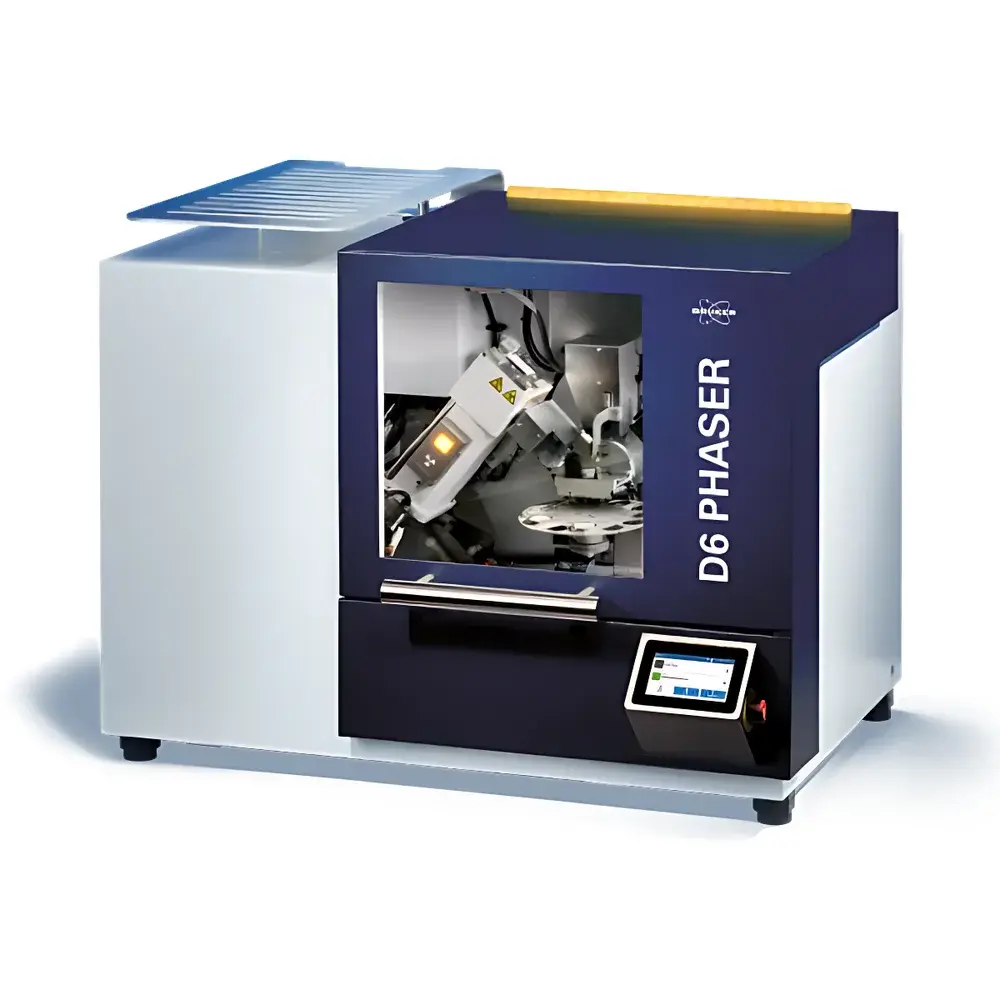
Bruker D6 PHASER Benchtop X-ray Diffractometer
| Brand | Bruker |
|---|---|
| Origin | USA |
| Instrument Type | Single-Crystal X-ray Diffractometer |
| Configuration | Benchtop |
| Design Principle | Bragg’s Law-based θ–2θ scanning with Cu Kα radiation (λ = 1.5418 Å) |
| Detector | LynxEye XE high-speed energy-dispersive detector |
| Sample Stage | Motorized goniometer with ±60° 2θ range |
| Data Acquisition Mode | Step-scanning and continuous scanning |
| Compliance | CE, UL 61010-1, IEC 61326-1 |
Overview
The Bruker D6 PHASER is a compact, benchtop single-crystal X-ray diffractometer engineered for high-fidelity structural characterization in academic, industrial, and quality control laboratories. Operating on Bragg’s law (nλ = 2d sinθ), the system utilizes a sealed-tube Cu anode X-ray source (λ = 1.5418 Å) and a LynxEye XE energy-dispersive linear detector to deliver rapid, high-resolution diffraction data without the need for monochromators or moving slits. Unlike conventional powder diffractometers, the D6 PHASER supports both single-crystal and microcrystalline sample geometries through its modular goniometer architecture—enabling precise orientation-dependent measurements critical for crystallographic phase identification, lattice parameter refinement, and strain analysis. Its rigid optical bench, thermally stabilized X-ray tube housing, and vibration-damped base ensure measurement reproducibility across extended acquisition periods, meeting the stability requirements of ISO 17873 and ASTM E975 for XRD-based phase quantification.
Key Features
- Modular benchtop platform designed for laboratory space efficiency without compromising analytical capability
- Motorized θ–2θ goniometer with ±60° 2θ scan range and sub-arcminute angular resolution
- LynxEye XE detector: 256-channel energy-dispersive silicon strip sensor enabling simultaneous multi-angle detection and real-time background subtraction
- Integrated sample stage with XYZ translation and tilt adjustment for precise crystal alignment
- Pre-aligned optical path with fixed divergence and receiving slits—eliminating routine recalibration
- Robust mechanical architecture compliant with IEC 61326-1 for electromagnetic compatibility in shared lab environments
Sample Compatibility & Compliance
The D6 PHASER accommodates single crystals (0.05–2 mm dimensions), oriented thin films, and microcrystalline powders mounted on standard glass slides or metal holders. Optional accessories include a cryostream interface (80–500 K), humidity-controlled sample chamber, and fiber-texture stage for preferred-orientation studies. All hardware and firmware conform to CE marking requirements under Directive 2014/30/EU (EMC) and 2014/35/EU (LVD). Data acquisition and processing workflows support audit trails and electronic signatures per FDA 21 CFR Part 11 when deployed with Bruker’s TOPAS or DIFFRAC.SUITE software in regulated environments. The system meets GLP documentation standards for raw data archiving, including metadata stamping (date/time, operator ID, instrument serial number, calibration status).
Software & Data Management
Controlled via Bruker’s DIFFRAC.SUITE platform, the D6 PHASER integrates with EVA for phase identification (ICDD PDF-4+ database), TOPAS for Rietveld refinement, and DIFFRAC.EVA for quantitative phase analysis. All software modules support automated batch processing, report generation in PDF/XLS formats, and direct export to LIMS via ODBC. Raw .raw files contain embedded calibration parameters, detector response curves, and environmental sensor logs (temperature, humidity), ensuring traceability. Data integrity safeguards include write-once archive mode, SHA-256 checksum validation, and version-controlled method templates compliant with ISO/IEC 17025 Clause 7.7.
Applications
- Determination of unit cell parameters and space group symmetry for novel crystalline compounds
- Quantitative phase analysis of pharmaceutical polymorphs (e.g., distinguishing Form I vs. Form II of active pharmaceutical ingredients)
- Residual stress mapping in metallurgical components using sin²ψ methodology
- Thin-film texture analysis in semiconductor and photovoltaic R&D
- In-situ thermal expansion coefficient derivation via variable-temperature XRD
- Teaching crystallography principles in undergraduate materials science curricula
FAQ
Is the D6 PHASER suitable for routine QC analysis in GMP environments?
Yes—when configured with DIFFRAC.SUITE’s 21 CFR Part 11-compliant modules, it supports electronic records, role-based access control, and audit trail generation required for pharmaceutical and medical device manufacturing.
Can the system perform Rietveld refinement out-of-the-box?
Rietveld analysis requires TOPAS software, which is available as an optional licensed module; the base system includes EVA for qualitative and semi-quantitative phase matching.
What is the minimum crystal size resolvable for single-crystal structure solution?
While optimized for microcrystals ≥100 µm, successful structure solution depends on crystal quality, absorption, and symmetry—not solely dimension; typical success threshold is ~0.1 × 0.1 × 0.1 mm with low mosaicity.
Does the D6 PHASER require external water cooling or high-power electrical supply?
No—it operates on standard 100–240 V AC, 50/60 Hz with internal air cooling; no chilled water or dedicated circuit is needed.
How is calibration maintained over time?
The system employs a built-in Si reference standard for automatic angular calibration prior to each run; long-term drift is monitored via quarterly NIST-traceable verification protocols.





