
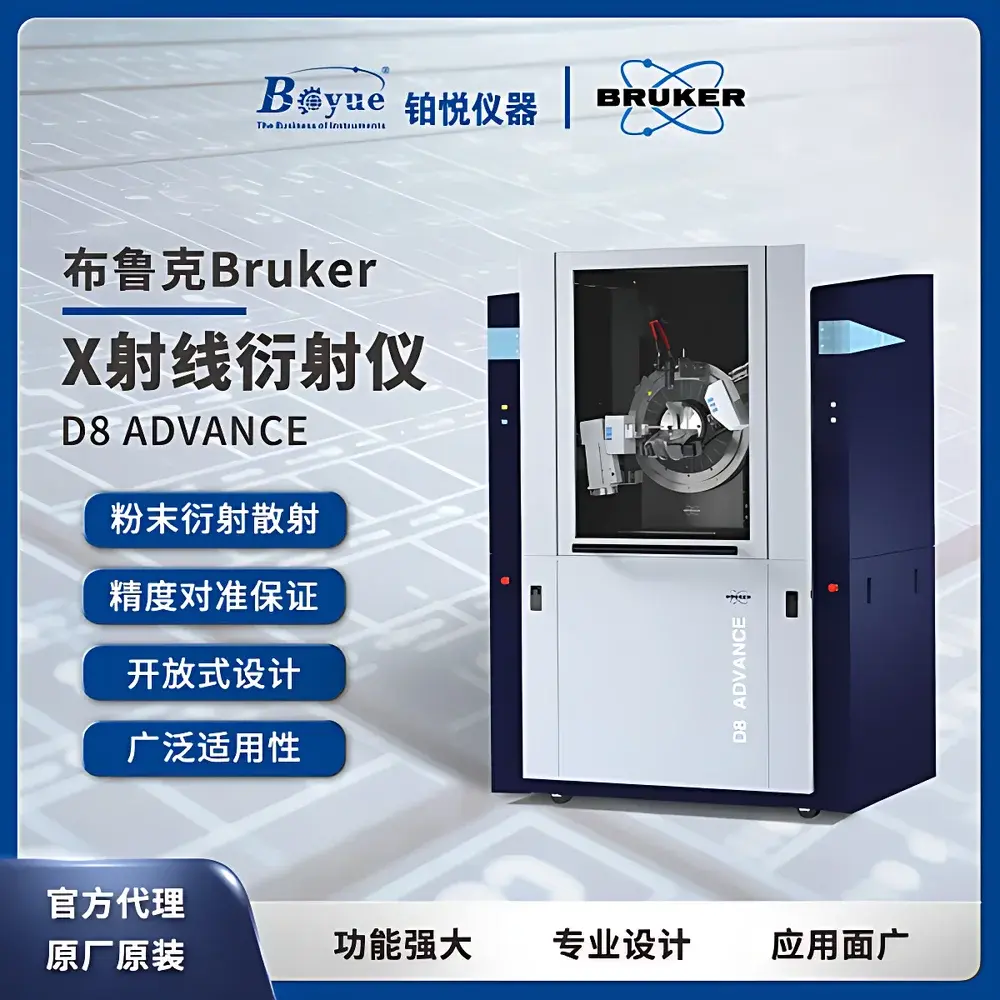
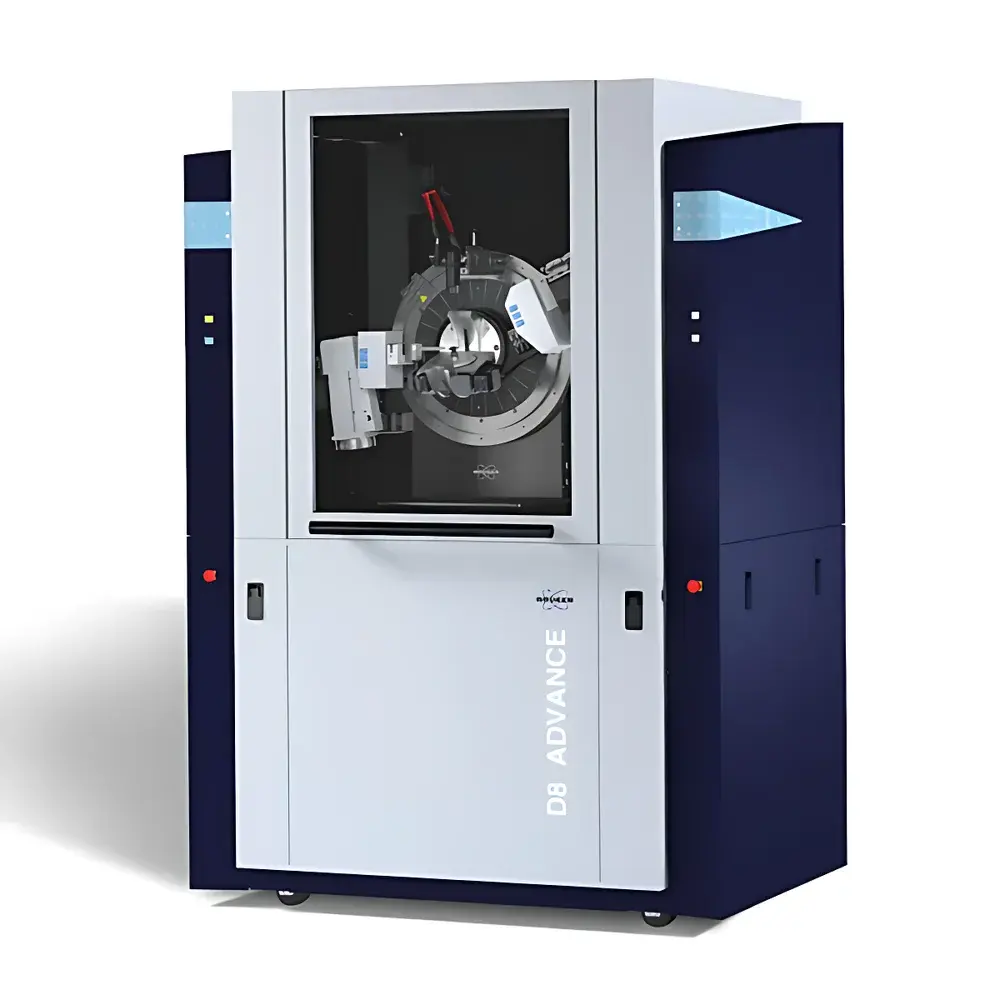
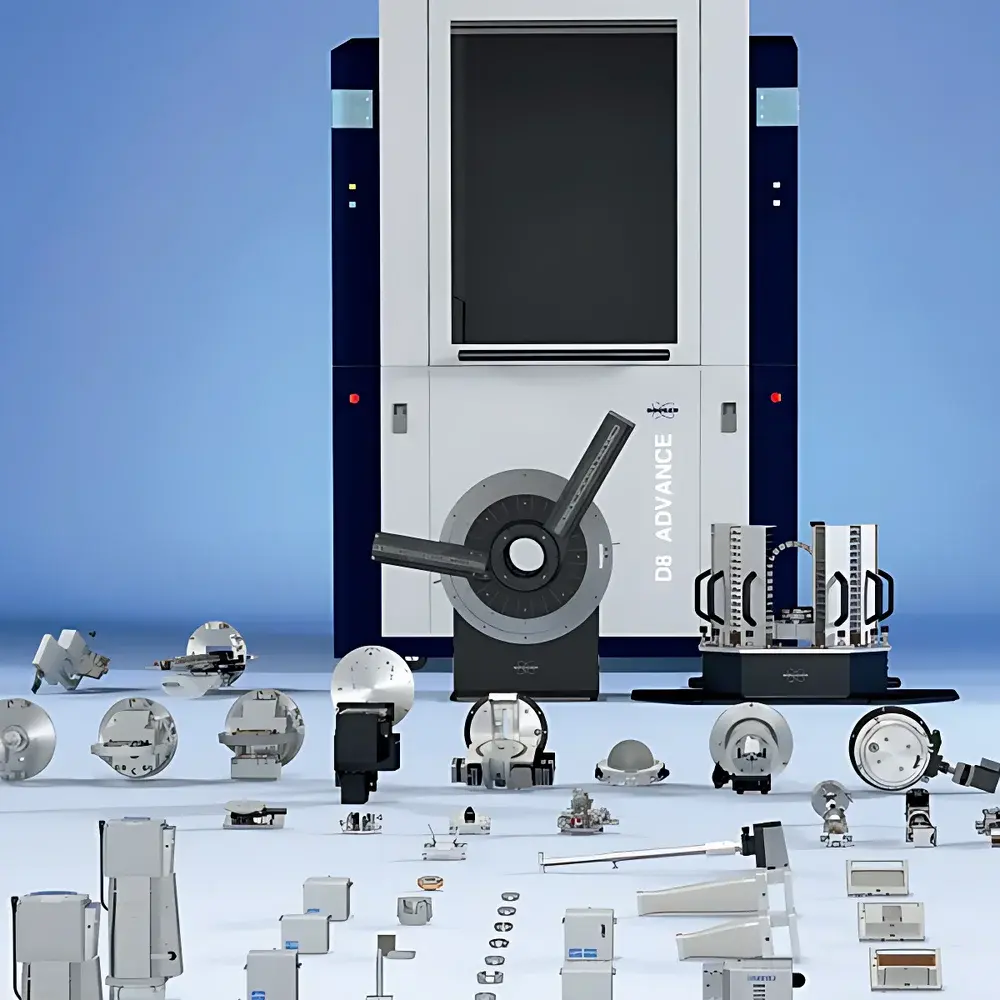
Bruker D8 ADVANCE X-ray Diffractometer
| Brand | Bruker |
|---|---|
| Origin | Germany |
| Model | D8 ADVANCE |
| Instrument Type | High-Resolution X-ray Diffractometer |
| Configuration | Floor-Standing |
| Power Options | 1 kW (ECO) or 3 kW |
| Angular Accuracy | ±0.01° (2θ) |
| Angular Resolution | 0.01° (2θ) |
Overview
The Bruker D8 ADVANCE is a high-performance, floor-standing X-ray diffractometer engineered for precision powder diffraction (XRPD), total scattering (PDF), thin-film analysis, and small-angle/wide-angle X-ray scattering (SAXS/WAXS). Built upon Bruker’s proven D8 platform, it employs Bragg-Brentano parafocusing geometry with advanced beam optics and real-time geometric calibration to deliver exceptional data fidelity across the full 2θ range (typically −5° to 160°). Its core measurement principle relies on monochromatic X-ray irradiation (Cr, Cu, Co, Fe, or Ag Kα radiation) interacting with crystalline or partially ordered materials to generate constructive interference patterns governed by Bragg’s law (nλ = 2d sinθ). The system integrates hardware-level angular alignment guarantees—certified over the entire scan range—ensuring traceable instrument performance compliant with ISO 17873 and ASTM E975 for residual stress and phase analysis.
Key Features
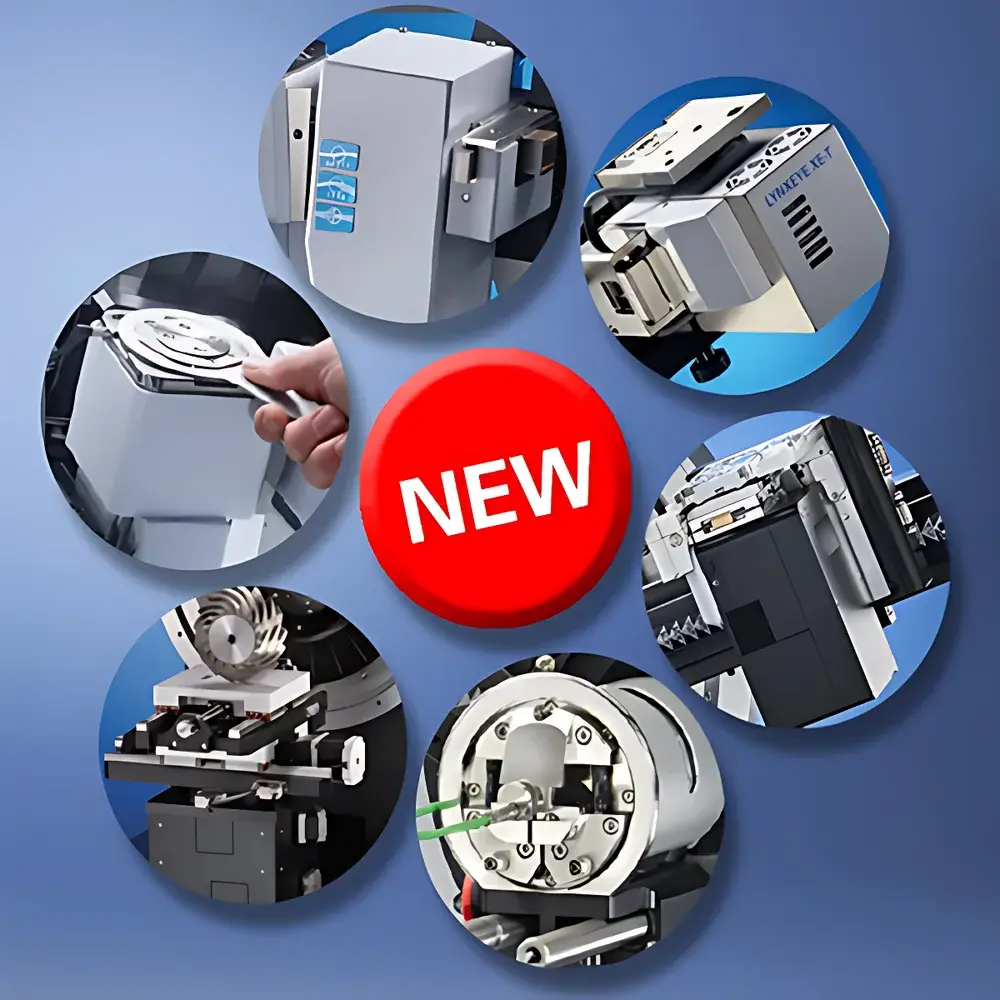
- DAVINCI modular design: Tool-free, alignment-free component exchange enabled by embedded ID chips and real-time optical validation; eliminates manual collimation and reduces setup errors.
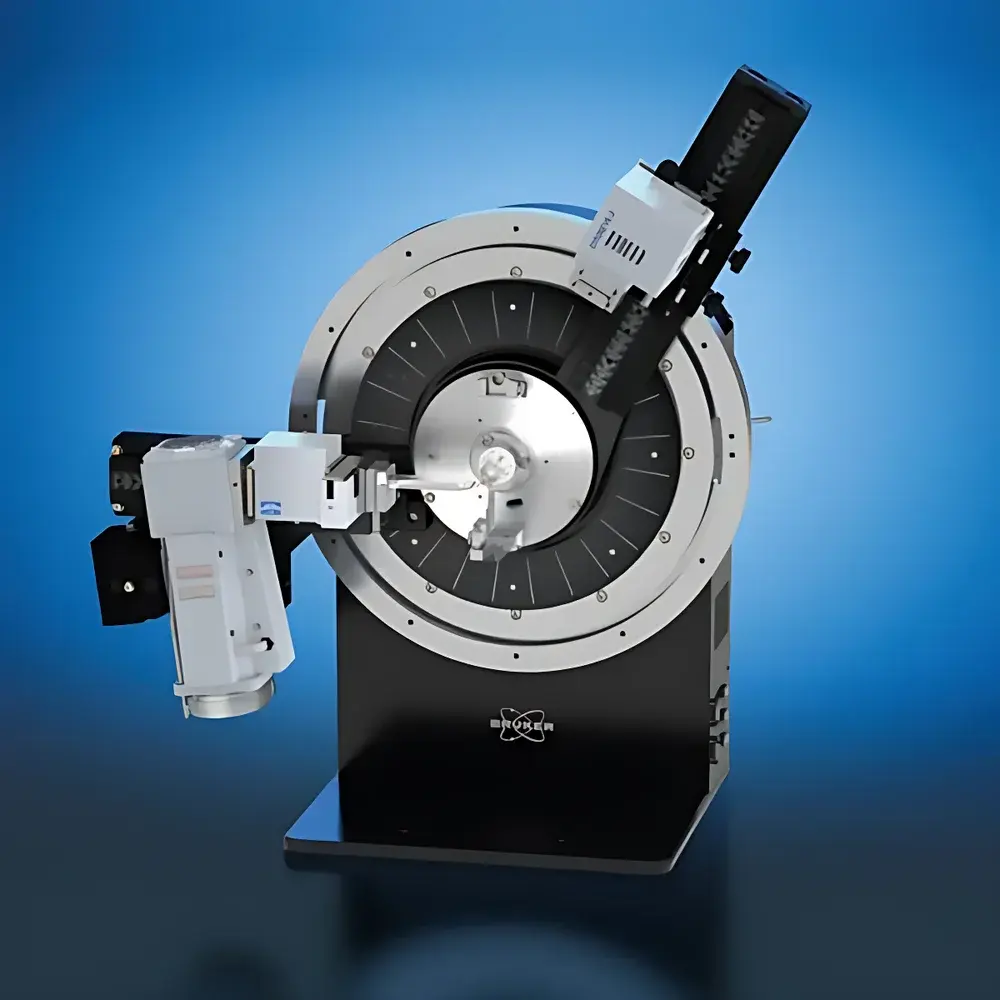
- TWIN/TWIN and TRIO beam-path architecture: Automatic switching among up to six beam geometries—including Bragg-Brentano, parallel-beam, grazing-incidence (GID), and X-ray reflectivity (XRR)—without user intervention or mechanical reconfiguration.
- Dynamic Beam Optimization (DBO): Motorized divergence slits, anti-scatter plates, and variable detector windows synchronize in real time based on sample dimensions; maximizes intensity and resolution—especially at low 2θ angles (<10°).
- LYNXEYE XE-T energy-dispersive detector: Simultaneous 0D/1D/2D acquisition across all common anode materials (Cr–Ag); ≤380 eV energy resolution enables 100% Fe Kβ fluorescence suppression without physical filters or secondary monochromators—preserving signal integrity and eliminating absorption-edge artifacts.
- EIGER2 R hybrid photon-counting detector option: Integrated with vacuum transfer line and panoramic Söller collimator for high-dynamic-range 2D data collection in SAXS, PDF, and texture studies.
- Comprehensive geometric certification: Factory-verified angular accuracy of ±0.01° (2θ) and resolution of 0.01° (2θ) across full angular range, backed by Bruker’s Instrument Performance Verification Manual.
Sample Compatibility & Compliance
The D8 ADVANCE accommodates diverse sample forms—powders, bulk solids, fibers, foils, liquids, thin films (nm–µm thickness), and multilayer stacks—under ambient, heated, cooled, or controlled-atmosphere conditions. Its modular stage options support in situ/operando experiments including temperature-controlled ramping (−180 °C to +1700 °C), humidity control, and gas-flow cells. Regulatory compliance includes full audit-trail capability per FDA 21 CFR Part 11, EU Annex 11, and cGMP/GLP requirements via DIFFRAC.SUITE software with electronic signatures, role-based access control, and immutable raw-data archiving. All hardware and software components undergo IQ/OQ/PQ validation support documentation.
Software & Data Management
DIFFRAC.SUITE provides an integrated, workflow-driven environment for acquisition, processing, and reporting. Modules include DIFFRAC.EVA (phase identification and semi-quantitative analysis), DIFFRAC.TOPAS (Rietveld refinement, PDF modeling, and ab initio structure solution), DIFFRAC.LEPTOS (residual stress and XRR), DIFFRAC.TEXTURE (pole figure and ODF calculation), and DIFFRAC.SAXS (nanoparticle size distribution from 2D scattering patterns). Raw data are stored in vendor-neutral, self-documenting *.raw and *.uxd formats. All processing steps—including background subtraction, peak deconvolution, and scale factor adjustment—are fully traceable and reproducible. Software validation packages and GxP-compliant installation qualification (IQ) documentation are available upon request.
Applications
- Powder Diffraction (XRPD): Quantitative phase analysis (QPA) of multiphase mixtures, crystallite size and microstrain determination (Scherrer/Hall–Williamson), preferred orientation (texture) mapping, and residual stress evaluation using sin²ψ methodology.
- Pair Distribution Function (PDF) Analysis: Structural characterization of amorphous, nanocrystalline, and disordered materials—enabling short-range order modeling alongside long-range crystallographic information.
- Thin-Film & Multilayer Characterization: High-resolution XRD (HR-XRD), reciprocal space mapping (RSM), grazing-incidence XRD (GIXRD), and X-ray reflectivity (XRR) for thickness, density, interfacial roughness, and strain profiling.
- In Situ & Operando Studies: Real-time monitoring of structural evolution during thermal cycling, electrochemical cycling (e.g., battery cathode/anode materials), or chemical reaction pathways.
- Industrial QA/QC: Material reliability identification (PMI), cement clinker analysis, pharmaceutical polymorph screening, pigment phase quantification, and metallurgical phase fraction control (e.g., retained austenite in steels).
FAQ
What X-ray sources are compatible with the D8 ADVANCE?
The system supports standard sealed-tube anodes (Cr, Cu, Co, Fe, Ag) and optional rotating-anode or microfocus sources. Source selection is optimized for application-specific signal-to-noise and penetration depth requirements.
Is the D8 ADVANCE suitable for regulatory submissions in pharmaceutical development?
Yes. When configured with 21 CFR Part 11-compliant DIFFRAC.SUITE and validated workflows, it meets ICH Q5A/Q5B requirements for structural characterization and batch release testing.
How does the D8 ADVANCE ensure long-term angular stability?
Through factory-certified mechanical alignment, thermally compensated goniometer design, and real-time laser-assisted optical verification—guaranteeing ≤0.01° (2θ) repeatability over extended operation and environmental fluctuations.
Can the system perform both XRD and SAXS/WAXS on the same sample?
Yes. With appropriate beam conditioning (e.g., Göbel mirrors, pinhole collimation) and detector configuration (EIGER2 R or LYNXEYE XE-T), the D8 ADVANCE supports seamless transition between wide-angle diffraction and small-angle scattering modes.
What level of technical support and service coverage is provided?
Bruker offers global field service engineers, remote diagnostics, preventive maintenance contracts, and application-specific training—aligned with ISO/IEC 17025-accredited service laboratories.





