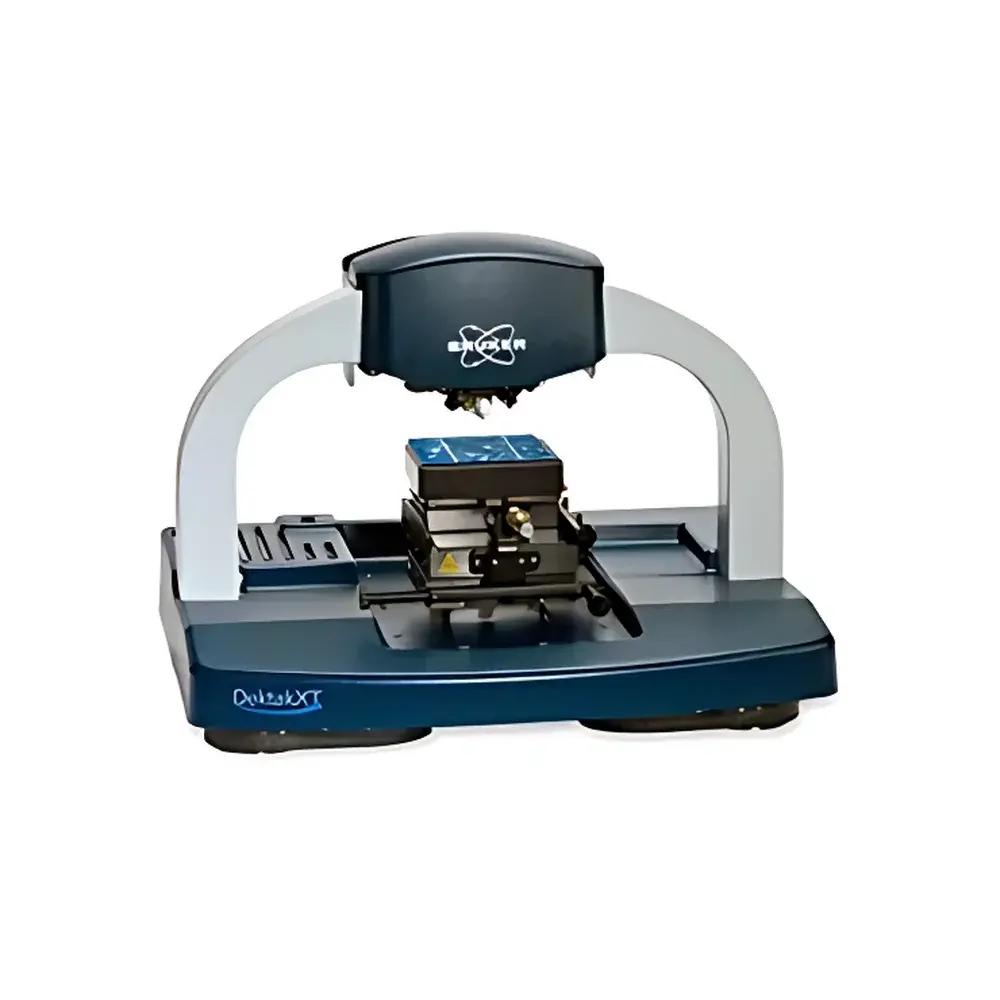
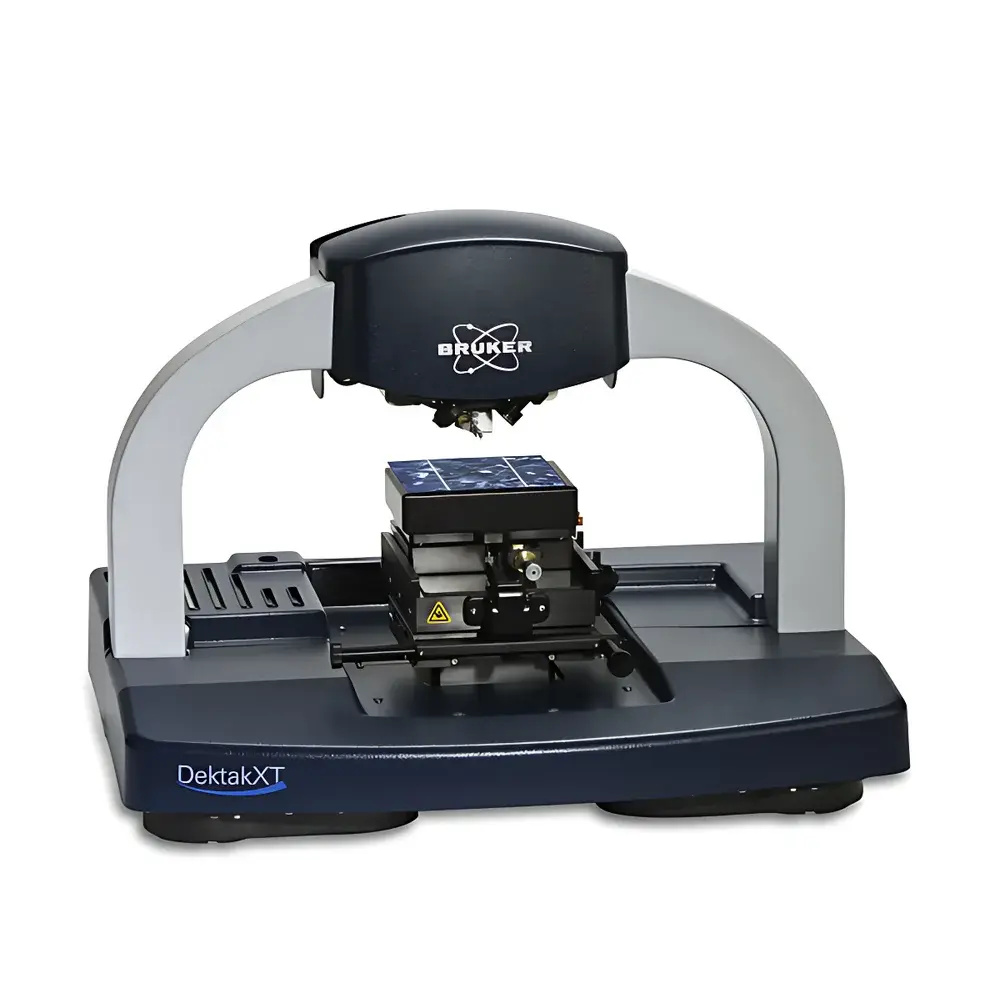
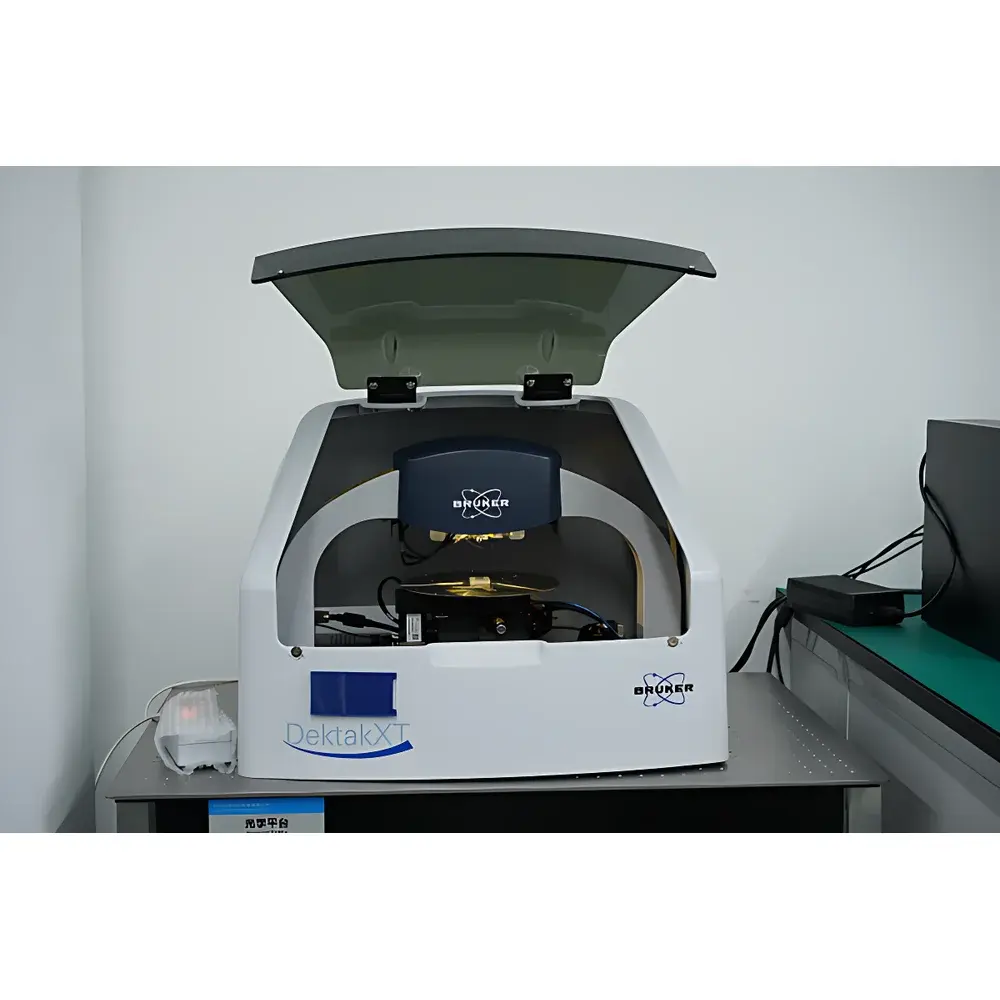
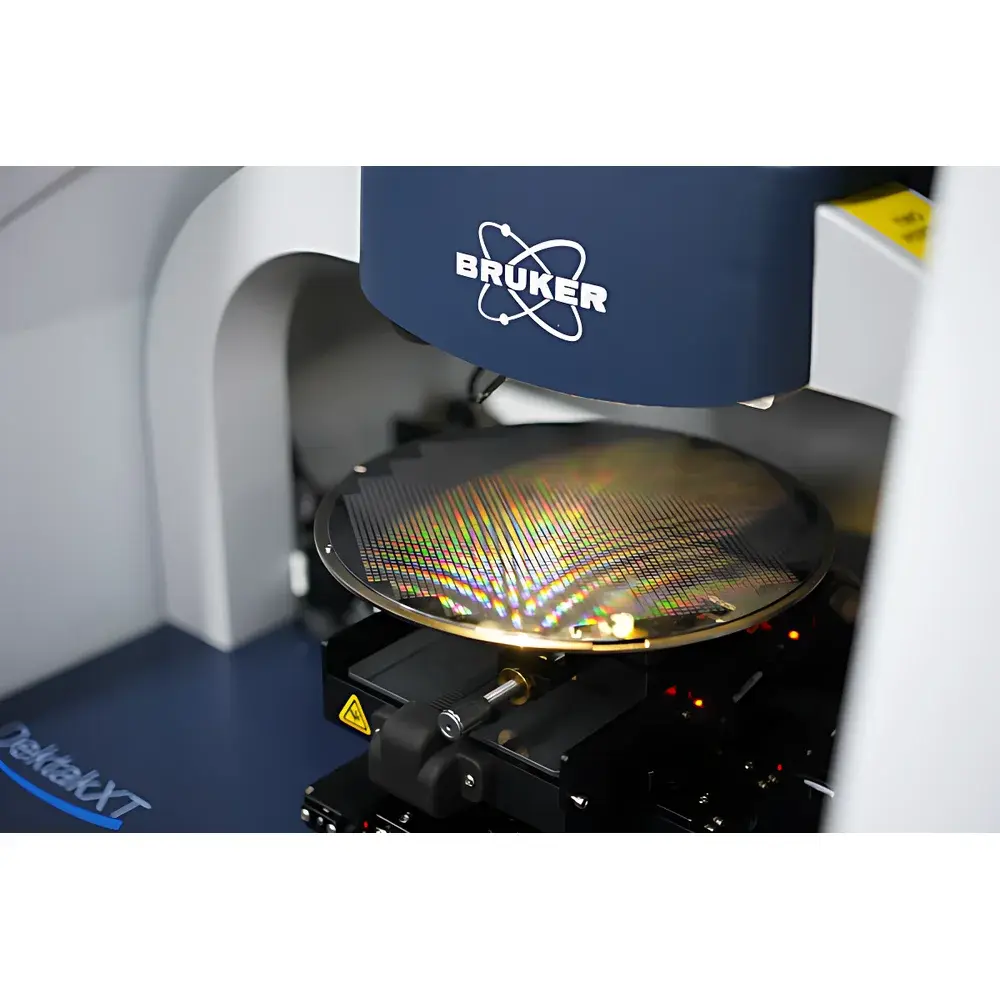
Bruker Dektak XT-10th Step Height and Surface Profilometer
| Brand | Bruker |
|---|---|
| Origin | USA |
| Manufacturer Type | Authorized Distributor |
| Product Origin | Imported |
| Model | Dektak XT-10th |
| Measurement Principle | Capacitive Probe Sensing |
| Measurement Capability | 2D Surface Topography Profiling |
| Vertical Accuracy | ±1 Å |
| Probe Tip Radius | 50 nm – 25 µm |
| Normal Force | 15 µN |
| Scan Length | 55 mm (2 in) |
| Step Height Repeatability | < 5 Å |
| Vertical Resolution | 1 Å |
| Maximum Sample Size | 50 mm |
Overview
The Bruker Dektak XT-10th is a high-precision, capacitive-based contact profilometer engineered for quantitative surface topography characterization at the nanoscale. Leveraging over four decades of probe-based profilometry heritage, the XT-10th implements a single-arch mechanical architecture that minimizes thermal drift and mechanical hysteresis—critical for sub-ångström vertical repeatability and long-range scan stability. Its measurement principle relies on a precisely calibrated stylus that traverses the sample surface while detecting minute capacitance variations between the probe tip and conductive or dielectric substrates; this signal is converted into high-fidelity height data with 1 Å vertical resolution. Designed for R&D laboratories and production QA/QC environments, the system delivers traceable, ISO/IEC 17025-compatible surface metrology for thin-film thickness, step height, roughness (Ra, Rq, Rz), curvature, and stress-induced deformation analysis.
Key Features
- Single-arch structural design ensures exceptional mechanical rigidity and thermal stability across extended scans (up to 55 mm), enabling reliable long-range 2D profiling without compromise in resolution or noise floor.
- Integrated true-color HD optical camera (5 MP) co-aligned with the probe path allows real-time visual navigation, precise feature targeting, and automatic region-of-interest (ROI) definition prior to scanning.
- Direct-drive scanning stage eliminates backlash and belt-driven inertia, reducing inter-scan dead time by >40% while preserving <5 Å step height repeatability—even during multi-pass or multi-location workflows.
- Intelligent electronics architecture—including low-noise analog front-end, 24-bit ADC, and on-board FPGA processing—establishes a new benchmark for signal-to-noise ratio in contact profilometry.
- Automated tip calibration routine verifies and compensates for tip wear or contamination in situ, maintaining measurement traceability without manual intervention or external reference standards.
- 64-bit parallel processing hardware coupled with Bruker’s Vision64 software enables real-time synchronization of data acquisition, filtering, and visualization—accelerating 3D topography reconstruction by up to 10× versus legacy platforms.
Sample Compatibility & Compliance
The Dektak XT-10th accommodates wafers, substrates, and planar specimens up to 50 mm in diameter and ≤10 mm in thickness. Compatible with silicon, sapphire, glass, metals, polymers, and coated ceramics, it supports both conductive and insulating surfaces without requiring conductive coating. Probe normal force is adjustable from 1–100 µN (standard operating point: 15 µN), minimizing plastic deformation on soft films (e.g., photoresists, battery anodes, OLED layers). The instrument complies with ISO 25178-2 (areal surface texture), ISO 4287 (profile roughness), ASTM E1099 (step height measurement), and supports GLP/GMP audit trails via Vision64’s 21 CFR Part 11–compliant user access control, electronic signatures, and immutable data logging.
Software & Data Management
Vision64 is a native 64-bit application built on a modular, extensible framework optimized for large-volume profilometry datasets. It provides synchronized acquisition and analysis—supporting real-time Gaussian, Spline, and ISO 16610–based filters; automated edge detection; cross-section extraction; and statistical reporting per ISO 14253-1. All raw profiles are stored in Bruker’s proprietary .pro format (HDF5-based), ensuring metadata integrity, versioned calibration records, and backward compatibility. Export options include CSV, ASCII, STP, and industry-standard Metrology XML (MMIS) for integration into MES or LIMS platforms. Audit logs record operator ID, timestamp, parameter changes, and software version—fully compliant with FDA 21 CFR Part 11 requirements for regulated environments.
Applications
- Semiconductor process control: gate oxide step height, CMP uniformity, lithographic resist profile analysis, and etch depth quantification.
- Microelectronics packaging: solder bump height, underfill void assessment, and interposer warpage mapping.
- Energy materials: electrode thickness variation in Li-ion battery cathodes/anodes, solid electrolyte layer uniformity, and thermal barrier coating roughness.
- Optoelectronics: LED epitaxial layer thickness, micro-LED mesa isolation depth, and AR/HR coating step characterization.
- Advanced materials: 2D material transfer quality (graphene, TMDCs), thin-film solar cell layer stacking, and MEMS/NEMS device surface flatness verification.
FAQ
What is the minimum resolvable step height on the Dektak XT-10th?
The system achieves a vertical resolution of 1 Å and demonstrates step height repeatability better than 5 Å under controlled environmental conditions (20 ± 2 °C, <40% RH).
Can the Dektak XT-10th measure non-conductive samples?
Yes—capacitive sensing enables stable profiling of insulators such as SiO₂, polymers, and oxides without metallization, provided surface cleanliness and probe force are optimized.
Is Vision64 compatible with Windows 11 and 64-bit systems?
Vision64 is a native 64-bit application fully certified for Windows 10 and Windows 11 (64-bit only); it requires ≥16 GB RAM and an OpenGL 4.5–capable GPU for optimal 3D rendering performance.
How does the XT-10th handle thermal drift during long scans?
The monolithic single-arch frame, low-coefficient-of-expansion granite base, and active thermal stabilization of critical electronics reduce thermal drift to <0.5 Å/°C over 1-hour continuous operation.
Does the system support automated batch measurement routines?
Yes—Vision64 includes scriptable macro functionality (Python API) and a graphical sequence editor for unattended multi-site, multi-parameter measurement campaigns with pass/fail threshold reporting.