
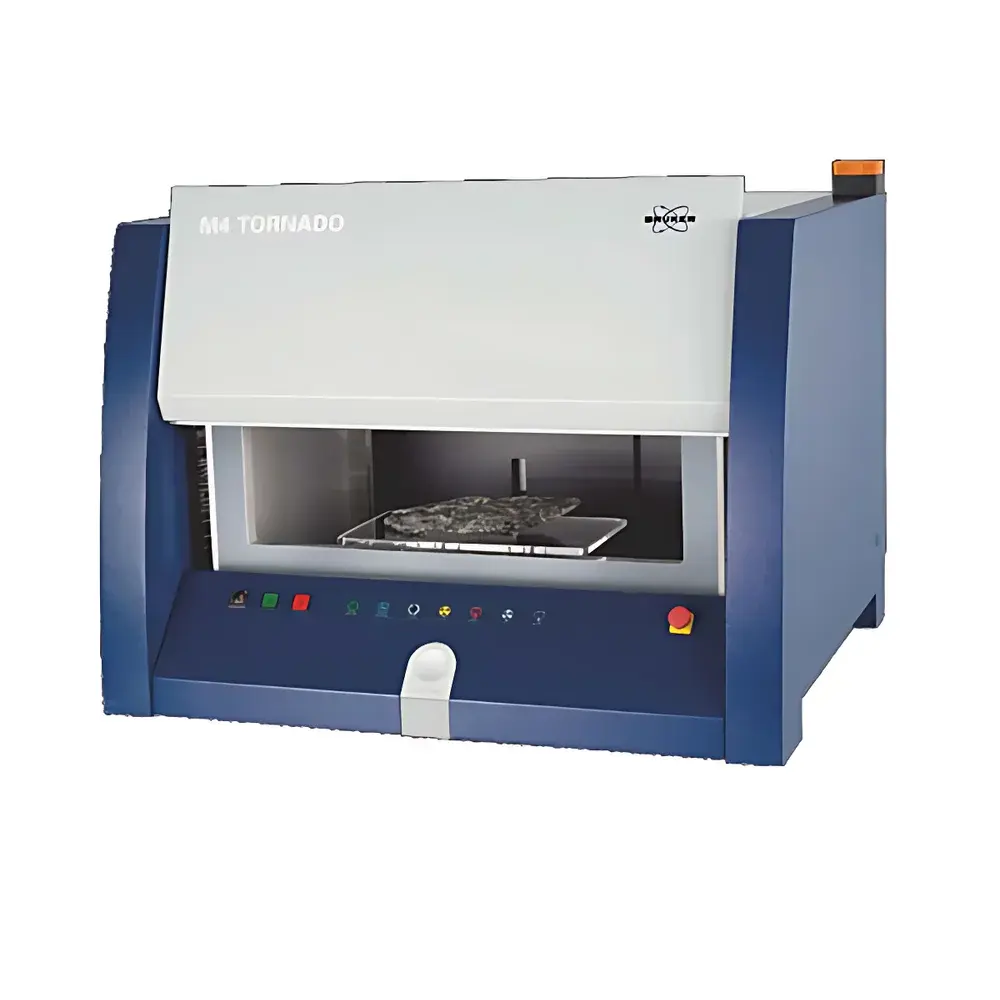
Bruker M4 TORNADO Micro-XRF Elemental Mapping Analyzer
| Brand | Bruker |
|---|---|
| Origin | Germany |
| Configuration | Benchtop/Floor-Standing |
| Application Type | General-Purpose |
| Elemental Range | Mg to U |
| Quantitative Detection Range | 1 ppm – 99.99 wt% |
| Energy Resolution | <140 eV (Mn Kα) |
| Repeatability | ≤0.1% RSD |
| Detector | Silicon Drift Detector (SDD) |
| Excitation | Dual X-ray Tube Option + Up to 6 Automatic Filter Positions |
| Optics | Polycapillary Focusing Lens |
| Sample Stage | Motorized X-Y-Z with Turbo-Drive |
| Imaging | Integrated Zoom Camera for Real-Time Sample Navigation |
| Vacuum Capability | Full Sample Chamber Evacuation |
| Quantification Method | Fundamental Parameters (FP)-Based Calibration-Free Analysis |
| Compliance | Fully Compatible with ISO 17025 Laboratory Practices, Supports Audit-Ready Data Logging per GLP/GMP Requirements |
Overview
The Bruker M4 TORNADO is a high-performance benchtop/floor-standing micro-X-ray fluorescence (μ-XRF) elemental mapping analyzer engineered for non-destructive, spatially resolved chemical characterization of heterogeneous, irregular, or micro-scale samples. Operating on the principle of energy-dispersive X-ray fluorescence (ED-XRF), the system excites characteristic X-ray emissions from sample atoms using focused primary X-rays and resolves emitted photon energies via a high-throughput silicon drift detector (SDD). Its core architecture integrates polycapillary optics to achieve sub-30 µm spot sizes—enabling true micro-scale elemental distribution imaging without sectioning or coating. Unlike conventional bulk XRF, the M4 TORNADO delivers quantitative 2D/3D elemental maps with trace-level sensitivity (down to 1 ppm), making it indispensable for research and QA/QC workflows requiring both compositional accuracy and spatial context.
Key Features
- Polycapillary focusing lens delivering high-flux, micron-scale X-ray beams for superior spatial resolution and signal-to-noise ratio
- Turbo-driven motorized X-Y-Z stage enabling rapid, precise raster scanning at speeds up to 100 mm/s with sub-micron repeatability
- Integrated variable-magnification optical camera for real-time sample visualization and “fly-through” mapping—no pre-scanning required
- Dual X-ray tube configuration (Cr & Rh targets standard; optional Mo or W) with six-position automatic filter wheel for optimized excitation across light and heavy elements
- High-count-rate SDD detector (≥100,000 cps) with <140 eV energy resolution at Mn Kα, supporting fast acquisition of high-fidelity spectra per pixel
- Full-vacuum sample chamber (down to 10⁻² mbar) for enhanced detection of low-Z elements (Mg–Na) and reduced atmospheric absorption
- Fundamental Parameters (FP)-based quantification engine eliminating need for matrix-matched standards—validated for bulk solids, thin films, and multilayer structures
Sample Compatibility & Compliance
The M4 TORNADO accommodates diverse geometries: flat sections, curved artifacts, embedded inclusions, cross-sectioned devices, and fragile specimens up to 300 × 300 × 150 mm (W × D × H). No conductive coating is required, preserving sample integrity for subsequent analysis (e.g., SEM-EDS or SIMS). It meets international metrological requirements for elemental analysis laboratories, including ISO 17025 clause 5.9 on measurement uncertainty estimation. Data acquisition and processing comply with ALCOA+ principles (Attributable, Legible, Contemporaneous, Original, Accurate), and full audit trails—including instrument parameters, calibration history, and user actions—are automatically logged in accordance with FDA 21 CFR Part 11 and EU Annex 11 expectations for regulated environments.
Software & Data Management
ESPRESSO software provides an integrated platform for acquisition, spectral deconvolution, elemental mapping, layer thickness modeling, and statistical analysis. Batch processing supports automated ROI definition, cluster analysis (PCA, HCA), and correlation overlays with optical images. All raw spectra and metadata are stored in vendor-neutral .spe/.img formats compliant with ASTM E1301 and IUPAC recommendations. Export options include CSV, TIFF, HDF5, and direct import into third-party tools (MATLAB, Python/Pandas, HyperSpy). Secure user role management (admin/operator/analyst) enforces SOP adherence and data governance across multi-user facilities.
Applications
- Geosciences: Core scanning, sediment laminae profiling, fossil biomineralization mapping, and provenance studies via trace-element fingerprinting
- Forensics: GSR (gunshot residue) particle identification, paint chip layer sequencing, and counterfeit document ink differentiation
- Cultural Heritage: Pigment stratigraphy in paintings, corrosion product analysis on metal artifacts, and authenticity verification of ceramics/glass
- Life Sciences: Metal ion diffusion in orthopedic implants, Ca/P distribution in bone/tissue sections, and elemental gradients in plant xylem/phloem
- Materials Engineering: Cathode heterogeneity screening in Li-ion batteries, interdiffusion in thermal barrier coatings, and inclusion analysis in high-strength alloys
- Environmental Monitoring: Speciation-independent quantification of As, Pb, Cd, Cr in soils, sludges, and airborne particulates
- Electronics QA: RoHS-compliant screening of Pb, Hg, Cd, Cr⁶⁺, Br in PCBs, solder joints, and encapsulated components
FAQ
What is the smallest detectable feature size for elemental mapping?
The practical lateral resolution is ~25–30 µm under optimal vacuum and excitation conditions, limited by beam spot size and detector solid angle—not pixel binning.
Can the M4 TORNADO analyze liquids or powders?
Yes—powders may be pressed into pellets or analyzed in capillary tubes; liquids require containment in low-background XRF cells with polymer windows.
Is spectral deconvolution automated for overlapping peaks (e.g., S Kα / Pb Mα)?
Yes—ESPRESSO employs iterative least-squares fitting with physical models of peak shape, escape peaks, and sum peaks, validated against NIST SRM reference materials.
How does the system handle topography-induced intensity variation?
Height mapping via integrated laser triangulation (optional) enables Z-correction during acquisition, while FP modeling accounts for variable take-off angles in quantification.
Does Bruker provide application-specific method templates?
Yes—pre-configured workflows are available for RoHS screening, geological core logging, forensic GSR, and battery cathode QC, all fully customizable and version-controlled.
Related Products





