
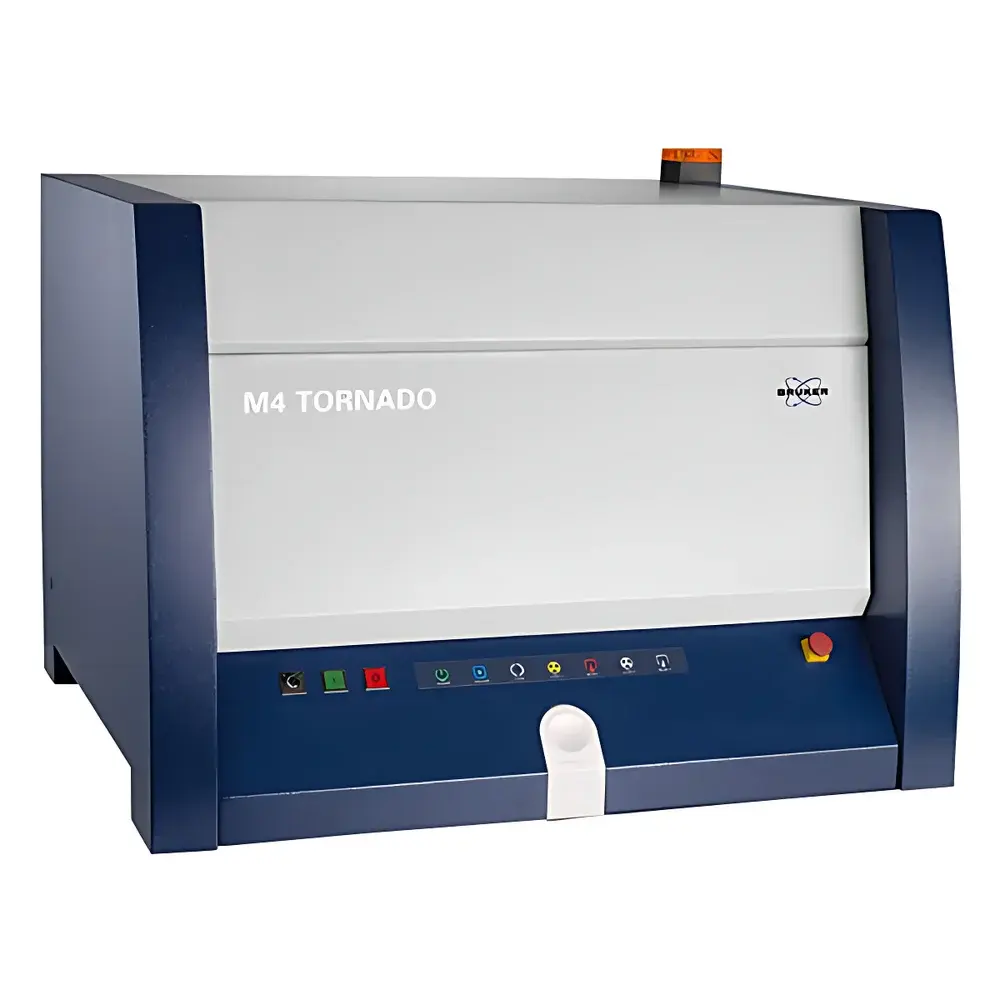
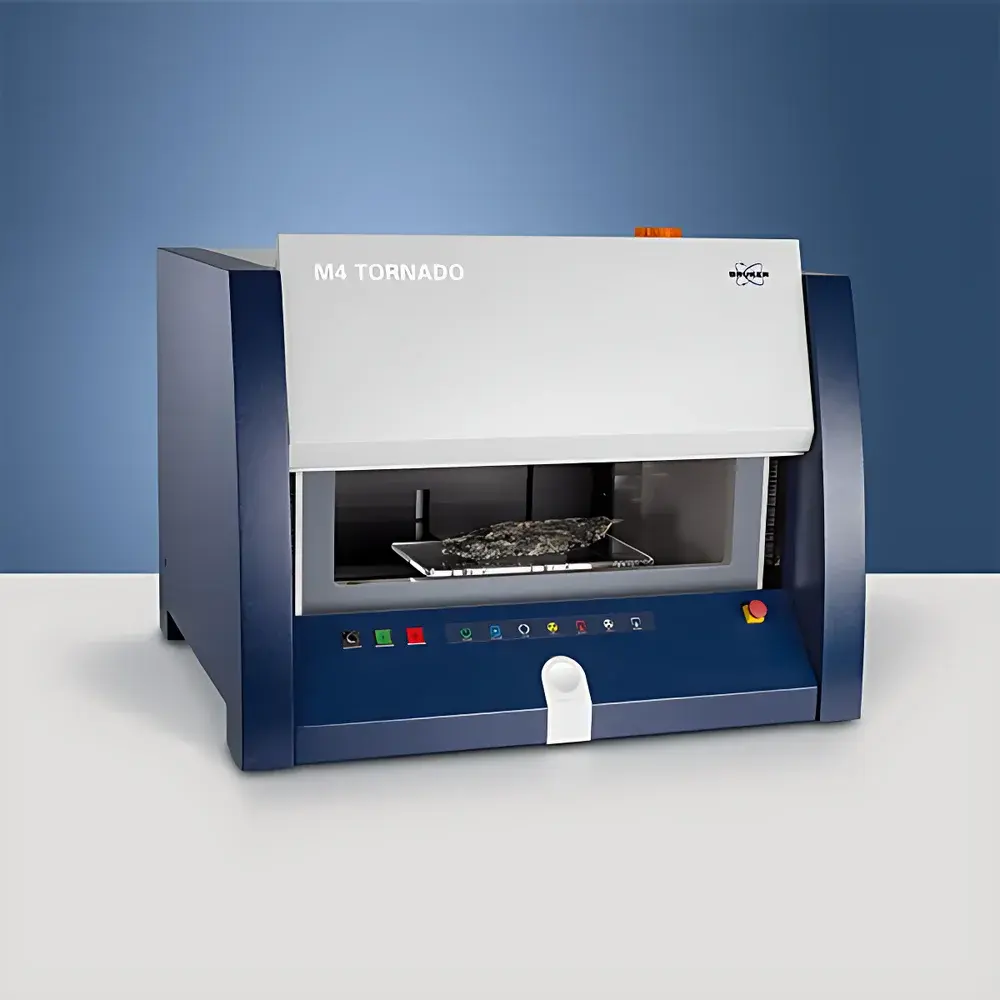
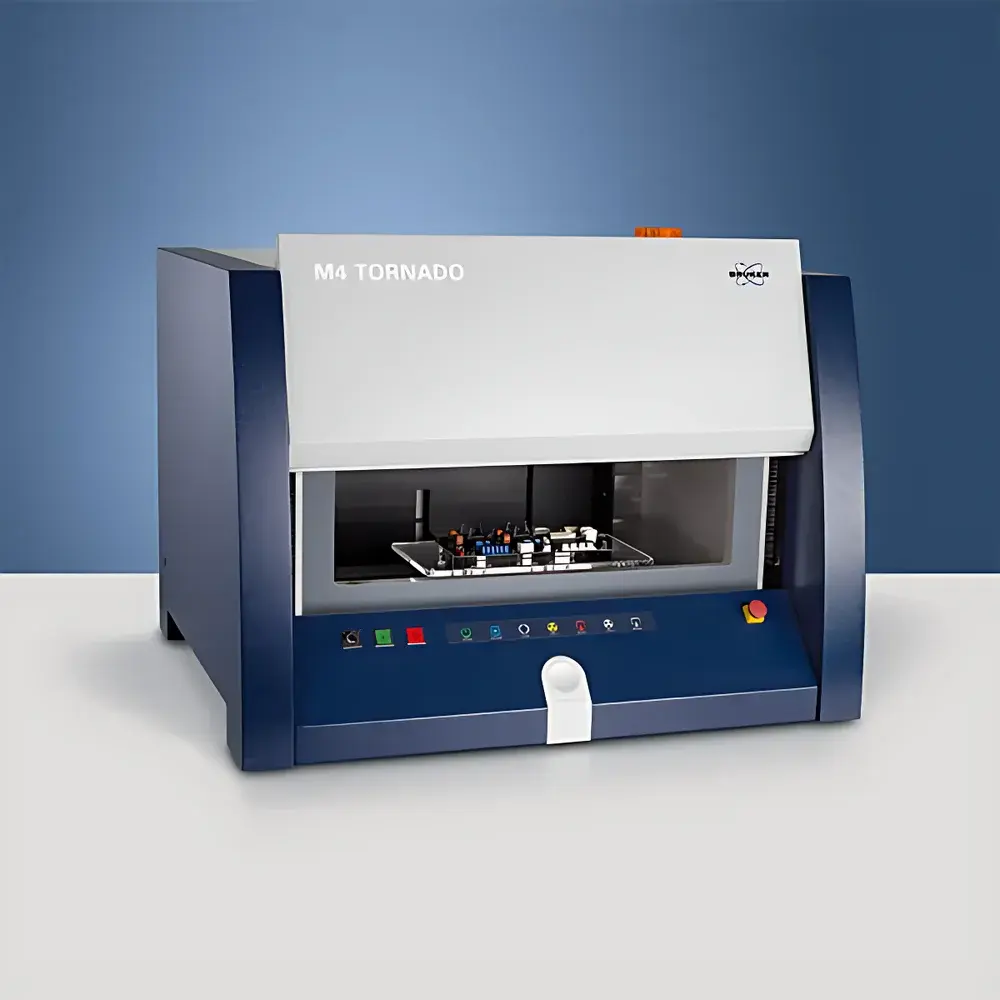
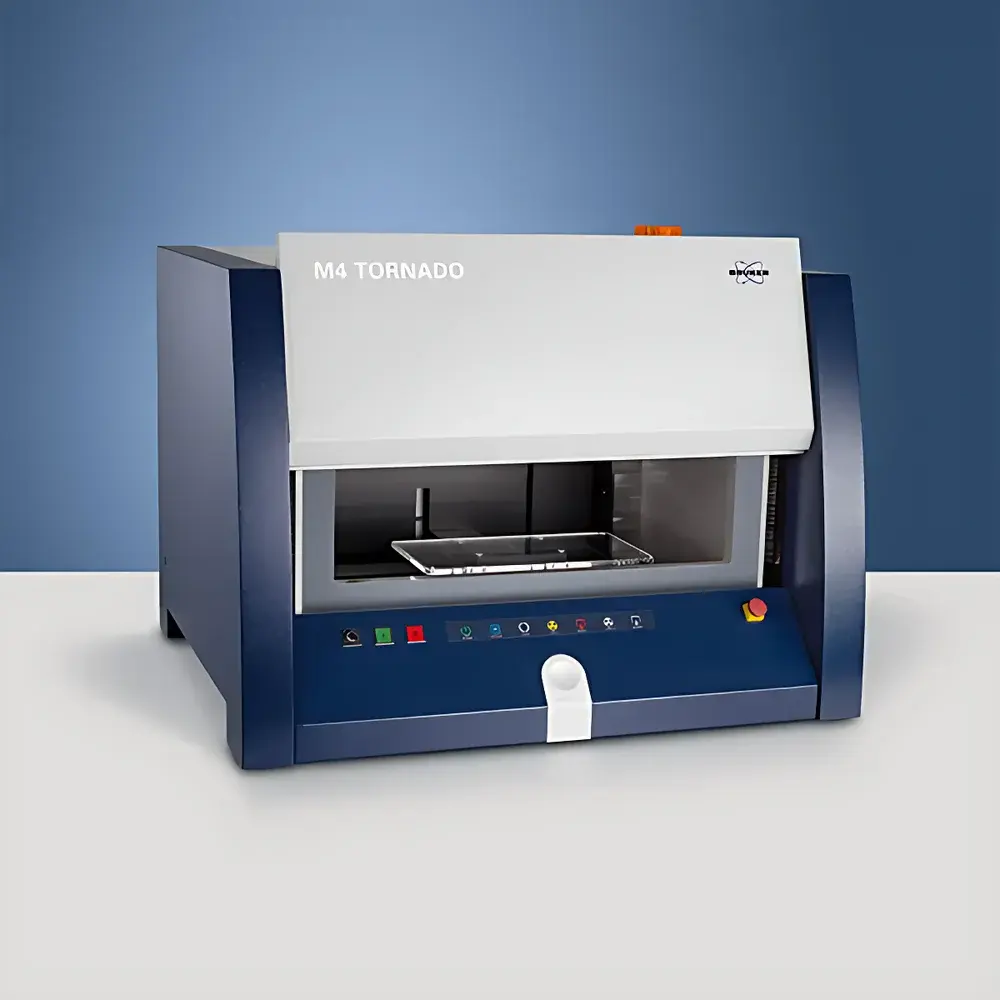
Bruker M4 TORNADO Micro-XRF Spectrometer
| Brand | Bruker |
|---|---|
| Origin | Germany |
| Configuration | Benchtop/Floor-standing |
| Elemental Range | Na–U |
| Quantification Range | 1 ppm – 99.99 wt% |
| Energy Resolution | <140 eV (Mn Kα) |
| Repeatability | ≤0.1% RSD |
| Detector | Silicon Drift Detector (SDD) |
| Compliance | CE, RoHS, IEC 61000-6-3/6-4 |
| Sample Chamber Dimensions | 300 × 300 × 150 mm (W×D×H) |
Overview
The Bruker M4 TORNADO is a high-performance benchtop/floor-standing micro-focused energy dispersive X-ray fluorescence (μ-EDXRF) spectrometer engineered for non-destructive elemental mapping and quantitative analysis at micrometer-scale spatial resolution. Utilizing a polycapillary optic-focusing X-ray source and a large-area silicon drift detector (SDD), the system delivers high-count-rate spectral acquisition with excellent peak-to-background ratio and sub-140 eV energy resolution at Mn Kα. Its core measurement principle relies on primary X-ray excitation of sample atoms, followed by detection of characteristic secondary (fluorescent) X-rays emitted during electron relaxation—enabling simultaneous multi-element identification and quantification without sample digestion or vacuum requirements. Designed for materials science laboratories, quality control environments, and failure analysis centers, the M4 TORNADO supports both point analysis and automated raster scanning up to 100 × 100 mm², with spot sizes down to 25 μm (optional 10 μm configuration). Its robust architecture ensures long-term stability under routine operation, making it suitable for GLP-compliant workflows and regulated industrial testing.
Key Features
- Micro-focused X-ray beam with selectable spot sizes (standard 25 μm; optional 10 μm) for high-resolution elemental imaging and thin-film thickness profiling.
- Large-area SDD detector with Peltier cooling and digital pulse processing, enabling count rates >1 million cps with minimal dead time and high spectral fidelity.
- Motorized XYZ stage with optical microscope integration (5×–50× zoom) for precise region-of-interest navigation and real-time visual correlation with elemental maps.
- Automated multi-layer thin-film analysis using fundamental parameter (FP) algorithms compliant with ISO 3497 and ASTM E1508 standards.
- Integrated helium purge or vacuum chamber option for enhanced light-element sensitivity (down to sodium, Na).
- Modular software architecture supporting method validation, calibration traceability, and audit-ready reporting per FDA 21 CFR Part 11 requirements.
Sample Compatibility & Compliance
The M4 TORNADO accommodates heterogeneous solid samples up to 300 × 300 × 150 mm in dimension and 5 kg in mass—including metallurgical cross-sections, coated substrates, electronic assemblies, concrete cores, geological thin sections, and packaged food simulants. No conductive coating or vacuum preparation is required for insulating or hydrated samples. The instrument meets electromagnetic compatibility (EMC) standards IEC 61000-6-3 (emission) and IEC 61000-6-4 (immunity), carries CE marking for safe operation within the EU, and complies with RoHS Directive 2011/65/EU for restricted substances. For regulated industries, its software supports user access levels, electronic signatures, and full audit trails—facilitating alignment with ISO/IEC 17025, USP /, and GMP/GLP documentation expectations.
Software & Data Management
The proprietary ESPRIT™ software suite provides end-to-end workflow control—from experimental design and acquisition setup to multivariate image processing and statistical reporting. Key modules include: (i) AutoQuant for matrix-matched and standardless quantification using fundamental parameters; (ii) MapSpectra for hyperspectral data cube generation and false-color elemental distribution visualization; (iii) LayerScan for depth-resolved composition modeling of stratified structures (e.g., coatings, solder joints, corrosion layers); and (iv) ReportEngine for customizable PDF/Excel export with embedded metadata, uncertainty estimates, and calibration history. All raw spectra and processed results are stored in vendor-neutral .spe/.hdr formats compatible with third-party chemometric tools.
Applications
- Thin-film metrology: Thickness and stoichiometry mapping of ALD/CVD-deposited layers (e.g., TiN, HfO₂) on semiconductor wafers.
- Corrosion science: Spatially resolved Cl, S, and Fe distribution in reinforced concrete to assess chloride ingress depth and rebar passivation breakdown.
- Failure analysis: Identification of intermetallic phases, void-associated elemental segregation, and solder joint contamination in PCB assemblies.
- Food safety screening: Detection and localization of heavy metals (Pb, Cd, As) in packaging materials and processed matrices without extraction.
- Geological and archaeological research: In-situ provenance studies via trace-element fingerprinting of ceramics, pigments, and mineral inclusions.
- Recycling & compliance: Rapid screening of restricted elements (Cr⁶⁺, Br, Hg) in polymers and alloys per IEC 62321-5 and RoHS enforcement protocols.
FAQ
What is the minimum detectable limit (MDL) for lead (Pb) in polymer samples?
MDL depends on measurement time, spot size, and matrix effects; typical values range from 2–5 ppm for 100 s acquisitions on homogeneous PE/PP substrates using 25 μm beam and He purge.
Can the M4 TORNADO perform depth profiling?
It does not perform destructive sputtering, but enables non-destructive pseudo-depth profiling through variable take-off angle measurements and multi-layer FP modeling of coated systems.
Is vacuum required for light-element analysis?
Vacuum or He purge is recommended for reliable quantification of elements below titanium (e.g., Mg, Al, Si, P, S) due to atmospheric absorption of low-energy X-rays.
How is calibration traceability maintained?
Certified reference materials (CRMs) from NIST, BAM, or JSS are used for initial calibration; periodic verification follows ISO 17025 internal quality control procedures with control charts and drift correction routines.
Does the system support automated batch analysis?
Yes—via scriptable acquisition sequences and scheduled map runs, integrated with LIMS-compatible output formats and barcode-triggered sample ID recognition.
Related Products




