
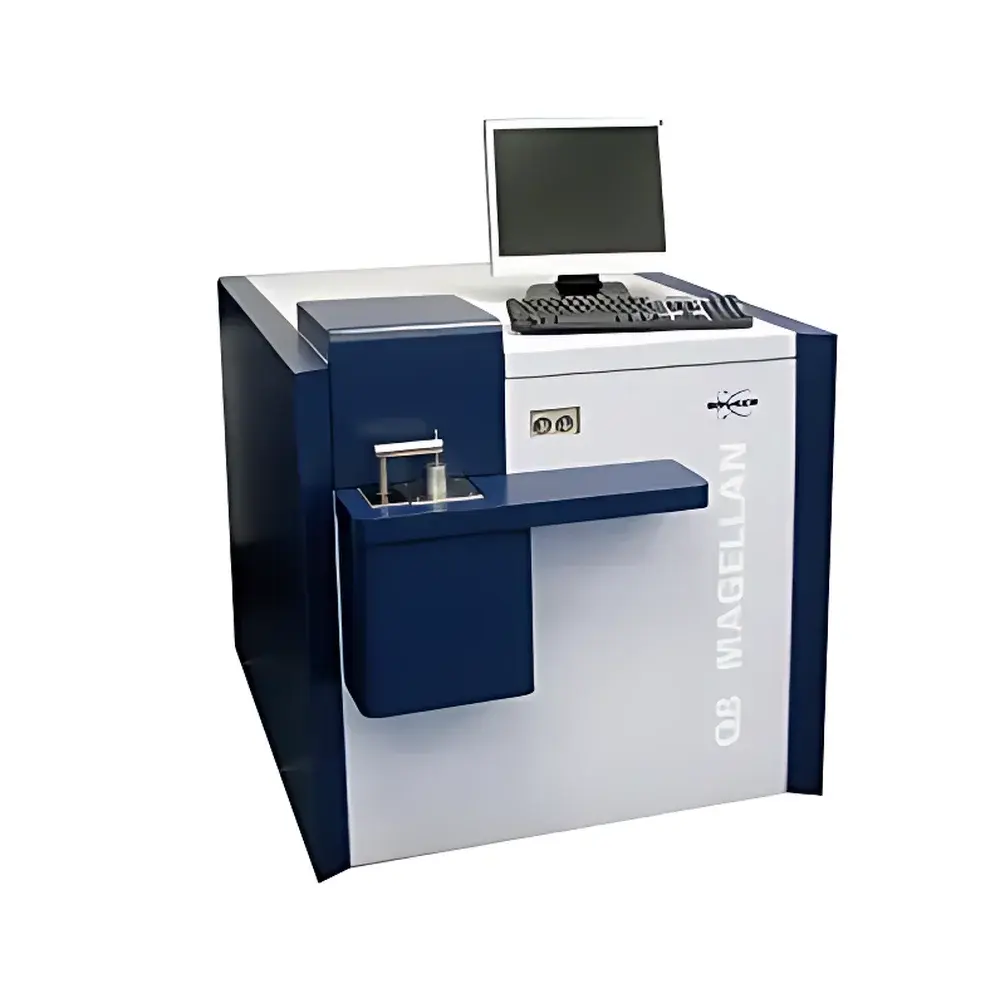
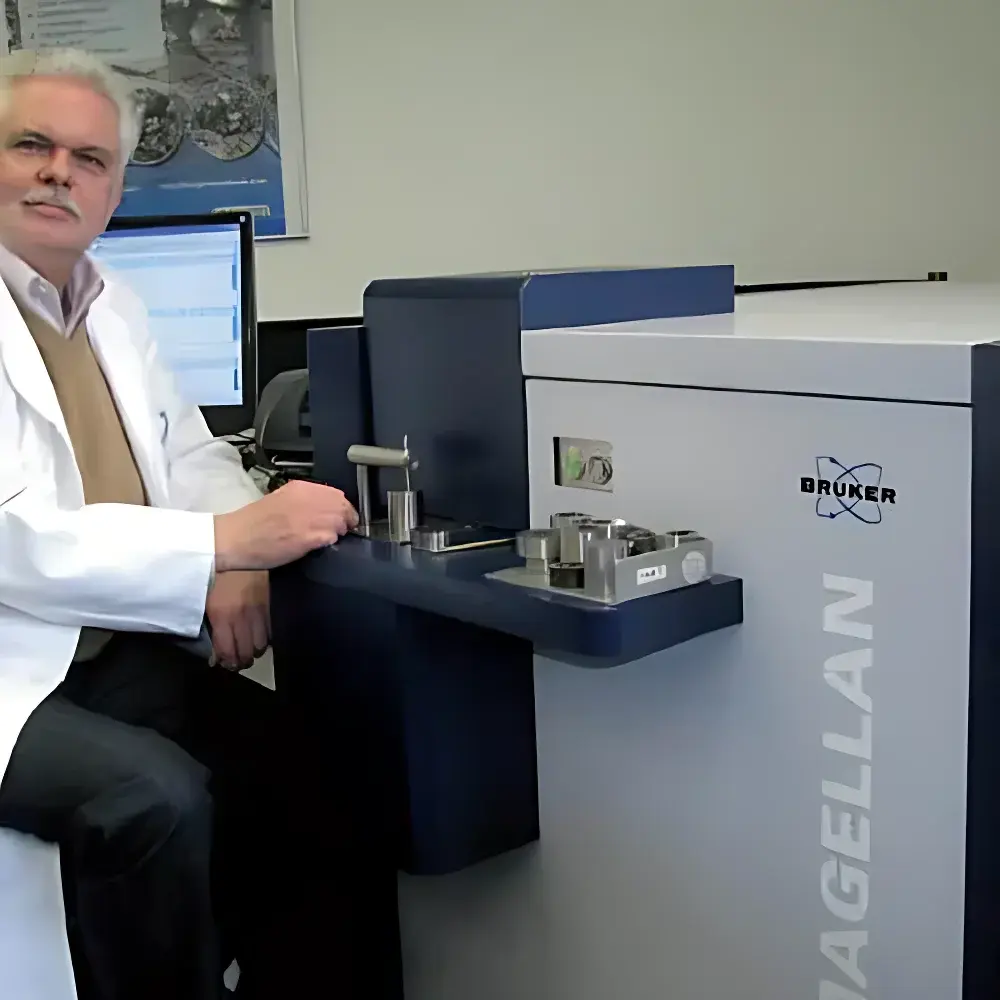
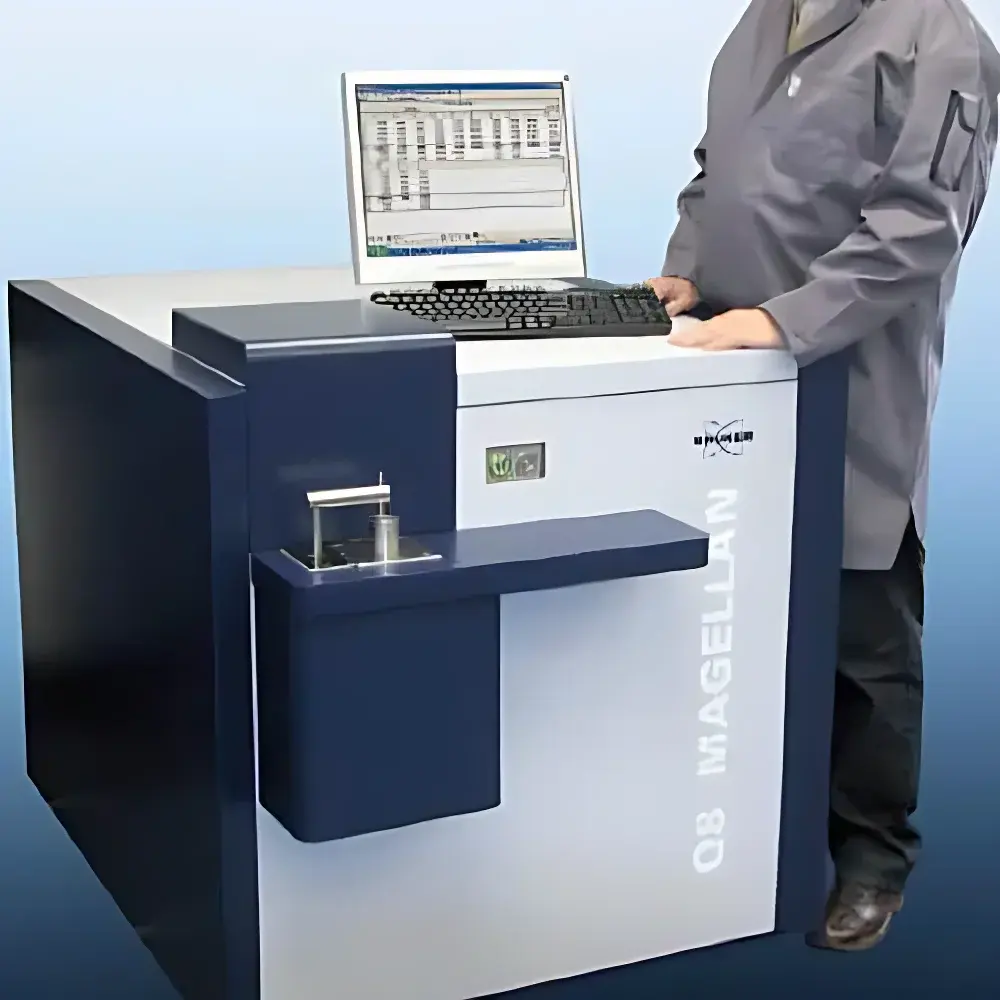
Bruker Q8 MAGELLAN Direct-Reading Spark Optical Emission Spectrometer
| Brand | Bruker |
|---|---|
| Origin | Germany |
| Instrument Type | Benchtop |
| Excitation Method | Spark |
| Detector Type | Photomultiplier Tube (PMT) |
| Focal Length | 1000 mm |
| Grating Groove Density | 3600 lines/mm |
| Wavelength Range | 110–800 nm |
| Number of Channels | 128 |
Overview
The Bruker Q8 MAGELLAN is a high-performance benchtop direct-reading spark optical emission spectrometer (OES) engineered for precise, reproducible elemental analysis of metallic materials in demanding industrial and laboratory environments. It operates on the fundamental principle of spark-induced atomic emission spectroscopy: a controlled high-energy spark ablates a micro-volume of the conductive sample surface, generating a transient plasma whose emitted light is dispersed by a high-resolution Czerny-Turner optical system and detected with channel-specific photomultiplier tubes. The instrument’s vacuum-sealed, thermostatically stabilized optical chamber—equipped with a turbomolecular pump—eliminates hydrocarbon contamination from oil-based vacuum systems and ensures long-term wavelength stability across the full spectral range (110–800 nm). With a 1000 mm focal length and 3600 lines/mm holographic grating, the Q8 MAGELLAN achieves exceptional spectral resolution (~0.2 nm/mm in second order), enabling reliable separation of closely spaced analytical lines—critical for complex multi-element alloys containing Fe, Al, Cu, Ni, Ti, Mg, Co, Sn, Pb, and Zn.
Key Features
- Full-digital solid-state spark generator with adjustable energy, frequency (up to 1000 Hz), and pulse duration—ensuring stable excitation and minimized electrode wear.
- Single-pulse spark acquisition technology: captures 1000 individual spark pulses per analysis cycle, with up to four independently configurable time-resolved detection windows per channel to suppress matrix-dependent background and enhance signal-to-noise ratio.
- Dedicated PMT detector array with ultra-low dark current and optimized quantum efficiency across VUV to NIR regions; each channel features independent high-voltage control and analog-to-digital conversion.
- Maintenance-free heavy-duty argon-flushed spark stand with coaxial gas flow design, minimizing argon consumption while maximizing plasma stability and crater homogeneity.
- Integrated vacuum architecture with active temperature stabilization (±0.1 °C) and real-time pressure monitoring—compliant with ISO 11574 and ASTM E407 requirements for optical emission spectrometry.
- Modular electronics platform supporting future firmware upgrades, expanded channel configuration, and optional compliance modules (e.g., 21 CFR Part 11 audit trail, electronic signature).
Sample Compatibility & Compliance
The Q8 MAGELLAN is validated for solid, electrically conductive metal samples—including castings, forgings, rolled plates, wires, and machined parts—with diameters ≥10 mm and thickness ≥4 mm. It supports standardized sample preparation per ISO 11577 (surface conditioning) and ASTM E1184 (spark OES sampling procedures). All calibration models are traceable to NIST SRM reference materials (e.g., SRM 1250a, 1251, 1253) and certified against EN 10315, ISO 17025, and ASTM E3061. The system meets GLP/GMP documentation requirements when configured with Bruker’s SPECTRUM Suite software featuring full audit trail, user access levels, and electronic signature support per FDA 21 CFR Part 11.
Software & Data Management
Controlled via Bruker’s SPECTRUM Suite—a Windows-based, modular application designed for routine QA/QC and R&D workflows—the Q8 MAGELLAN provides intuitive method setup, real-time spectral visualization, multivariate calibration (PLS, MLR), and automated drift correction. Data export complies with ASTM E1382 (ASCII), ISO/IEC 17025-compliant reporting templates, and LIMS integration via OPC UA or CSV/Excel protocols. Raw spectral data (intensity vs. time/wavelength) is stored in vendor-neutral HDF5 format, enabling third-party chemometric analysis. Software validation packages—including IQ/OQ/PQ documentation—are available for regulated environments.
Applications
The Q8 MAGELLAN delivers robust performance across metallurgical production and quality assurance domains: rapid grade identification and sorting of ferrous and non-ferrous scrap; melt process control in primary steelmaking and secondary aluminum recycling; incoming raw material verification for automotive and aerospace suppliers; certification testing for pressure vessel steels (ASME SA-372, EN 10028); and research-grade compositional mapping of intermetallic phases in Ni-based superalloys. Its high channel count (128) and time-resolved detection support simultaneous quantification of major, minor, and trace elements—including C, P, S, N, B, and rare earths—at sub-ppm detection limits in optimized matrices.
FAQ
What vacuum level does the Q8 MAGELLAN maintain during operation?
Typically 1×10⁻³ mbar, sustained by a hybrid pumping system combining a dry scroll forepump and a 300 L/s turbomolecular pump.
Is argon purity critical for optimal performance?
Yes—99.996% pure argon (ISO 8573-1 Class 1.1.1) is required to prevent spectral interference from oxygen and water vapor absorption below 190 nm.
Can the Q8 MAGELLAN analyze coated or plated samples?
Only after mechanical removal of non-conductive coatings; spark OES requires direct electrical contact with bulk metal.
How often is recalibration required under continuous use?
Daily standardization using certified reference materials is recommended; full recalibration intervals depend on application severity and are typically every 3–6 months.
Does the system support remote diagnostics and service access?
Yes—via encrypted TLS-secured connection through Bruker’s Remote Support Portal, compliant with ISO/IEC 27001 information security standards.




