
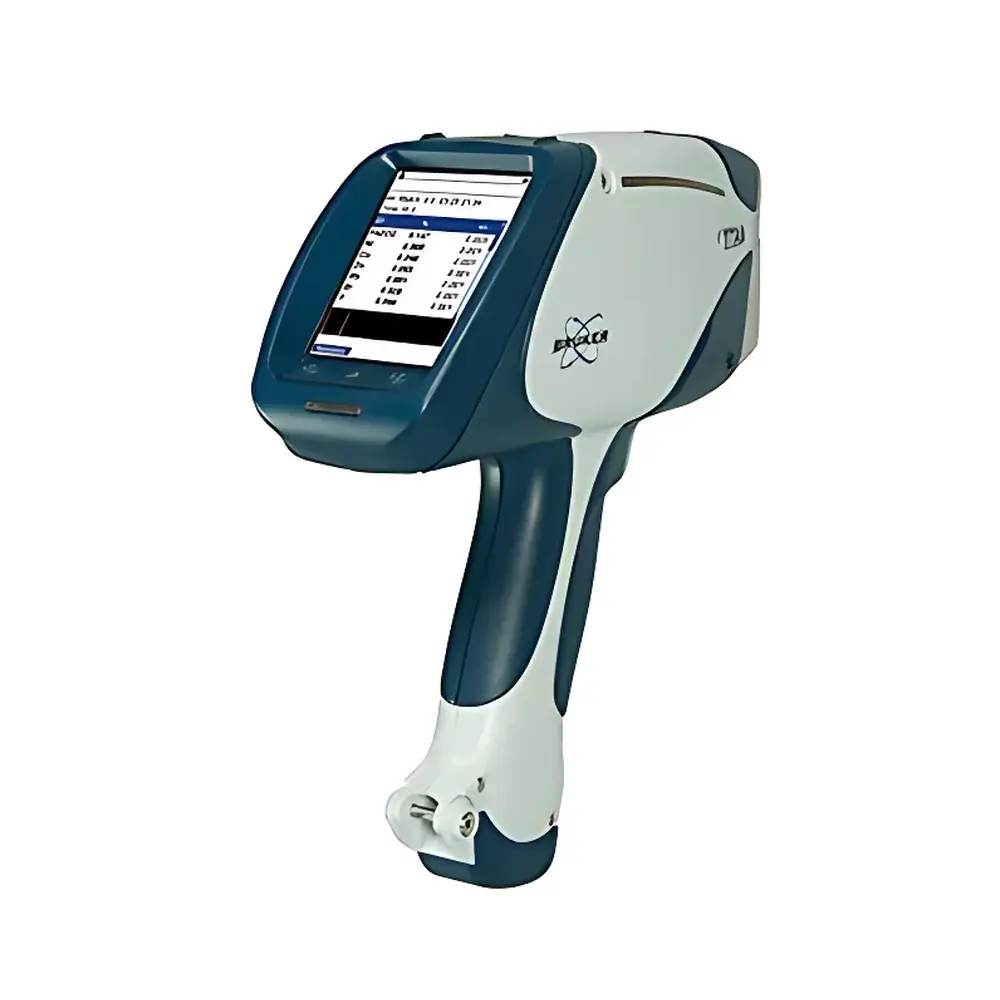
Bruker S1 TITAN 200 Handheld X-ray Fluorescence (XRF) Soil Heavy Metal Analyzer
| Brand | Bruker |
|---|---|
| Origin | USA |
| Model | S1 TITAN 200 |
| Instrument Type | Heavy Metal Contaminant Analyzer |
| Elemental Range | ≥40 elements (S–U) |
| Application Scope | Soil, sediment, sludge, dust, filter media, solid waste |
| Compliance | Meets ASTM D6739, EPA Method 6200, ISO 18551, and EU RoHS/WEEE screening requirements |
| Detector | High-resolution silicon drift detector (SDD) |
| Excitation Source | Rhodium-target microfocus X-ray tube |
| Operating Environment | Field-deployable (–10 °C to 50 °C), IP54 rated |
| Data Output | Quantitative ppm/wt% results with statistical uncertainty reporting |
Overview
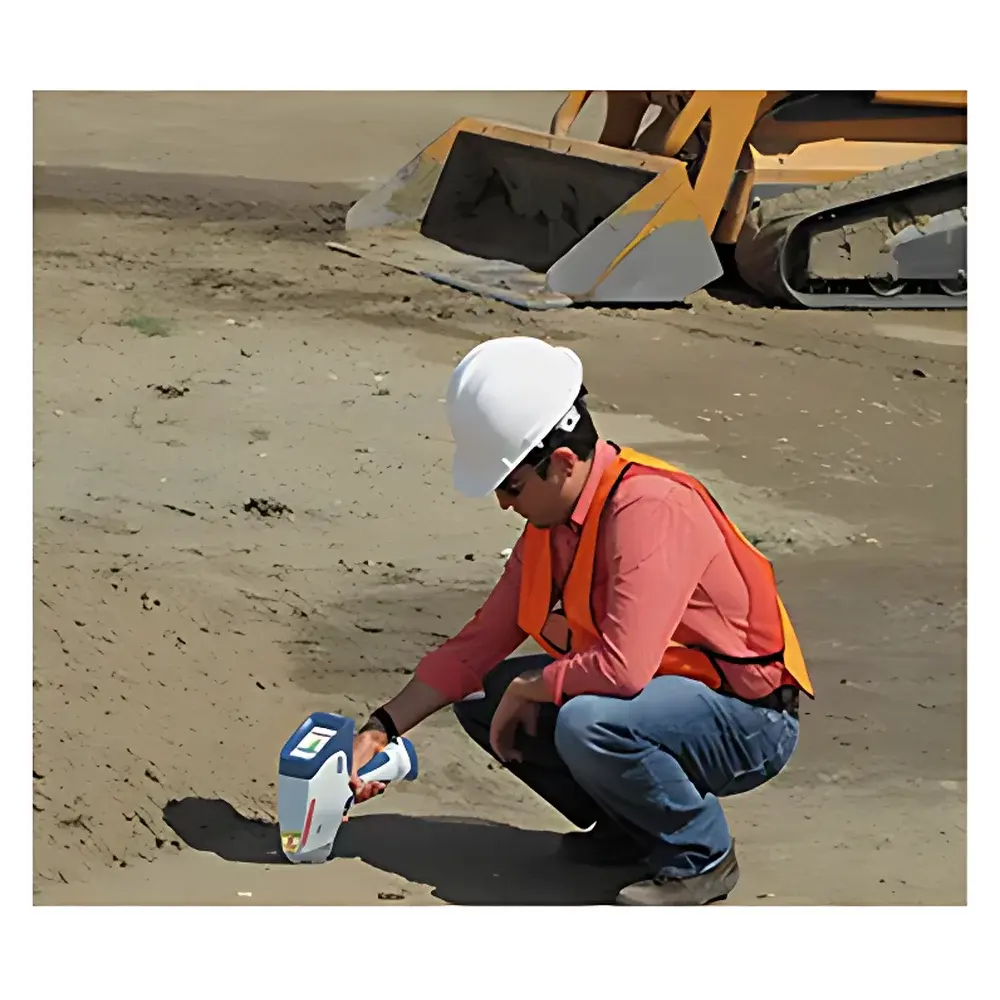
The Bruker S1 TITAN 200 is a field-portable, high-performance handheld X-ray fluorescence (XRF) spectrometer engineered for rapid, non-destructive elemental analysis of heavy metals in soil and related environmental matrices. Based on energy-dispersive XRF (ED-XRF) principles, the instrument employs a rhodium-target microfocus X-ray tube and a high-resolution silicon drift detector (SDD) to deliver precise quantification of toxic elements—including Pb, As, Cd, Hg, Cr, Ni, Cu, and Zn—at parts-per-million (ppm) detection limits in heterogeneous field samples. Its physics-based calibration architecture supports matrix-matched quantification using fundamental parameter (FP) algorithms and empirical calibrations traceable to NIST SRM reference materials. Designed for regulatory-grade data acquisition, the S1 TITAN 200 operates without sample digestion or chemical reagents, enabling real-time decision-making during site characterization, remediation verification, and emergency response deployments.
Key Features
- Ruggedized industrial design with IP54 ingress protection and MIL-STD-810G compliance for shock, vibration, and thermal cycling in outdoor environments
- Real-time spectral processing with automatic peak deconvolution and inter-element correction for overlapping lines (e.g., As Kα/Pb Lα, Cr Kβ/V Kα)
- Integrated GPS, digital camera, and voice annotation for georeferenced data logging and chain-of-custody documentation
- Pre-loaded factory calibrations for soil, sediment, and sludge matrices—validated against EPA SW-846 Method 6200 and ASTM D6739 protocols
- Onboard data validation tools including spectral quality metrics (peak-to-background ratio, resolution FWHM), measurement repeatability indicators, and auto-diagnostic alerts
- Battery life exceeding 8 hours under continuous operation; hot-swappable Li-ion battery system for uninterrupted field surveys
Sample Compatibility & Compliance
The S1 TITAN 200 is validated for direct analysis of air-dried, homogenized soil samples (particle size ≤2 mm), sediments, sludges, construction debris, fly ash, and particulate filter media. It complies with U.S. EPA Method 6200 for field screening of regulated metals in soils and meets the performance criteria outlined in ASTM D6739 (Standard Test Method for Determination of Metals in Soils by Portable XRF). Internationally, its measurement protocols align with ISO 18551:2017 (Soil quality — Determination of elemental composition by portable XRF) and support compliance with EU CLP, REACH, and ITRC guidance documents. All quantitative outputs include uncertainty estimation per ISO/IEC 17025:2017 Annex A.5, and audit trails are maintained in accordance with GLP and FDA 21 CFR Part 11 requirements when used with Bruker’s PC-based reporting software.
Software & Data Management
Data acquisition, processing, and reporting are managed through Bruker’s proprietary S1 PXRF software suite, compatible with Windows 10/11 and deployable on ruggedized tablets or laptops. The software provides full spectral review, calibration management, custom method creation, and batch report generation in PDF, CSV, and XML formats. Integrated cloud synchronization enables secure, role-based access to project databases via Bruker’s TitanCloud platform—supporting multi-user collaboration, version-controlled calibration libraries, and automated QA/QC flagging (e.g., outlier detection, drift monitoring). Raw spectra and metadata (GPS coordinates, operator ID, timestamp, ambient temperature/humidity) are stored with SHA-256 hashing to ensure data integrity and forensic traceability.
Applications
- Regulatory site assessment and Tier 1/2 screening under CERCLA, RCRA, and state brownfield programs
- Pre- and post-remediation verification of metal immobilization or soil washing efficacy
- Industrial hygiene monitoring around smelters, battery recycling facilities, and electroplating operations
- Long-term trend analysis in agricultural zones impacted by wastewater irrigation or phosphate fertilizer application
- Emergency response to spills, illegal dumping, or natural disasters involving hazardous material release
- Academic and governmental research on geochemical dispersion patterns, bioavailability modeling, and risk-based corrective action (RBCA) parameterization
FAQ
Does the S1 TITAN 200 require sample preparation prior to analysis?
Yes—soil samples must be air-dried, sieved to ≤2 mm, and homogenized to minimize particle-size effects and ensure representative measurement volume. No acid digestion or fusion is required.
Can it quantify mercury (Hg) reliably in organic-rich soils?
Hg detection is achievable at ≥10 ppm in mineral soils; however, sensitivity decreases in high-organic or high-water-content matrices due to attenuation. For regulatory Hg reporting, confirmatory lab analysis per EPA Method 7471B is recommended.
Is calibration transfer supported between instruments?
Yes—Bruker’s Calibration Transfer Utility (CTU) enables quantitative method migration across S1 TITAN units using standardized reference blocks and spectral matching algorithms.
What regulatory standards does its performance validate against?
Primary validation references include EPA Method 6200, ASTM D6739, ISO 18551, and EU EN 17242 for field XRF in soil testing.
How is measurement uncertainty reported?
Uncertainty is calculated per ISO/IEC Guide 98-3 (GUM) using type-A (repeatability) and type-B (calibration, matrix effects) components, displayed alongside each result as ±X ppm at 95% confidence.







