
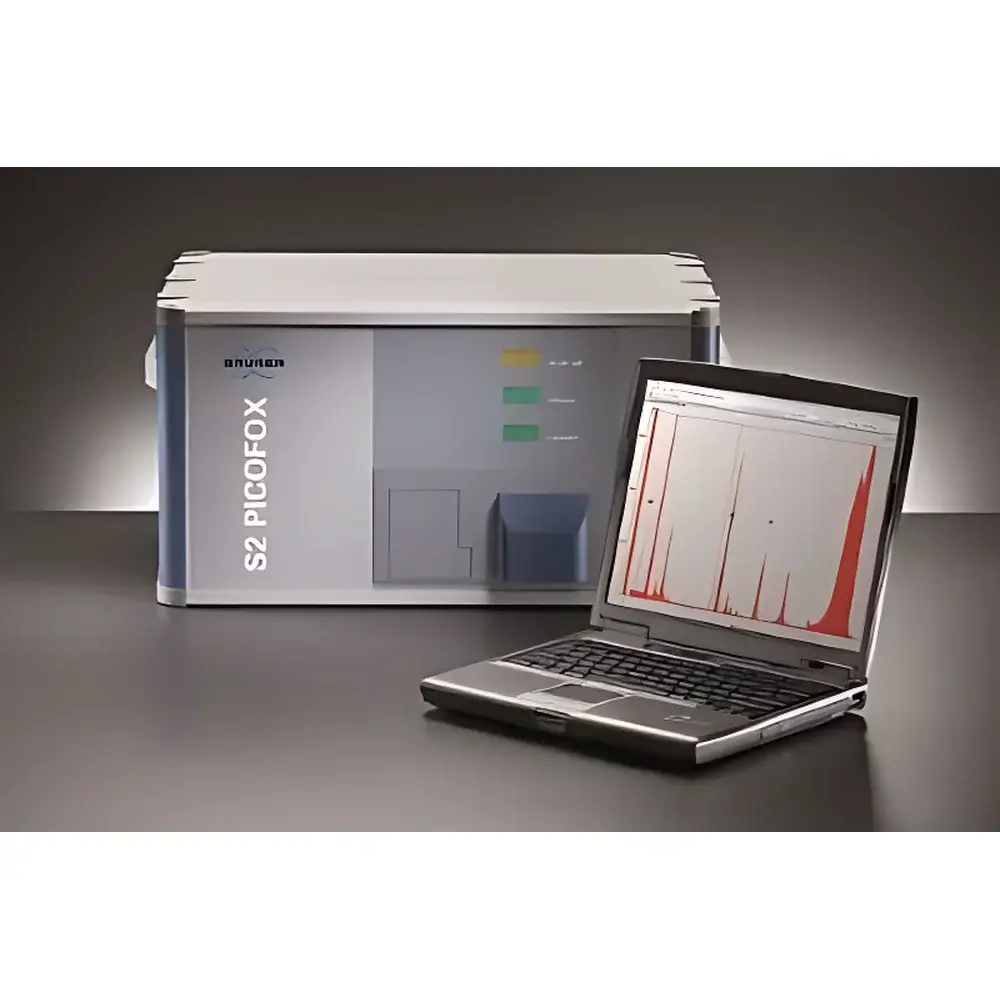
Bruker S2 PICOFOX Energy Dispersive Total Reflection X-Ray Fluorescence (TXRF) Spectrometer
| Brand | Bruker |
|---|---|
| Origin | Germany |
| Configuration | Benchtop TXRF System |
| Element Range | Al (13) to U (92) |
| Detection Limit | down to 2 pg |
| Quantification Range | sub-ppb to 100% w/w |
| Energy Resolution | <125 eV at Mn Kα (FWHM, 100 kcps) |
| Repeatability | ≤0.1% RSD |
| Detector | Fourth-generation XFlash® Silicon Drift Detector (SDD) with Peltier cooling |
| Sample Volume | 1–50 µL (liquids/suspensions) |
| Automation Options | 1-position or 25-position autosamplers |
| Compliance | Fully compatible with ISO 17025, ASTM E2486, and EU Directive 2009/48/EC for elemental migration testing |
Overview
The Bruker S2 PICOFOX is a high-sensitivity benchtop total reflection X-ray fluorescence (TXRF) spectrometer engineered for trace and ultra-trace multi-element analysis without matrix interference. Unlike conventional ED-XRF, TXRF operates at incident angles below the critical angle (~0.1°), enabling X-rays to undergo total external reflection from a flat, polished quartz carrier. This geometry suppresses background scattering by >10⁴-fold, resulting in exceptional signal-to-noise ratios and detection limits as low as 2 pg per element on the sample carrier. The instrument leverages monochromatic Mo Kα radiation (17.4 keV) generated by a high-stability microfocus X-ray tube, ensuring minimal spectral overlap and optimal excitation efficiency across the analytical range (Al to U). Its compact, self-contained architecture eliminates dependence on cryogenic cooling, compressed gases, or external vacuum pumps—making it suitable for both laboratory and field-deployable operation under ambient conditions.
Key Features
- Fourth-generation XFlash® SDD detector with integrated Peltier cooling: achieves energy resolution <125 eV at Mn Kα (FWHM, 100 kcps), enabling robust peak deconvolution for overlapping transitions (e.g., As Kα/Pb Lα, Se Kα/Br Kα).
- Optimized TXRF optical path with precision goniometer and motorized height adjustment: ensures reproducible beam alignment and carrier positioning within ±0.005° angular tolerance.
- Pre-calibrated factory quantification: linear calibration curves for >40 elements are embedded in firmware; no user-provided standards required for routine analysis of aqueous, digested, or suspended samples.
- Dual automation configurations: optional 1-position manual carrier stage for rapid method development, or 25-position carousel autosampler supporting unattended overnight analysis with programmable rinse cycles and carrier exchange.
- Robust carrier handling: accommodates standard 25 mm × 25 mm quartz reflectors; supports direct deposition of liquids, slurries, digests, filters, thin films, and aerosol-collected particulates without digestion or dilution.
Sample Compatibility & Compliance
The S2 PICOFOX accepts diverse sample forms—including aqueous solutions, acid digests (HNO₃/HCl), suspensions, dried filter residues, electroplated films, and airborne particulate matter collected on polycarbonate or quartz filters. Minimal sample consumption (1–50 µL liquid; ≤10 µg solid) reduces preparation time and contamination risk. Method validation adheres to ISO 17025 requirements for testing laboratories, with documented uncertainty budgets traceable to NIST SRM 2783 (Air Particulate on Filter) and BAM CRM 721 (Soil). It meets ASTM E2486 for TXRF-based elemental screening in environmental matrices and supports compliance reporting for EU RoHS, WEEE, and REACH substance restrictions. All quantitative workflows generate audit-ready reports compliant with FDA 21 CFR Part 11 when used with Bruker’s OPUS TXRF software suite.
Software & Data Management
OPUS TXRF v8.5 provides full instrument control, spectral acquisition, peak integration, matrix correction (internal standard or fundamental parameters), and statistical reporting. The software implements GLP-compliant electronic signatures, version-controlled method templates, and automated data archiving with SHA-256 checksum integrity verification. Raw spectra and processed results are stored in vendor-neutral .rif format (ASTM E1346), enabling third-party reprocessing. Batch processing supports ICP-MS cross-validation via correlation coefficient mapping and recovery calculation against certified reference materials. Audit trails record all parameter changes, user logins, and report exports with timestamped metadata.
Applications
The S2 PICOFOX delivers validated performance in regulated and research environments requiring sub-ppb sensitivity without sample destruction. Key use cases include: monitoring heavy metals (As, Cd, Pb, Hg) in drinking water per EPA Method 200.9; quantifying nutrient and contaminant elements (Ca, Mg, Fe, Ni, Cr) in soil extracts per ISO 11466; speciation-independent total element profiling in clinical biofluids (urine, serum) for occupational exposure assessment; screening leachable elements from toys and packaging per EN 71-3; and elemental mapping of thin-film uniformity in semiconductor process control. Its portability and low power demand (<300 W) further enable deployment in mobile labs for on-site soil screening or industrial hygiene surveys.
FAQ
Does the S2 PICOFOX require liquid nitrogen or external cooling gas?
No. The XFlash® SDD detector uses thermoelectric (Peltier) cooling only—no consumables, no maintenance, and stable operation over continuous 24/7 acquisition.
Can it analyze undigested solid samples directly?
Direct analysis is limited to homogeneous thin films or particulates deposited on carriers. Bulk solids (e.g., rocks, soils) require acid digestion or fusion prior to deposition to ensure representative sampling and avoid particle-size bias.
How is calibration verified without user standards?
Factory calibration is traceable to BAM and NIST reference materials. Users perform periodic verification using supplied check standards (e.g., multielement solution CRM BAM-U001), with automated drift correction applied during routine runs.
Is spectral deconvolution automated for overlapping peaks?
Yes. The OPUS TXRF software applies iterative least-squares fitting with physically constrained line shapes and known transition energies from the IUPAC X-ray database, minimizing operator-dependent interpretation.
What regulatory documentation is provided for GMP/GLP audits?
Bruker supplies IQ/OQ documentation packages, 21 CFR Part 11 configuration files, raw data integrity certificates, and annual performance qualification protocols aligned with ISO/IEC 17025:2017 Annex A.3.
Related Products




