
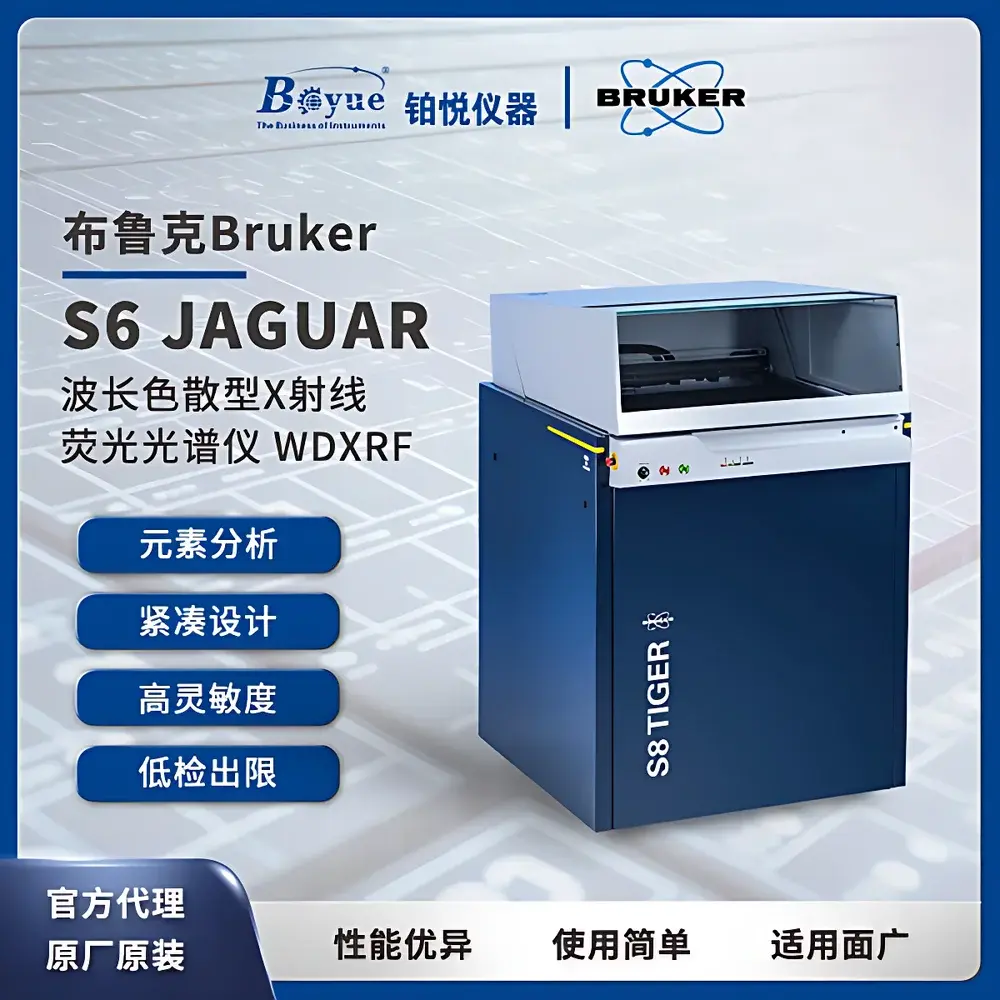
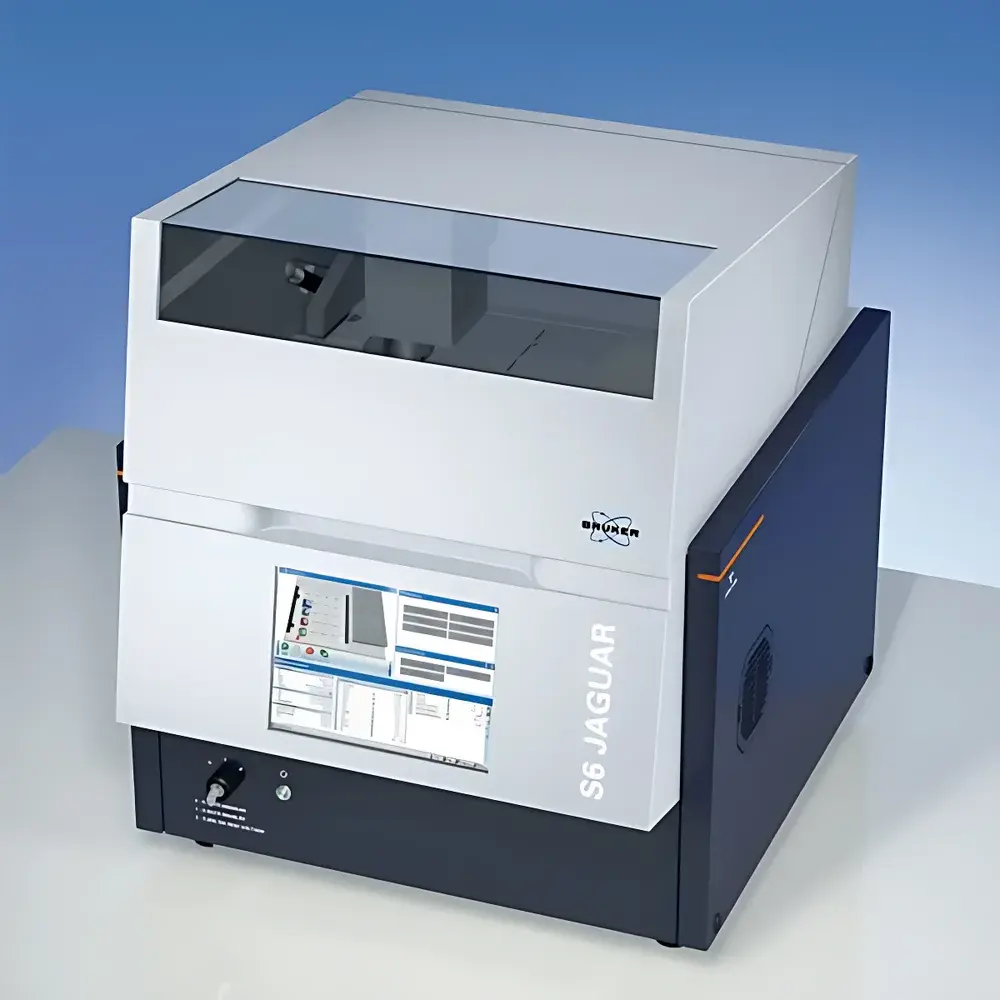
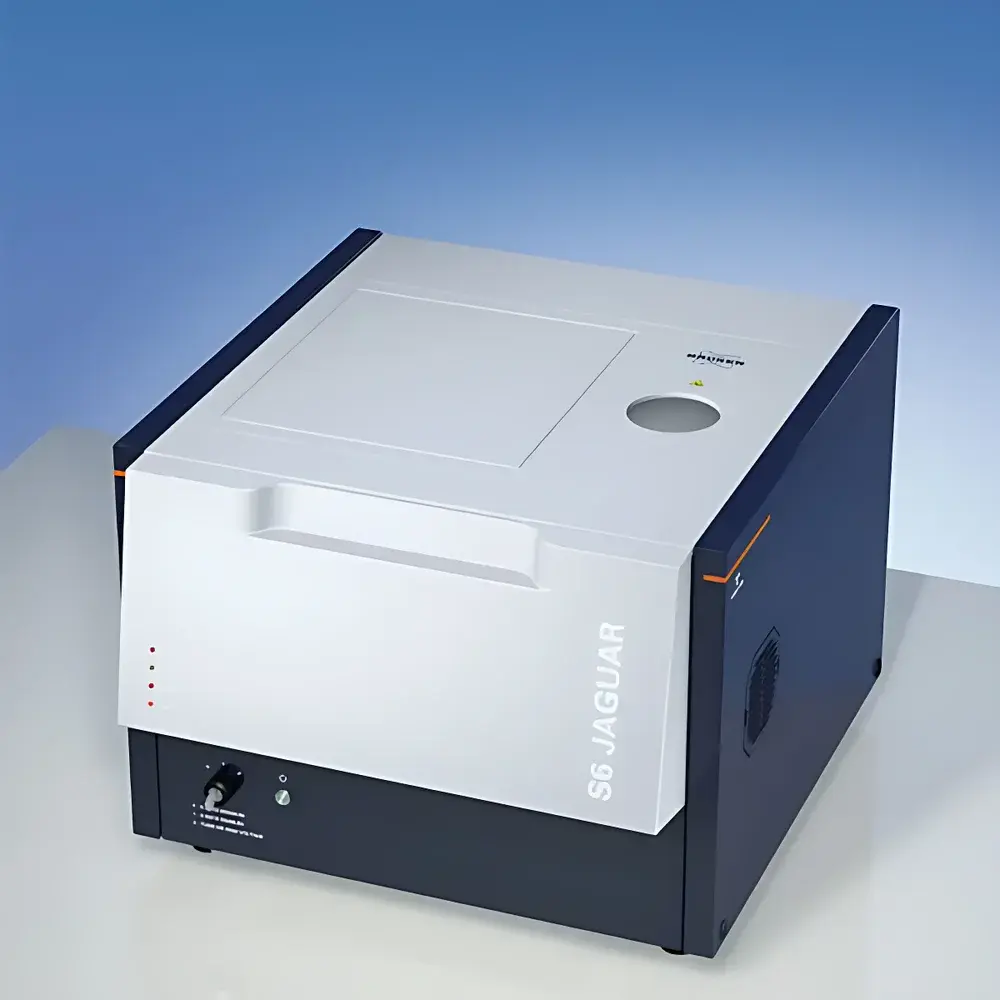
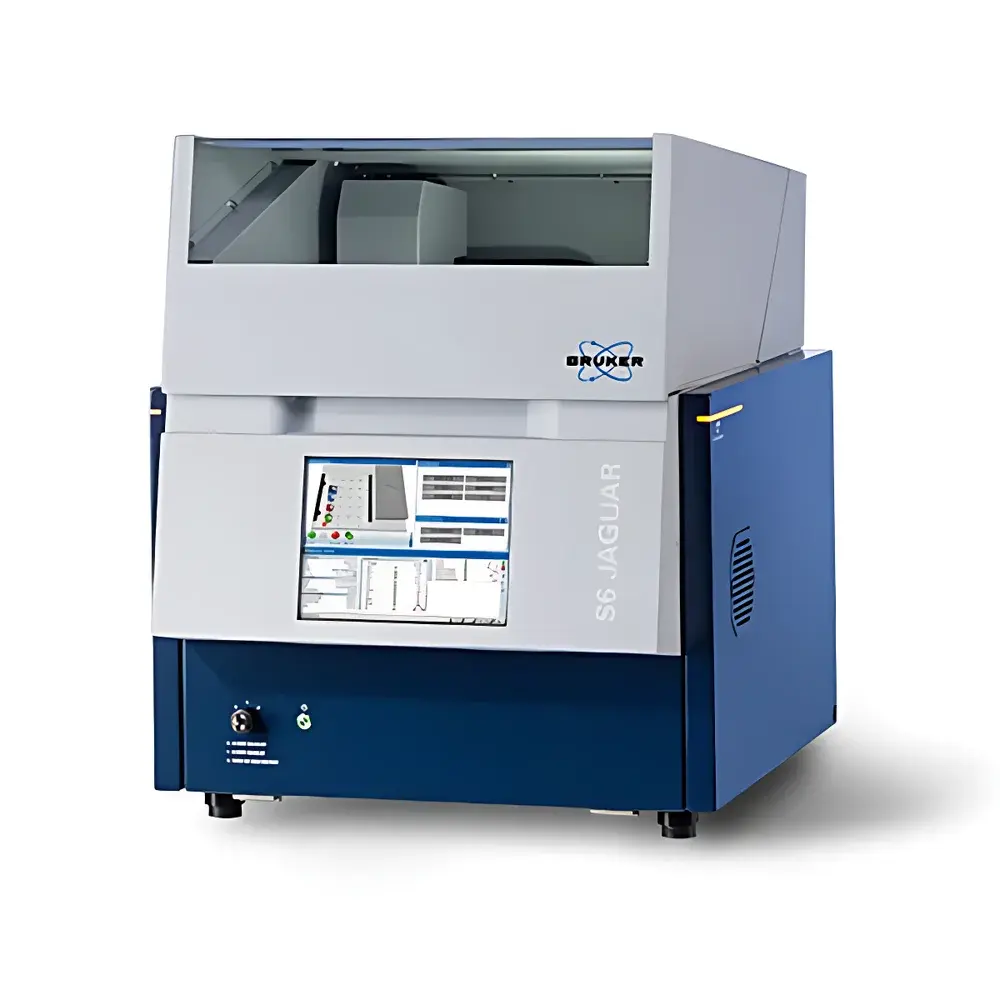
Bruker S6 JAGUAR Wavelength Dispersive X-Ray Fluorescence (WDXRF) Spectrometer
| Brand | Bruker |
|---|---|
| Origin | Germany |
| Model | S6 JAGUAR |
| Instrument Type | Benchtop |
| X-ray Tube Power | 400 W |
| Elemental Range | F to U |
| Detector Linear Count Rate | 2 Mcps |
| Beryllium Window Thickness | 75 µm |
| Configuration | Sequential + Simultaneous (Hybrid Scanning/Multi-Channel) |
| Compliance | ASTM C114, ASTM D2622, ASTM D6443, ISO 2936, ISO 8258, USP <232>/<233> |
Overview
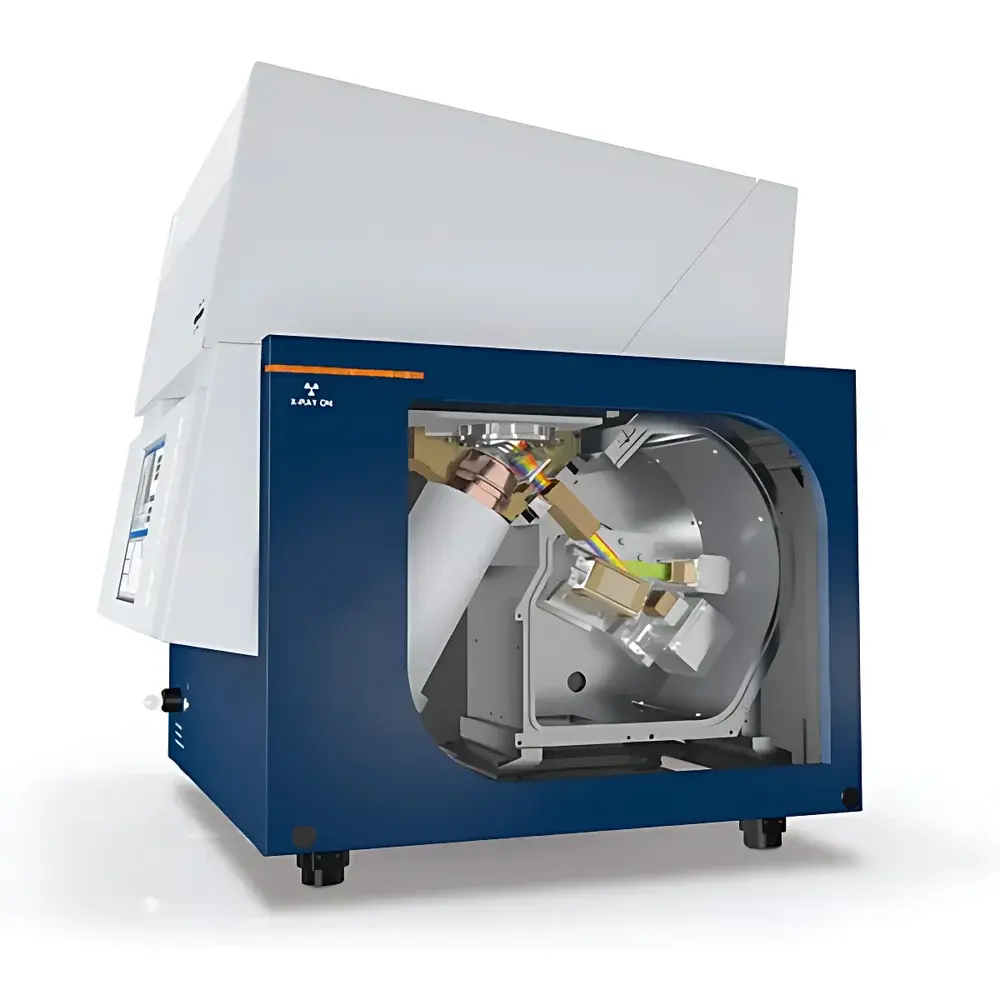
The Bruker S6 JAGUAR is a high-performance benchtop wavelength dispersive X-ray fluorescence (WDXRF) spectrometer engineered for precision elemental analysis across research, industrial quality control, and regulatory-compliant laboratories. Unlike energy-dispersive systems (EDXRF), the S6 JAGUAR employs Bragg diffraction from precisely aligned analyzing crystals to isolate characteristic X-ray lines—delivering superior spectral resolution, peak-to-background ratio, and quantitative accuracy, especially for overlapping or trace-level elements. Its 400 W direct-excited X-ray tube operates at variable kV (up to 50 kV) and mA (up to 17 mA), enabling optimized excitation conditions for both light elements (e.g., F, Na, Mg, Al, Si) and heavy elements (e.g., Pb, U) within a single platform. The instrument integrates a compact HighSense™ goniometer with four interchangeable analyzing crystals (e.g., LiF, PET, TAP, OVO-50), a five-position filter changer, dual detector options (including the HighSense™ XE proportional counter), and motorized collimator masks—ensuring full coverage from ppm-level detection to 100 wt% quantification without hardware reconfiguration.
Key Features
- 400 W high-power X-ray tube with independent kV/mA control: delivers up to 2× higher photon flux than 200 W systems and 8× higher than legacy 50 W instruments, significantly improving counting statistics and reducing measurement time by >50% for routine analyses.
- HighSense™ XE detector with 2 Mcps linear count rate and energy resolution ≤150 eV (Mn Kα), providing ≥2× better resolution than conventional flow-proportional counters—critical for minimizing inter-element overlaps in complex matrices.
- Four crystal positions and five selectable filters enable method-agnostic optimization for light- and heavy-element analysis, including low-Z elements down to fluorine (F) using optimized vacuum path and 75 µm Be window.
- Benchtop architecture with integrated temperature-stabilized optics and SampleCare™ sample protection system ensures long-term drift stability (<0.01% intensity variation over 24 h) and safe handling of liquids, powders, and solids.
- Touchscreen-driven SMART-QUANT WD™ software featuring fundamental parameter (FP) algorithms for true standardless quantification—even for unknown or heterogeneous samples—with optional certified reference material (CRM)-based calibration for GLP/GMP environments.
- Compliance-ready design: supports audit trails, electronic signatures, and 21 CFR Part 11–compliant data management via optional Bruker LabSolutions™ suite; validated for ASTM, ISO, and USP elemental impurity testing protocols.
Sample Compatibility & Compliance
The S6 JAGUAR accommodates solid discs (10–40 mm), pressed pellets, fused beads, thin films, and liquid samples in standardized cups—enabled by its programmable sample stage, automatic height compensation, and optional EasyLoad™ robotic autosampler. Its vacuum-compatible sample chamber and configurable collimators support analysis under air, helium, or vacuum depending on light-element requirements. Regulatory alignment includes full support for ASTM C114 (cement), ASTM D2622/D6443 (petroleum sulfur/additives), ISO 2936 (glass), ISO 8258 (statistical process control), and USP / (elemental impurities in pharmaceuticals). All analytical methods are fully documented, version-controlled, and exportable in PDF/CSV formats compliant with internal audit and external inspection requirements.
Software & Data Management
SMART-QUANT WD™ provides intuitive workflow navigation, real-time spectrum visualization, and automated peak deconvolution using iterative least-squares fitting. It embeds physics-based matrix correction models and supports user-defined calibration curves with uncertainty propagation. For regulated environments, optional LabSolutions™ adds role-based access control, electronic lab notebook (ELN) integration, raw data archiving with SHA-256 hashing, and full 21 CFR Part 11 compliance—including audit trail logging of all method changes, result modifications, and user actions. Data export supports LIMS connectivity via ASTM E1384 or OPC UA protocols.
Applications
- Cement & Construction Materials: Quantitative analysis of CaO, SiO₂, Al₂O₃, Fe₂O₃, SO₃, MgO, and alkalis in raw meal, clinker, and finished cement per ASTM C114—with RSD <0.2% for major oxides.
- Petrochemicals & Fuels: Ultra-low sulfur determination in ULSD (detection limit <10 ppm) per ASTM D2622; additive profiling in lubricants (Zn, Ca, P) per ASTM D6443.
- Pharmaceuticals & Chemicals: Elemental impurity screening (As, Cd, Hg, Pb, Ir, Os, Pd, Rh, Ru, Sb, Se, Tl) in APIs and excipients per ICH Q3D and USP /.
- Food & Feed: Multi-element mineral profiling (Na, Mg, Ca, Fe, Zn, Cu, Mn) in dairy, cereals, and animal feed; detection of toxic elements (e.g., Pb, Cd) in compliance with EU Commission Regulation (EC) No 1881/2006.
- Metallurgy & Slag Analysis: High-precision quantification of slag components (CaO, SiO₂, Al₂O₃, MgO, TiO₂, Cr₂O₃) and alloying elements (Ni, Co, Mo) in steelmaking processes.
- Geology & Mining: Grade control of iron ore, nickel laterite, copper sulfides, and industrial minerals (feldspar, limestone, quartz) with calibrated accuracy traceable to NIST SRMs.
- Glass & Ceramics: Compositional analysis of borosilicate, soda-lime, and technical ceramics—including trace transition metals affecting color and dielectric properties.
FAQ
What is the minimum detectable limit (MDL) for sulfur in diesel fuel using the S6 JAGUAR?
Typical MDL is <10 ppm under optimized vacuum/helium conditions per ASTM D2622; actual performance depends on sample homogeneity, measurement time, and matrix composition.
Can the S6 JAGUAR analyze liquid samples without digestion or dilution?
Yes—using dedicated liquid cups and the EasyLoad™ system, it directly measures fuels, oils, and aqueous solutions with no sample preparation required.
Is SMART-QUANT WD™ suitable for GLP-regulated laboratories?
Standard SMART-QUANT WD™ supports traceable reporting; full GLP compliance requires LabSolutions™ with 21 CFR Part 11 modules and validated installation/operational qualification (IQ/OQ) packages.
How many elements can be calibrated simultaneously in one method?
Up to 32 elements per method; sequential scanning allows unlimited element lists, while simultaneous channels (via optional multi-channel detector) accelerate high-throughput QC workflows.
Does the instrument require external cooling water or compressed air?
No—integrated thermoelectric cooling and sealed gas-flow detectors eliminate dependency on external utilities, reducing infrastructure cost and increasing operational reliability.




