
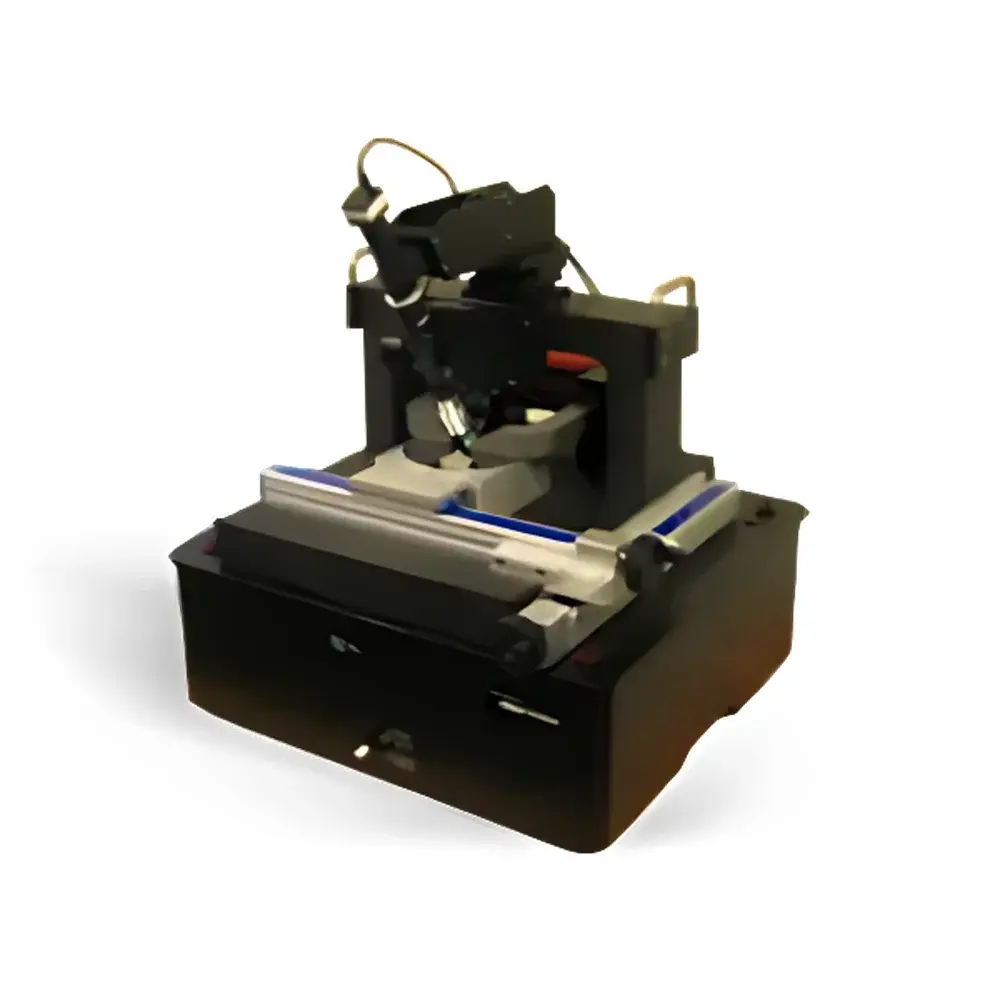
Bruker SmartProber TT Tunneling Magnetoresistance (TMR) Measurement System
| Brand | Bruker |
|---|---|
| Origin | USA |
| Manufacturer Type | Authorized Distributor |
| Origin Category | Imported |
| Model | SmartProber TT |
| Pricing | Available Upon Request |
| In-Plane Magnetic Field | Up to 48 kA/m (0.6 kOe) |
| Sample Stage | Manual X/Y Translation, 150 mm × 150 mm Clear Aperture |
| Maximum Sample Size | 150 mm (6″) diameter, ≤1.3 mm thickness |
| RA Range | 0.5–100 kΩ·µm² |
Overview
The Bruker SmartProber TT is a compact, benchtop tunneling magnetoresistance (TMR) characterization system engineered for precise current-in-plane tunneling (CIPT) measurements on magnetic thin-film stacks and spintronic device structures. Utilizing quantum mechanical electron tunneling through ultrathin insulating barriers (e.g., MgO, Al₂O₃), the SmartProber TT quantifies the resistance-area (RA) product and magnetoresistance ratio (MR%) as a function of in-plane applied magnetic field. Its design centers on accessibility and experimental flexibility—delivering metrology-grade CIPT data without requiring cleanroom integration or cryogenic infrastructure. The system operates at ambient temperature and pressure, making it suitable for rapid iterative testing during materials screening, process optimization, and prototype validation in academic labs and industrial R&D environments.
Key Features
- Benchtop CIPT platform with integrated electromagnet delivering a stable, uniform in-plane field up to 48 kA/m (0.6 kOe), calibrated traceably to NIST standards.
- Manual high-precision X/Y translation stage with 150 mm × 150 mm unobstructed travel range, enabling full mapping of 150 mm (6″) wafers or discrete samples.
- Automated probe landing mechanism with force feedback control, ensuring repeatable, low-damage contact across varied surface topographies (e.g., patterned MTJ arrays, CoFeB/MgO bilayers).
- Vibration-isolated optical table base with passive damping, minimizing mechanical drift during long-duration resistance sweeps (±0.1% stability over 30 min).
- Modular electrical interface supporting four-point probe configurations and optional lock-in amplification for low-noise RA extraction down to 0.5 kΩ·µm².
Sample Compatibility & Compliance
The SmartProber TT accommodates rigid planar substrates up to 150 mm in diameter and 1.3 mm in thickness—including Si/SiO₂ wafers, glass slides, and sapphire templates coated with magnetic multilayers (e.g., Ta/CoFeB/MgO/CoFeB/Ta). It supports both blanket films and lithographically defined test structures. All electrical measurements comply with ASTM F2627–22 (Standard Test Method for Resistance–Area Product of Magnetic Tunnel Junctions) and align with industry practices for MRAM development per JEDEC JESD22-A121. The system’s open architecture permits integration into GLP-compliant workflows, including audit-ready metadata logging (timestamp, field setpoint, probe position, environmental temperature) for regulatory documentation.
Software & Data Management
Bruker’s SmartProber Control Suite provides intuitive instrument orchestration via Windows-based GUI, supporting automated field sweeps, RA/MR% extraction, and real-time plotting. Raw voltage–current–field datasets are exported in HDF5 format with embedded metadata (including calibration coefficients and uncertainty estimates), ensuring FAIR (Findable, Accessible, Interoperable, Reusable) data principles. The software includes built-in statistical tools for within-wafer uniformity analysis (e.g., σ/μ of RA across 49 points) and supports export to MATLAB, Python (via h5py), or Excel for further modeling. Audit trails—including user login, parameter changes, and measurement timestamps—are retained in accordance with FDA 21 CFR Part 11 requirements when configured with electronic signature modules.
Applications
- Quantitative evaluation of MgO-based TMR stack quality during deposition process development (sputtering, annealing).
- Correlation of RA and MR% with interfacial roughness, oxygen stoichiometry, and thermal stability in CoFeB/MgO systems.
- Rapid screening of synthetic antiferromagnet (SAF) pinned layers and free-layer composition variants.
- Failure analysis of post-fabrication degradation (e.g., interdiffusion, pinhole formation) via spatially resolved CIPT mapping.
- Teaching and training in spintronics laboratories—enabling hands-on instruction in quantum transport, magnetic anisotropy, and tunnel barrier physics.
FAQ
What sample types are compatible with the SmartProber TT?
Standard substrates include Si wafers (up to 150 mm), fused silica, and alumina plates coated with magnetic multilayers; flexible or highly curved samples are not supported.
Is cryogenic operation possible?
No—the SmartProber TT is designed for ambient-temperature CIPT characterization only; low-temperature extensions require third-party integration and are not covered under standard warranty.
How is magnetic field uniformity verified?
Each system ships with a Hall probe map of the active area (±2% variation over central 100 mm × 100 mm), documented in the factory calibration report.
Can the system measure spin-valve GMR structures?
Yes—though optimized for TMR, the platform supports GMR measurements via configurable current paths and field orientation; RA ranges differ and must be validated per material stack.
Does Bruker provide application support for data interpretation?
Yes—Bruker offers remote application consulting, including RA/MR% modeling workshops and assistance with ASTM-compliant reporting templates.



