
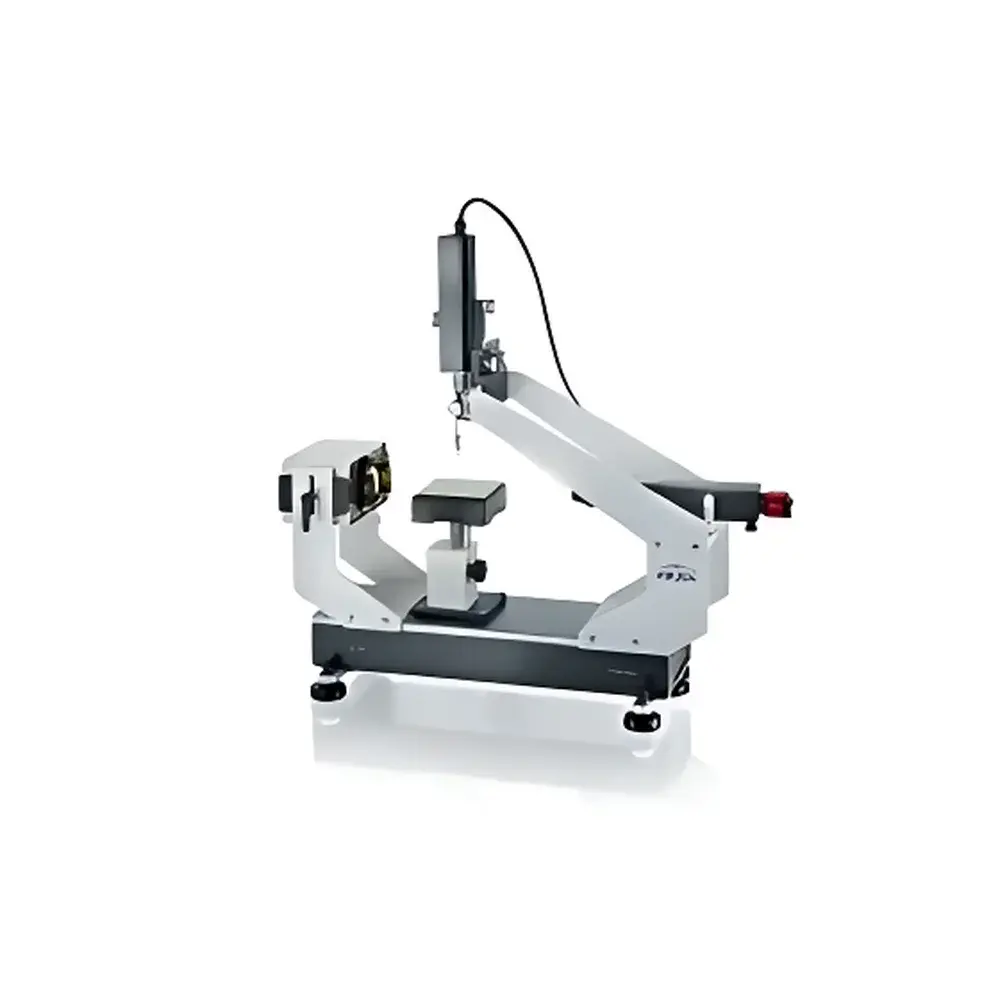
Kruss DSA25 Standard Video-Based Contact Angle Analyzer
| Brand | Kruss |
|---|---|
| Origin | Germany |
| Model | DSA25 |
| Instrument Type | Benchtop Laboratory Video Optical Contact Angle Analyzer |
| Contact Angle Measurement Range | 0–180° |
| Contact Angle Accuracy | ±0.1° |
| Sample Stage Dimensions | 105 × 105 mm |
| Optical Magnification | 6.5× |
| Surface/Interfacial Tension Range | 0.01–2000 mN/m |
| Surface/Interfacial Tension Accuracy | ±0.1 mN/m |
Overview
The Kruss DSA25 Standard Video-Based Contact Angle Analyzer is a precision-engineered benchtop instrument designed for quantitative characterization of solid–liquid interfacial phenomena using high-resolution video optical methodology. Based on the sessile drop technique, it captures real-time images of liquid droplets deposited on solid substrates and applies advanced edge-detection algorithms to determine contact angles with sub-degree resolution. The system operates on the principle of Young’s equation and extends analysis to dynamic wetting behavior—including advancing, receding, and roll-off angles—enabling rigorous assessment of surface heterogeneity, hysteresis, and anisotropy. Integrated temperature and humidity control modules allow measurements under environmentally stabilized conditions (–30 °C to +160 °C; RH 5–95%), ensuring reproducibility across diverse material systems and process-relevant environments. As a core platform in Kruss’ surface science portfolio—developed continuously since 1796—the DSA25 reflects over six decades of dedicated focus on interfacial metrology and compliance with international standards for surface property quantification.
Key Features
- High-precision optical imaging system with 6.5× magnification and motorized focus, delivering sharp, distortion-corrected droplet profiles for robust angle fitting
- Automated dual-syringe micro-dosing unit enabling needle-free, pressure-controlled dispensing—eliminating tip contamination and enabling rapid sequential measurement of static/dynamic angles
- Thermally regulated sample stage and environmental chamber supporting controlled measurements from –30 °C to +160 °C, with optional humidity regulation (5–95% RH) to suppress evaporation artifacts
- Dedicated surface energy module applying Owens–Wendt, Wu, Fowkes, van Oss–Chaudhury–Good, and Schultz models to decompose total surface energy into dispersive and polar components
- Benchtop architecture with compact footprint (W × D × H ≈ 450 × 400 × 500 mm), CE-marked electrical safety, and vibration-isolated optical baseplate for lab-integrated deployment
Sample Compatibility & Compliance
The DSA25 accommodates rigid and flexible planar samples up to 105 × 105 mm in dimension and 50 mm in thickness—including wafers, polymer films, coated metals, ceramics, textiles, and biological membranes. Its modular design supports optional accessories such as tilting stages (±90°), temperature-controlled Peltier cells, and gas purge chambers for inert-atmosphere testing. The instrument complies with ISO 19403-2 (contact angle determination), ISO 19403-4 (surface free energy calculation), ASTM D7334 (surface energy of polymer coatings), and supports audit-ready documentation per GLP/GMP and FDA 21 CFR Part 11 requirements when paired with Kruss ADVANCE software’s electronic signature and data integrity modules.
Software & Data Management
Kruss ADVANCE software provides a unified interface for instrument control, image acquisition, real-time analysis, and report generation. All workflows—including static angle, dynamic cycle, surface energy mapping, and tensiometry—are accessible via tabbed navigation without hidden menus or context-switching. Image sequences are timestamped and stored with full metadata (temperature, humidity, syringe pressure, lighting intensity). Data export supports CSV, PDF, PNG, and XML formats; batch processing enables statistical evaluation across multiple samples or time points. Software validation packages and IQ/OQ documentation kits are available for regulated laboratories requiring formal instrument qualification.
Applications
- Quantitative evaluation of plasma, corona, flame, or chemical surface treatments on polymers and composites
- Adhesion optimization in printing, lamination, and adhesive bonding processes through wetting envelope analysis
- Quality assurance of semiconductor wafers, display glass, and medical device substrates for cleanliness and functional coating uniformity
- Development and screening of hydrophobic/hydrophilic coatings for architectural glass, automotive surfaces, and filtration membranes
- Stability assessment of emulsions and foams via pendant drop interfacial tension measurements at elevated temperatures
FAQ
What measurement methods does the DSA25 support?
Sessile drop (static and dynamic), pendant drop (surface/interfacial tension), tilt-based roll-off angle, and captive bubble (for hydrophilic or porous substrates).
Can the DSA25 measure contact angles on curved or rough surfaces?
Yes—using optional high-magnification lenses and top-view illumination, combined with advanced baseline correction algorithms for non-planar topographies.
Is the system compatible with third-party environmental chambers?
Yes—the DSA25 features standardized I/O ports and RS-232/Ethernet interfaces for synchronization with external temperature, humidity, or gas-control units.
How is calibration performed for contact angle and surface tension?
Angle calibration uses certified reference standards (e.g., Kruss CAL-100, 90° and 120° sapphire wedges); surface tension calibration employs pure water and diiodomethane at 20 °C per ISO 1409.
Does the software support automated pass/fail criteria for QC workflows?
Yes—user-defined tolerance limits can be applied per parameter (e.g., contact angle ±1.5°, surface energy ±2.0 mJ/m²), triggering visual alerts and auto-flagging of out-of-spec results in reports.



