
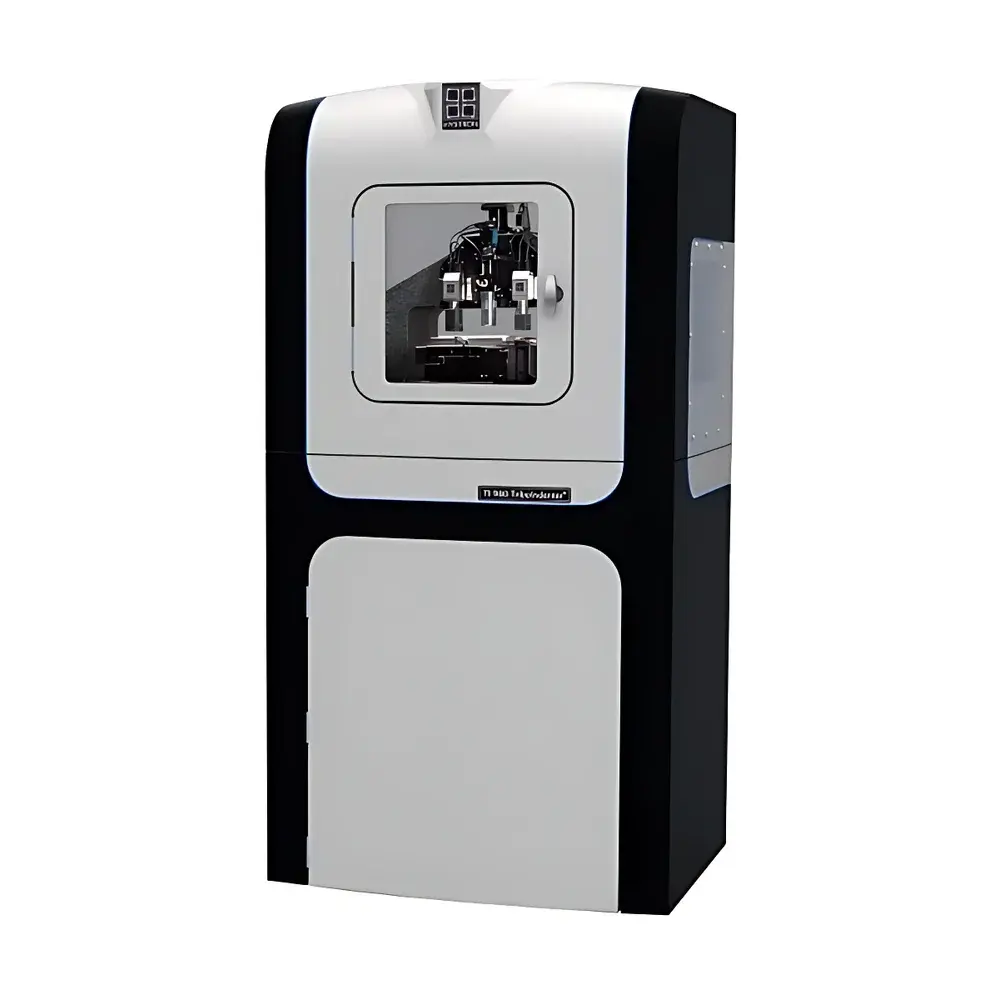
Bruker TI 980 High-Precision Nanomechanical Testing System
| Brand | Bruker |
|---|---|
| Origin | USA |
| Model | TI 980 |
| Instrument Type | Nanoindentation and Scratch Tester |
| Key Technology | Three-Plate Capacitive Transduction |
| Compliance | ASTM E2546, ISO 14577, ISO 20503, USP <1062> |
| Optional Modules | High-Temperature Stage, Electrical Characterization Module, Humidity Control Chamber, Cryogenic Stage, Raman Coupling Interface |
Overview
The Bruker TI 980 High-Precision Nanomechanical Testing System is a fully automated, high-throughput platform engineered for quantitative nanoscale mechanical characterization of advanced materials. Based on the fundamental principles of depth-sensing indentation and controlled lateral loading, the system employs a proprietary three-plate capacitive transduction architecture to achieve sub-nanometer displacement resolution and femtonewton force sensitivity. This core sensing technology enables direct, real-time measurement of load–displacement curves with exceptional signal-to-noise ratio and thermal drift suppression—critical for reproducible nanoindentation, nanoscratch, and dynamic mechanical analysis across heterogeneous surfaces and thin-film architectures. Designed for rigorous research and industrial quality control environments, the TI 980 operates under closed-loop force and displacement control, ensuring compliance with international standards including ASTM E2546 (Standard Test Method for Instrumented Indentation Testing), ISO 14577 (Metallic materials — Instrumented indentation test), ISO 20503 (Instrumented scratch testing), and USP (Mechanical Characterization of Pharmaceutical Solid Dosage Forms).
Key Features
- Three-plate capacitive transducer delivering <0.05 nm displacement resolution and ±0.2% full-scale force accuracy over a 10 nN–500 mN dynamic range
- Modular, motorized stage with 100 mm × 100 mm travel and integrated optical microscope (10×–100× zoom) for precise feature targeting and in situ imaging
- Automated multi-sample mapping capability supporting up to 1000 predefined test locations per run, with programmable grid, line, or custom pattern sequencing
- Real-time feedback control algorithms enabling constant strain-rate, constant loading rate, and creep/relaxation protocols per ISO 14577 Annex D
- Rigid granite base and active vibration isolation platform minimizing environmental perturbation during long-duration tests (e.g., 10,000 s creep measurements)
- Comprehensive calibration traceability to NIST-traceable reference standards for both force and displacement axes
Sample Compatibility & Compliance
The TI 980 accommodates specimens ranging from polished wafers and freestanding membranes to irregularly shaped biomedical implants and cross-sectioned composite laminates. Sample height tolerance spans −5 mm to +25 mm relative to stage plane, with vacuum chuck, mechanical clamps, and custom fixture options available. All measurement workflows support GLP/GMP-aligned audit trails, electronic signatures, and 21 CFR Part 11–compliant data integrity features—including immutable raw data archiving, user access tiering, and time-stamped operation logs. The system is routinely validated for use in regulated environments such as semiconductor process development labs, orthopedic biomaterial certification, and pharmaceutical coating adhesion assessment per ICH Q5E and Q5C guidelines.
Software & Data Management
TriboScan™ v5.1 software provides unified control, acquisition, and post-processing within a single GUI environment. It includes embedded modules for Oliver–Pharr analysis, pile-up/sink-in correction, Weibull statistics for fracture toughness, and ISO-compliant scratch failure classification (adhesive vs. cohesive). Raw data are stored in vendor-neutral HDF5 format with embedded metadata (test parameters, calibration history, environmental conditions). Integration with MATLAB®, Python (via Bruker SDK), and LabVIEW® enables custom algorithm deployment and statistical process control (SPC) pipeline integration. Automated report generation supports configurable templates compliant with internal SOPs or external regulatory submissions.
Applications
- Nanoscale hardness and elastic modulus mapping of ALD-grown oxide films on Si substrates
- Interfacial adhesion quantification of PVD-coated cutting tools using progressive-load scratch testing
- Critical stress intensity factor (KIC) determination in brittle ceramics via Vickers-induced crack analysis
- Time-dependent viscoelastic response of hydrogels under physiological temperature and humidity conditions (with optional environmental modules)
- Mechanical anisotropy profiling in additively manufactured Ti-6Al-4V lattice structures
- Wear volume quantification and coefficient of friction derivation during reciprocating nanoscratch cycles on polymer nanocomposites
FAQ
What standards does the TI 980 comply with for nanoindentation testing?
ASTM E2546, ISO 14577, ISO 20503, and USP , with full documentation of uncertainty budgets and calibration traceability.
Can the TI 980 perform simultaneous electrical and mechanical characterization?
Yes—when equipped with the optional Electrical Characterization Module, it supports DC current–voltage (I–V), resistance–load, and piezoresistive response measurements synchronized with indentation or scratch events.
Is remote operation and data monitoring supported?
Yes—the system supports secure HTTPS-based remote access via Bruker’s WebConnect portal, enabling real-time status monitoring, queue management, and diagnostic logging without local network exposure.
How is thermal drift compensated during extended hold tests?
A dual-sensor thermal compensation algorithm continuously monitors baseplate and transducer housing temperatures, dynamically adjusting displacement zero-reference points with sub-0.1 nm stability over 24-hour periods.
What sample preparation requirements apply for biological tissues?
Cryofixed or resin-embedded sections ≥5 µm thick mounted on conductive substrates; ambient humidity control (optional module) maintains hydration state during testing to prevent artifactual stiffening.



