
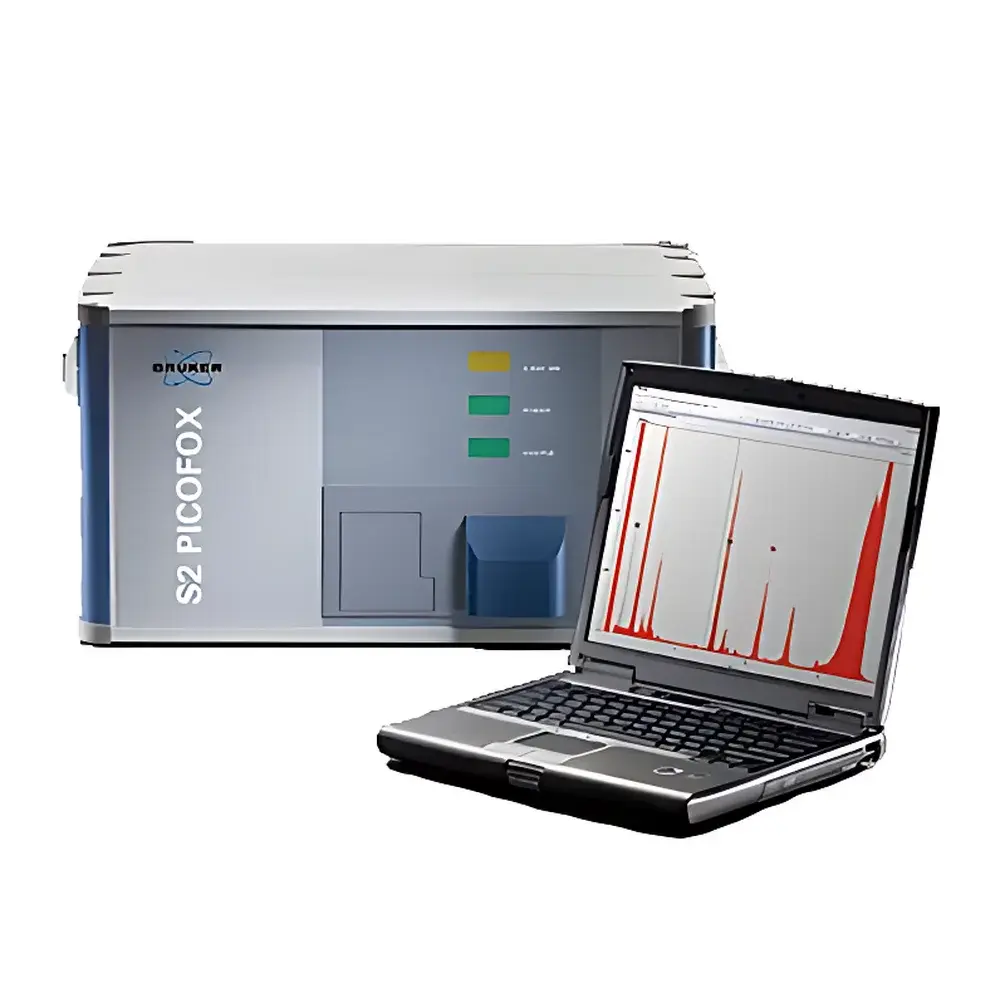
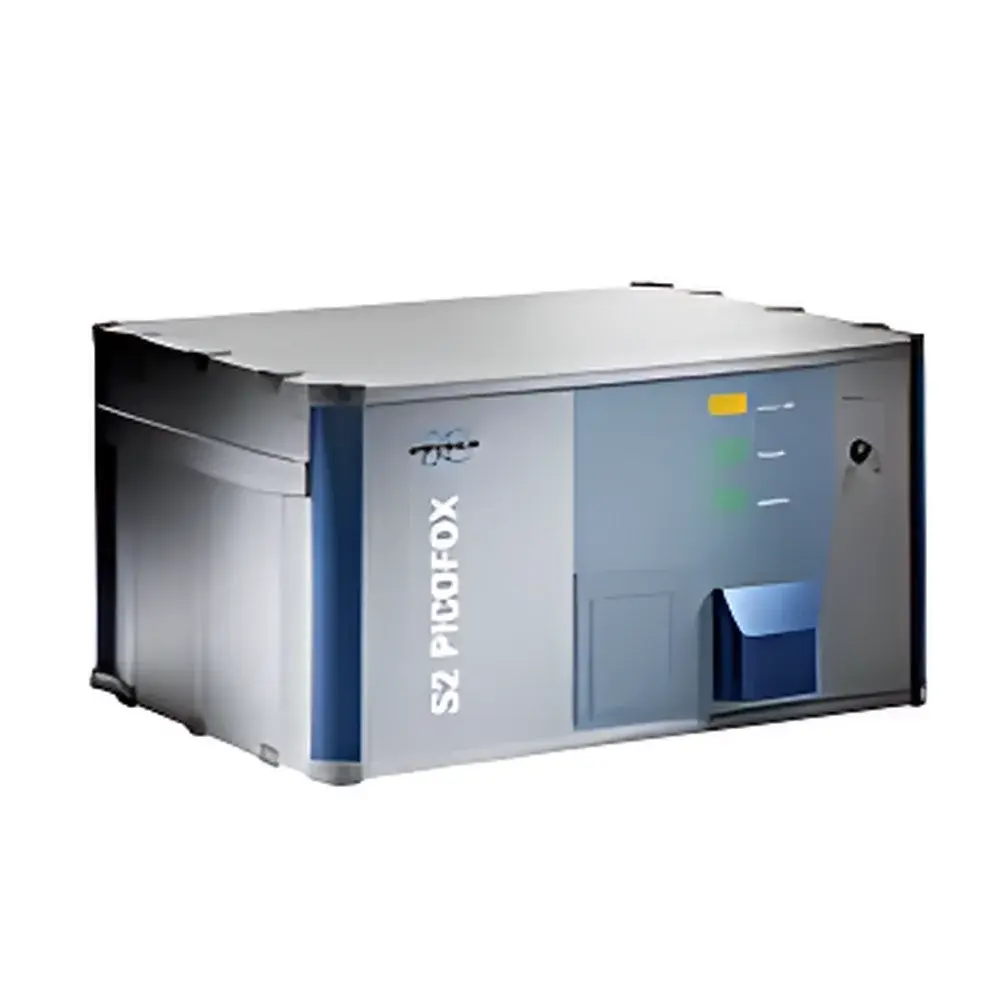
Bruker TXRF Blood Heavy Metal Analyzer
| Brand | Bruker |
|---|---|
| Origin | Germany |
| Type | Total Reflection X-ray Fluorescence (TXRF) Spectrometer |
| Model | Blood Heavy Metal Analyzer |
| Element Range | Al (13) to U (92) |
| Detection Limit | 2 pg |
| Sample Volume (Liquid/Suspension) | 1–50 µL |
| Sample Mass (Powder) | <10 µg |
| Detector | 4th-Generation XFlash® SDD Silicon Drift Detector |
| Cooling | Peltier (No Liquid Nitrogen Required) |
| Energy Resolution | <160 eV at Mn Kα (100 kcps) |
| Automation Options | 1-position or 25-position Auto-sampler |
| Compliance | ASTM D7782, ISO 17294-2, USP <232>/<233>, GLP/GMP-ready data integrity features |
Overview
The Bruker TXRF Blood Heavy Metal Analyzer is a benchtop total reflection X-ray fluorescence spectrometer engineered for ultra-trace elemental quantification in biological matrices—specifically whole blood, serum, plasma, and dried blood spots. Operating on the physical principle of total external reflection, the instrument directs a monochromatic, low-angle X-ray beam onto a polished quartz carrier, where the evanescent wave excites atoms within the thin (10⁴× compared to conventional ED-XRF, enabling direct quantification without matrix-matched standards. The system delivers sub-picomolar sensitivity across the full elemental range from aluminum (Z=13) to uranium (Z=92), with certified detection limits as low as 2 pg per element—equivalent to ~0.02 ng/mL in 20 µL whole blood. Its compact, self-contained architecture eliminates dependence on cryogenic cooling, high-pressure gases, or external vacuum pumps, making it suitable for regulated clinical laboratories, reference labs, and point-of-need toxicology screening environments.
Key Features
- Patented TXRF optical geometry ensuring near-zero background and linear fluorescence intensity vs. mass response (R² > 0.9998 over 4 orders of magnitude)
- 4th-generation XFlash® SDD detector with Peltier thermoelectric cooling—zero consumables, stable gain calibration, and resolution <160 eV at Mn Kα under high-count-rate conditions (100 kcps)
- Integrated micro-droplet dispensing and rapid drying module optimized for biological liquids: automated deposition of 1–50 µL samples onto quartz carriers with controlled evaporation kinetics
- Two configurable autosampler options: single-position for method development and validation; 25-position carousel for unattended batch analysis aligned with CLIA and CAP workflow requirements
- Pre-calibrated factory quantitative method libraries for As, Cd, Pb, Hg, Se, Zn, Cu, and Co in whole blood—traceable to NIST SRM 955c and ERM-DA483/ERM-DA484 certified reference materials
- Fully sealed X-ray tube with dual-anode (Mo/W) configuration, enabling optimal excitation energy selection for light- and heavy-element analysis without hardware modification
Sample Compatibility & Compliance
The analyzer accepts native, minimally processed biological specimens: anticoagulated whole blood (EDTA/K₂EDTA), serum, urine, and tissue homogenates. Solid-phase extraction residues, filter-collected airborne particulates, and digested environmental samples are also supported. All sample preparation adheres to ISO 17294-2:2016 (water quality) and ASTM D7782-22 (trace metals in biological fluids). Data acquisition and reporting comply with FDA 21 CFR Part 11 requirements—including electronic signatures, audit trails, and user-access controls—validated for GLP and GMP environments. Instrument qualification follows IQ/OQ/PQ protocols aligned with ICH Q2(R2) guidelines for analytical procedure validation.
Software & Data Management
The proprietary SPECTRA.ELEMENTS™ software provides end-to-end workflow automation: carrier positioning, beam alignment, spectrum acquisition, peak deconvolution (using fundamental parameter-based modeling), and concentration calculation via internal standard correction (e.g., Ga or Sc addition). All raw spectra and processing parameters are stored in a secure, encrypted SQLite database with immutable timestamps. Export formats include CSV, PDF analytical reports (with uncertainty propagation per GUM), and LIMS-compatible ASTM E1384-compliant XML. Software versioning, change control logs, and backup/recovery protocols satisfy laboratory accreditation requirements (e.g., ISO/IEC 17025:2017 Clause 7.7).
Applications
- Clinical toxicology: Quantitative monitoring of lead (Pb), mercury (Hg), cadmium (Cd), and arsenic (As) in occupational exposure screening and chelation therapy follow-up
- Nutritional assessment: Simultaneous measurement of essential elements (Zn, Cu, Se, Fe) and toxicants in pediatric and geriatric populations
- Forensic pathology: Multi-element profiling of postmortem blood and vitreous humor for cause-of-death determination
- Pharmaceutical quality control: Residual catalyst metal analysis (Pd, Pt, Ni) in biologics and small-molecule APIs per USP /
- Environmental health studies: Cross-matrix correlation of blood metal levels with soil/water contamination data in epidemiological cohorts
FAQ
Does the system require daily recalibration with certified standards?
No—factory pre-calibration using NIST-traceable multielement standards enables direct quantification. Routine verification uses a single-point check standard (e.g., 10 ng/mL Pb in matrix-matched blood surrogate) every 24 hours.
Can the instrument analyze hemolyzed or lipemic blood samples?
Yes—TXRF is insensitive to optical turbidity and organic matrix interference. Hemolysis and lipemia do not affect quantification accuracy when sample volume is precisely dispensed and uniformly dried.
What is the typical analysis time per blood sample?
Total cycle time—including carrier loading, drying, measurement (120 s live time), and cleaning—is ≤4.5 minutes for single-position operation and ≤5.2 minutes in 25-position batch mode.
Is method transfer possible between different Bruker TXRF systems?
Yes—spectral libraries, calibration coefficients, and acquisition methods are fully portable across Bruker’s S2 PICOFOX and M4 TORNADO TXRF platforms via standardized .mth file export/import.
How is data integrity ensured during power interruption or software crash?
The system implements atomic write operations and journaling filesystems; all spectrum acquisitions are written to non-volatile memory before confirmation, and interrupted runs resume from last valid checkpoint without data loss.




