
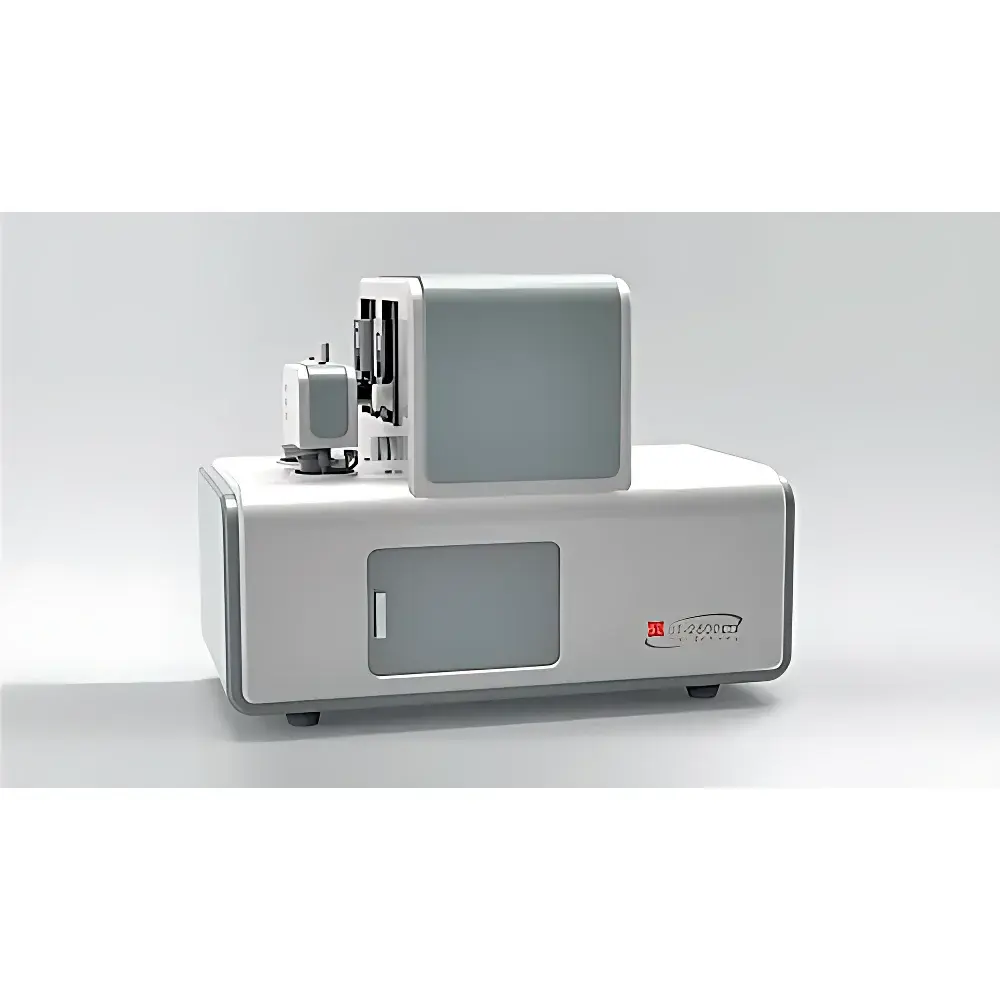
BT-2800 Dynamic Image-Based Particle Size and Shape Analyzer
| Brand | KJ GROUP (Shenyang Kejing) |
|---|---|
| Origin | Liaoning, China |
| Model | BT-2800 |
| Measurement Principle | Sheath-flow assisted high-speed dynamic imaging |
| Particle Size Range | 4–400 µm |
| Repeatability Error | ≤1% (D₅₀, GB standard reference material) |
| Accuracy Error | ≤1% (D₅₀, GB standard reference material) |
| Particle Recognition Speed | ≥10,000 particles/min |
| Imaging Frame Rate | 120 fps (CCD) |
| Optical Magnification | 150×–1000× |
| Resolution | ≤0.5 µm |
| Light Source | High-intensity LED point source |
| Output Data | Raw images, size distribution, shape descriptors (aspect ratio, circularity), cumulative/differential plots, equivalent diameters (e.g., Feret, Martin, projected area), interval content, D₁₀/D₅₀/D₉₀, Max particle size |
| Sample Preparation | Integrated stirring & ultrasonic dispersion |
| Fluidics | Sheath-flow hydrodynamic focusing with precision piston pump |
| Image Processing | Real-time particle segmentation, de-agglomeration algorithm for touching/overlapping particles |
| Compliance Support | ASTM E2457 (image-based particle characterization), ISO 13322-2:2013, USP <429>, GLP-compliant audit trail logging (via optional software module) |
Overview
The BT-2800 Dynamic Image-Based Particle Size and Shape Analyzer is an engineered solution for quantitative morphological characterization of dry or suspended particulates in the 4–400 µm range. It operates on the principle of high-speed dynamic imaging under controlled hydrodynamic conditions—specifically, sheath-flow-assisted particle alignment—enabling statistically robust single-particle analysis without sedimentation bias. Unlike static image analyzers requiring dried mounts, the BT-2800 captures particles in motion within a laminar flow stream, minimizing agglomeration artifacts and preserving native dispersion state. Its core architecture integrates a precision piston pump, microfluidic sheath-flow channel, high-stability LED illumination, and a 120 fps monochrome CCD sensor with 150×–1000× optical magnification. Each acquired frame undergoes real-time binary segmentation, edge detection, and geometric parameterization—delivering not only size distributions (based on Feret, Martin, and projected-area equivalent diameters) but also shape metrics including aspect ratio, circularity, convexity, and solidity. The system is designed for laboratories requiring traceable, repeatable, and morphology-inclusive quality control in advanced material development.
Key Features
- Sheath-flow hydrodynamic focusing ensures uniform particle orientation and minimizes multi-particle overlap during transit through the field of view.
- Integrated sample preparation module with programmable magnetic stirring and ultrasonic dispersion (frequency and duration configurable) enables reproducible suspension homogenization.
- Real-time de-agglomeration algorithm identifies and separates touching or partially fused particles using watershed segmentation and intensity gradient analysis—critical for needle-like or fibrous materials such as wollastonite or silicon carbide whiskers.
- Auto-alignment system maintains optimal optical path geometry between lens, light source, and sensor, reducing operator-dependent variability across measurement sessions.
- Data acquisition at 3,500 frames per second (interleaved sampling) combined with 120 fps full-resolution imaging yields >10,000 particles/min throughput with statistical confidence intervals suitable for QC release testing.
- Calibration traceability via NIST-traceable stage micrometer; software-supported validation protocols compliant with ISO/IEC 17025 internal verification requirements.
Sample Compatibility & Compliance
The BT-2800 accommodates aqueous and organic suspensions (e.g., ethanol, isopropanol) as well as dry powders introduced via aerosol dispersion (optional accessory). It is validated for narrow-distribution samples where Dmax/Dmin ≤ 30—ideal for spherical graphite anode materials, gas-atomized aluminum alloys, fused alumina abrasives, synthetic diamond grits, polystyrene calibration standards, and high-aspect-ratio silicates. Regulatory alignment includes support for ASTM E2457 (Standard Practice for Characterizing Particles Using Static Image Analysis), ISO 13322-2:2013 (Particle size analysis — Image analysis methods — Part 2: Dynamic image analysis), and USP (Light Diffraction and Image Analysis Methods). When configured with audit trail and electronic signature modules, the system meets FDA 21 CFR Part 11 requirements for regulated pharmaceutical and medical device manufacturing environments.
Software & Data Management
The proprietary KJ-ImagePro software provides a validated, Windows-based platform supporting method templates, instrument qualification logs, and raw image archiving (TIFF/RAW). All analyses generate timestamped reports containing histograms, scatter plots (circularity vs. aspect ratio), tabular statistics (D10, D50, D90, span, max diameter), and customizable export to CSV, PDF, or XML formats compatible with LIMS integration. Batch processing mode allows unattended sequential analysis of up to 24 samples with auto-threshold optimization per run. Software validation documentation (IQ/OQ/PQ protocols) and change control records are available upon request for GMP/GLP compliance audits.
Applications
- Battery materials R&D: Quantifying sphericity and surface roughness of synthetic graphite and silicon-carbon composites to correlate morphology with electrode packing density and cycle life.
- Advanced ceramics: Monitoring angularity and fragment distribution in milled SiC or Al2O3 abrasives to predict grinding efficiency and surface finish.
- Metal powder metallurgy: Verifying sphericity and satellite formation in plasma-rotating-electrode (PREP) or gas-atomized Ni-based superalloy powders for additive manufacturing feedstock qualification.
- Pharmaceutical excipients: Assessing crystallinity-induced shape variation in lactose monohydrate grades used in dry powder inhalers—where circularity directly influences aerosolization performance.
- Quality assurance labs: Routine release testing of glass microspheres, polymer beads, or catalyst supports where both size distribution width and shape consistency impact functional performance.
FAQ
What particle size range is supported by the BT-2800?
The system is optimized for particles between 4 µm and 400 µm. Below 4 µm, diffraction-limited resolution and Brownian motion reduce measurement fidelity; above 400 µm, field-of-view constraints limit statistical sampling density.
Can the BT-2800 analyze wet and dry samples interchangeably?
Yes—liquid suspensions are analyzed via the standard sheath-flow cell; dry powders require the optional aerosol dispersion unit with controlled carrier gas flow and electrostatic neutralization.
How does the system handle agglomerated or clustered particles?
A dedicated de-clustering algorithm applies morphological reconstruction and intensity thresholding to separate physically contacting particles, reporting corrected counts and metrics per ISO 13322-2 Annex B guidelines.
Is the software compliant with 21 CFR Part 11 for regulated industries?
Full compliance—including electronic signatures, audit trail, and role-based access control—is achievable with the optional KJ-ImagePro GxP Edition and associated validation package.
What calibration standards are recommended for routine verification?
NIST-traceable polystyrene microsphere kits (e.g., Thermo Scientific™ AccuCount™) and GBW(E)130014 glass bead standards are routinely used for size and shape verification across the operational range.



