
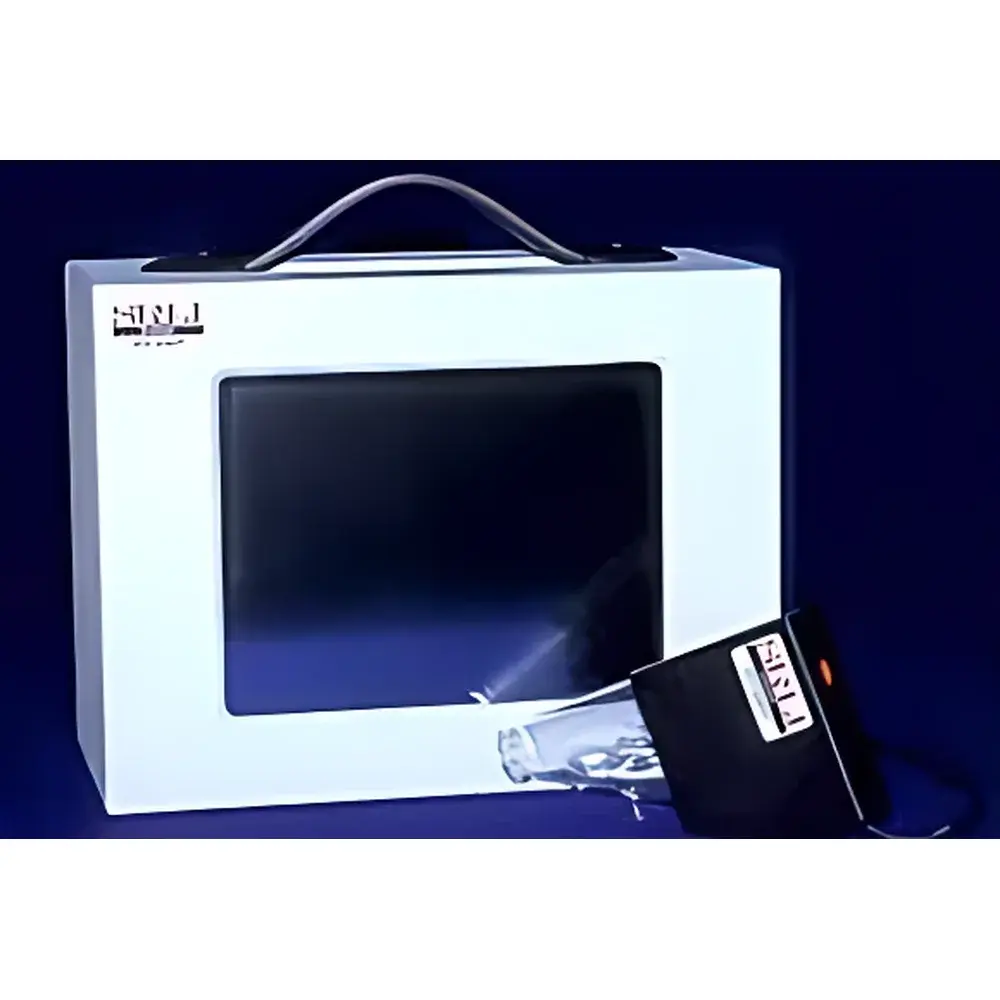
BTC-200 Cutaneous Viscoelasticity Analyzer – Non-Invasive Skin Compliance & Burn Scar Assessment System
| Origin | USA |
|---|---|
| Manufacturer Type | Authorized Distributor |
| Origin Category | Imported Instrument |
| Model | BTC-200 |
| Pricing | Available Upon Request |
| Sampling Rate | 10 Hz |
| Vacuum Ramp Rate | 10 mmHg/sec |
| Max Negative Pressure | 150 mmHg |
| Pressure Sensor Resolution | 0.01 mmHg |
| Laser Vertical Displacement Range | 0–25 mm |
| Laser Resolution | 3 µm |
| Probe Diameter (Suction) | 10 mm |
| Active Measurement Aperture | 2 mm |
| Power Input | 100–240 V AC, 50/60 Hz |
| Output | 24 V DC / 2.91 A |
| Dimensions | 30.48 × 25.4 × 15.24 cm |
| Weight | 7.7 kg |
Overview
The BTC-200 Cutaneous Viscoelasticity Analyzer is a precision-engineered, non-invasive instrument designed to quantify the mechanical behavior of biological and synthetic soft tissues under controlled negative pressure. Operating on the principle of vacuum-induced skin deformation coupled with high-resolution optical displacement sensing, the system measures both elastic recovery and viscoelastic relaxation in real time. A collimated laser beam—emitted from a stabilized diode source and detected by a photoreceptor—is attenuated proportionally as tissue is drawn into a 2 mm open-ended suction probe. The resulting intensity-to-depth relationship yields a pressure–displacement curve, from which key biomechanical parameters—including compliance, elastic modulus (E), creep compliance (J), and stress relaxation time constants—are derived using standardized constitutive modeling frameworks. Unlike indentation-based or tensile testers, the BTC-200 applies no lateral shear or compressive preload, preserving native tissue architecture and enabling repeatable longitudinal monitoring across clinical, dermatological, and biomaterial research settings.
Key Features
- Non-destructive, contactless optical measurement via 3 µm-resolution laser displacement sensing
- Controlled negative pressure application (0–150 mmHg) with programmable ramp rate (10 mmHg/sec) and dwell timing
- Dual-phase protocol: 5-second pressurization followed by 15-second relaxation, capturing full hysteresis loops
- Integrated vacuum pump with calibrated feedback loop and real-time pressure logging at 10 Hz sampling rate
- Compact, portable chassis (7.7 kg; 30.48 × 25.4 × 15.24 cm) suitable for clinic, lab, or field deployment
- Touchscreen interface with intuitive workflow navigation and on-device visualization of force–displacement curves
- Configurable analysis modes: raw displacement vs. pressure, normalized strain, time-dependent recovery kinetics, and area-normalized compliance
- Windows-compatible software with export options for CSV, PDF, and image formats; supports direct printer output and audit-trail-enabled data logging
Sample Compatibility & Compliance
The BTC-200 accommodates a broad spectrum of compliant substrates without sample preparation: human and porcine skin (intact, scarred, or grafted), burn wound granulation tissue, silicone gel breast implants, hydrogel scaffolds, synthetic membranes (e.g., polyurethane, PDMS), and elastomeric films. Its measurement paradigm aligns with ASTM D882 (tensile properties of thin plastic sheeting) and ISO 1798 (flexural properties of flexible cellular materials), while its clinical use adheres to ISO 14155:2020 (clinical investigation of medical devices) and FDA guidance on non-invasive dermal assessment tools. Data integrity meets 21 CFR Part 11 requirements for electronic records when configured with user authentication and timestamped audit trails. All test protocols are documented per GLP standards in over 70 peer-reviewed publications spanning wound healing, reconstructive surgery, cosmetic dermatology, and tissue engineering.
Software & Data Management
The BTC-200 Control Suite runs natively on Windows 10/11 and provides synchronized acquisition of pressure, displacement, and time vectors. Real-time plotting updates at ≥10 Hz, overlaying current and historical curves for comparative analysis. Built-in algorithms compute instantaneous compliance (Δz/ΔP), residual deformation ratio (zresidual/zmax), and time-to-50% recovery (T½). Users may define custom regions of interest, apply Savitzky-Golay smoothing, and export annotated datasets with metadata (operator ID, date/time, probe calibration ID, ambient temperature/humidity). Raw binary files (.btc) are encrypted and version-stamped; processed reports include traceable calibration certificates and uncertainty budgets per ISO/IEC 17025 guidelines. Software updates are delivered via secure HTTPS channel with SHA-256 signature verification.
Applications
- Quantitative evaluation of hypertrophic scar maturation following thermal injury in porcine and human models
- Longitudinal tracking of epidermal-dermal junction remodeling during moist wound healing therapies
- Comparative mechanical profiling of acellular dermal matrices (ADM), collagen scaffolds, and bioengineered skin substitutes
- In vitro validation of silicone gel sheeting efficacy on scar pliability and tensile recovery
- Preclinical assessment of topical agents (retinoids, peptides, hyaluronan derivatives) on age-related dermal stiffening
- Mechanical benchmarking of soft-tissue implants—including silicone breast prostheses—against native adipose and dermis
- Correlation of biomechanical metrics with histomorphometric features (elastin density, collagen crosslinking, MMP expression)
- Standardized endpoint measurement in Phase II/III trials of anti-fibrotic therapeutics targeting TGF-β signaling
FAQ
Does the BTC-200 require skin surface preparation prior to measurement?
No. The device operates on intact, dry, unoccluded skin; no coupling gels, abrasion, or occlusion is needed.
Can the BTC-200 differentiate between elastic and viscous components of tissue response?
Yes. By fitting the relaxation phase to a two-element Maxwell or three-element Kelvin-Voigt model, the system isolates instantaneous elastic modulus (E0) and retardation time (τ), enabling quantification of both solid-like and fluid-like behavior.
Is calibration traceable to national standards?
Yes. Pressure transducers are NIST-traceable; laser displacement calibration is verified annually using certified step gauges (NIST SRM 2160).
What is the minimum sample thickness compatible with the 2 mm aperture?
Samples ≥0.5 mm thick yield reliable signal-to-noise ratios; thinner membranes (e.g., 100 µm polymer films) require optional low-force mode activation.
How does the BTC-200 handle motion artifacts during clinical use?
The system incorporates adaptive baseline correction and motion rejection thresholds; operator-guided region-of-interest selection further minimizes extraneous displacement noise.





