
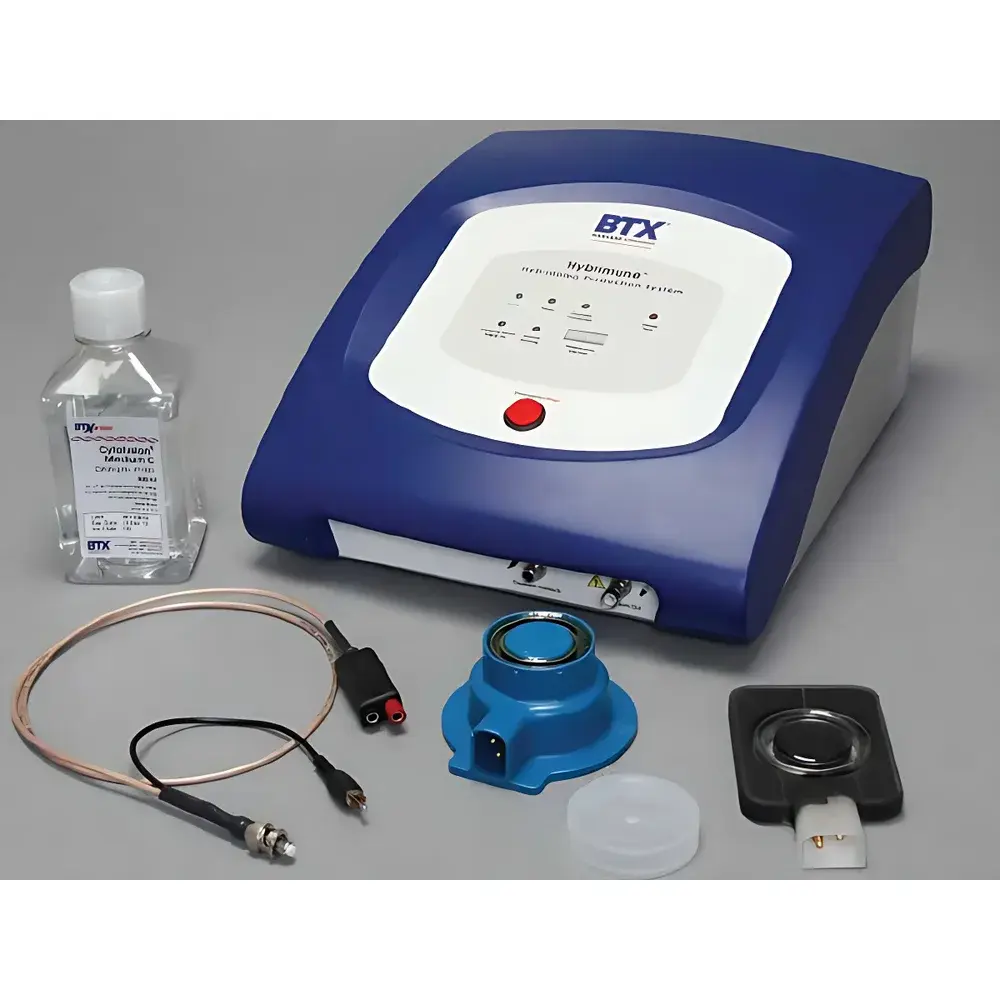
BTX Hybrimune High-Capacity Electroporation and Cell Fusion System
| Brand | BTX |
|---|---|
| Origin | USA |
| Model | BTX Hybrimune |
| Capacity Options | 2 mL (microscope-compatible transparent chamber) & 9 mL fusion chambers |
| AC Pre-Fusion Pulse | 0.2–2.0 MHz (0.2 MHz step), 5–75 V (0.1 V step), 0–60 s (1 s step), non-sinusoidal ramp-up waveform |
| AC Post-Fusion Pulse | same frequency/voltage range, ramp-down waveform |
| DC Fusion Pulse | square wave, 100–1000 V (5 V step), 20–1000 µs (10 µs step), 0–10 pulses, 0.125–10 s inter-pulse interval |
| Cycles | 1–10 sets |
| Operating Temperature | 20–30 °C |
| Compliance | Designed for GLP-compliant lab environments |
Overview
The BTX Hybrimune High-Capacity Electroporation and Cell Fusion System is an engineered platform for scalable, reproducible somatic cell fusion and electroporation-based transfection in life science research. Based on the well-established principle of reversible electroporation—where controlled electric fields transiently destabilize phospholipid bilayers to enable intercellular membrane reorganization—the Hybrimune system implements a precisely sequenced three-phase pulse protocol: AC pre-fusion alignment, DC fusion induction, and AC post-fusion stabilization. Unlike conventional single-pulse electroporators, this architecture enables high-efficiency hybridoma generation, interspecies cytoplasmic hybrid (cybrid) formation, and large-volume primary cell fusion with minimized thermal stress and maximal post-fusion viability. Its dual-chamber design (2 mL transparent and 9 mL high-yield) accommodates both real-time microscopic monitoring and preparative-scale applications—making it suitable for monoclonal antibody development, stem cell reprogramming studies, and synthetic biology workflows requiring stable heterokaryon formation.
Key Features
- Three-phase programmable pulse architecture: AC pre-alignment (ramp-up non-sinusoidal waveform), DC membrane restructuring (square-wave pulse), and AC post-stabilization (ramp-down waveform) — each independently adjustable in amplitude, duration, frequency, and step resolution.
- Dual-capacity fusion chambers: 2 mL chamber with optically clear bottom for live-phase contrast or fluorescence microscopy observation of bead-chain formation; 9 mL chamber optimized for high-yield hybridoma production and bioprocess scaling.
- Temperature-controlled operation (20–30 °C ambient range) with low-heat pulse delivery ensures minimal thermal denaturation during extended protocols.
- Fully software-driven interface enabling parameter definition, storage, recall, and versioned experimental logging — supporting method traceability and procedural consistency across users and timepoints.
- Proprietary fusion buffer formulation included, optimized for membrane fluidity modulation and electrochemical stability under pulsed field conditions — validated for enhanced fusion efficiency and post-fusion recovery in lymphocytes, myelomas, fibroblasts, and plant protoplasts.
Sample Compatibility & Compliance
The BTX Hybrimune system supports a broad spectrum of eukaryotic cell types including murine and human hybridoma lines, primary T-cells, embryonic stem cells, induced pluripotent stem cells (iPSCs), and plant protoplasts. It is compatible with standard electroporation buffers and proprietary BTX fusion media. All operational parameters comply with ISO/IEC 17025-aligned laboratory practice frameworks. While not FDA-cleared for clinical use, the system’s software architecture supports 21 CFR Part 11–compatible electronic signatures and audit-trail generation when deployed with validated IT infrastructure. Experimental records—including voltage profiles, timing sequences, chamber IDs, operator tags, and timestamps—are exportable in CSV and XML formats for integration into LIMS or ELN systems under GLP/GMP-aligned quality management systems.
Software & Data Management
The Hybrimune Control Suite provides a Windows-based GUI with intuitive parameter mapping, real-time pulse visualization, and hierarchical protocol libraries. Each saved method includes metadata such as chamber type, cell density input, buffer lot number, and environmental temperature reading. The software logs all executed runs with full waveform tracebacks, enabling retrospective troubleshooting and statistical analysis of fusion efficiency vs. parameter variation. Export functions support raw data dumps for third-party analysis in MATLAB, Python (NumPy/Pandas), or GraphPad Prism. Optional API integration allows automation via LabVIEW or custom Python scripts for high-throughput screening pipelines.
Applications
- Monoclonal antibody development: Efficient generation of stable hybridomas from splenocytes and myeloma cells with >60% viable heterokaryon yield under optimized protocols.
- Cell reprogramming studies: Creation of cybrids for mitochondrial replacement research and metabolic phenotyping across donor-recipient combinations.
- Plant biotechnology: Protoplast fusion for interspecific crop improvement where PEG-based methods show low reproducibility.
- Vaccine vector engineering: Electroporation-assisted delivery of large plasmid constructs (>15 kb) into dendritic cells followed by controlled fusion to amplify antigen-presenting capacity.
- CRISPR/Cas9 RNP delivery: Co-delivery of Cas9 ribonucleoprotein complexes and donor templates into hard-to-transfect primary cells prior to fusion-mediated expansion.
FAQ
What distinguishes the Hybrimune system from standard electroporators?
It integrates AC alignment and stabilization pulses with programmable DC fusion pulses—enabling true cell-cell membrane fusion rather than transient pore formation alone.
Can I monitor cell alignment in real time during AC pre-fusion?
Yes—the 2 mL chamber features a borosilicate glass base compatible with upright and inverted phase-contrast microscopes for live observation of pearl-chain formation.
Is the fusion buffer included with the instrument?
Yes, one initial kit of BTX-certified fusion buffer is supplied; additional kits are available under catalog number BTX-FB-KIT.
Does the software support multi-user access control and audit trails?
Yes—when configured with domain-authenticated Windows accounts and enabled logging, it meets ALCOA+ data integrity principles for regulated environments.
What maintenance is required for long-term reliability?
Annual calibration verification using the included test load module is recommended; no consumable electrodes or disposable chips are used—chambers are autoclavable and chemically resistant.





