
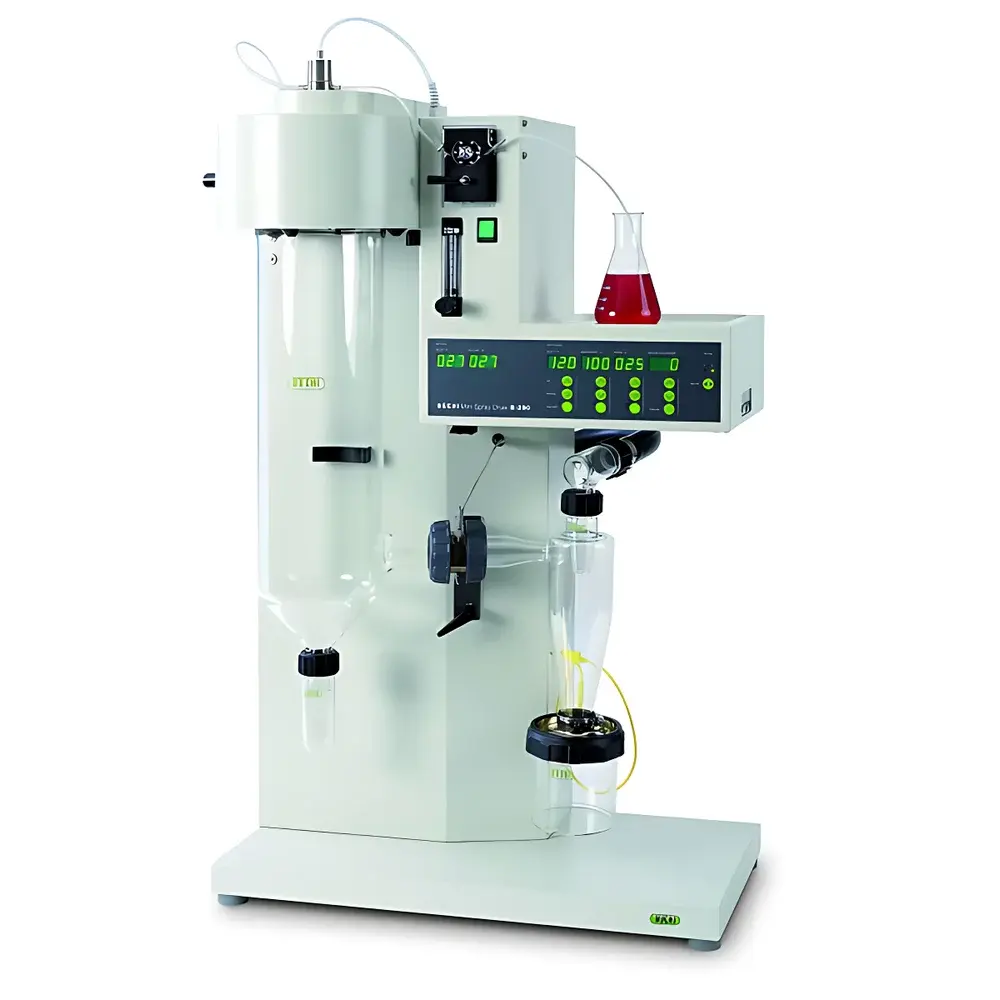
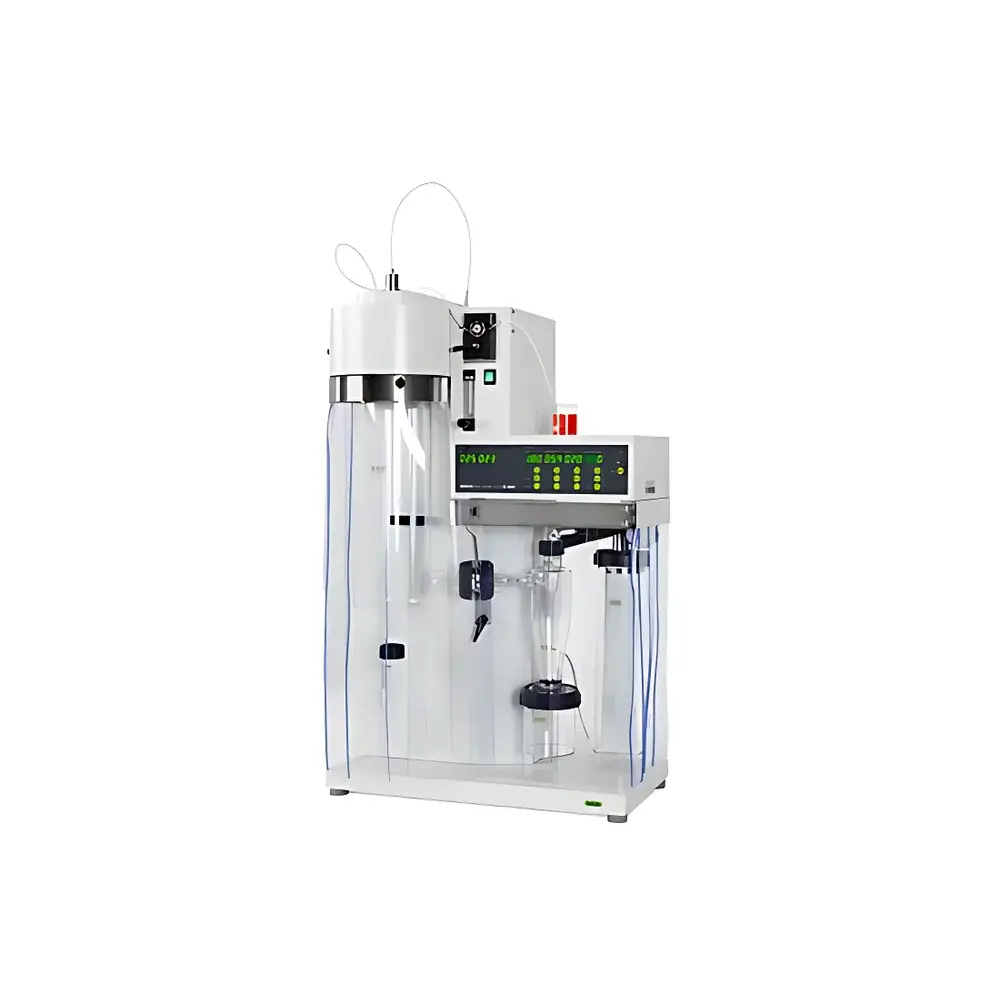
BUCHI B-290 Mini Spray Dryer
| Brand | BUCHI |
|---|---|
| Origin | Switzerland |
| Manufacturer | BUCHI Labortechnik AG |
| Type | Benchtop Spray Dryer |
| Model | B-290 |
| Sample Compatibility | Aqueous, Organic, and Mixed Solvent Systems |
| Maximum Feed Rate | 1.5 L/h (water), 2.0 L/h (organic solvents) |
| Inlet Air Temperature Range | 40–220 °C (optional up to 250 °C) |
| Particle Size Range | 1–100 µm (typical output 2–60 µm, adjustable via nozzle selection and process parameters) |
| Air Flow Rate | 35–40 m³/h |
| Atomizing Gas Flow | 200–1000 L/h at 5–8 bar |
| Drying Residence Time | 1.0–1.5 s |
| Nozzle Options | Standard ruby nozzle tip (0.7 mm), multi-fluid nozzles, ultrasonic nozzles, acid-resistant configuration available |
| Anti-static Coating | Patented internal glass surface treatment |
| Optional Upgrades | Solvent-compatible mode, spray freeze-drying module |
Overview
The BUCHI B-290 Mini Spray Dryer is a benchtop, continuous-feed spray drying system engineered for precision, reproducibility, and operational flexibility in research and development laboratories. It operates on the principle of flash evaporation: liquid feed is atomized into fine droplets using compressed gas or ultrasonic energy, then rapidly dried by concurrent hot air flow within a heated drying chamber. This results in near-instantaneous solvent removal—typically within 1.0–1.5 seconds—minimizing thermal exposure and preserving thermolabile compounds such as proteins, enzymes, probiotics, and active pharmaceutical ingredients (APIs). Designed and manufactured in Flawil, Switzerland, the B-290 integrates robust engineering with intuitive control architecture, supporting method development, formulation screening, and small-batch powder production under controlled, scalable conditions.
Key Features
- Patented anti-static glass drying chamber: Minimizes wall deposition and ensures >90% sample recovery without mechanical scraping or solvent rinsing.
- Adjustable inlet air temperature (40–220 °C, optional 250 °C) with real-time digital monitoring and PID-controlled heating.
- Modular atomization system: Interchangeable ruby-tipped nozzles (standard 0.7 mm), multi-fluid nozzles for core-shell microencapsulation, and ultrasonic nozzles for coarse particle generation (e.g., >50 µm).
- Integrated peristaltic feed pump with programmable flow rate (30 mL minimum volume), enabling precise dosing across low- and high-viscosity feeds.
- Comprehensive process parameter display: Inlet/outlet temperatures, airflow, atomizing gas pressure/flow, and feed rate are continuously monitored on an integrated LCD interface.
- Automatic nozzle cleaning (‘needle purge’): Cyclic mechanical clearing prevents clogging during extended operation with suspensions or viscous solutions.
- Solvent-safe configuration: Certified for use with flammable organic solvents (e.g., ethanol, acetone, dichloromethane) when equipped with inert gas purging and explosion-proof components.
- Optional spray freeze-drying upgrade: Enables direct lyophilization-like particle formation without cryogenic infrastructure.
Sample Compatibility & Compliance
The B-290 accommodates aqueous, organic, and mixed-phase feedstocks—including protein solutions, polymer dispersions, nanoparticle colloids, emulsions, and API suspensions—without requiring pre-concentration or surfactant addition. Its all-glass contact path (borosilicate 3.3) complies with USP , ISO 10993-5, and EU Directive 2002/72/EC for material biocompatibility. For regulated environments, the system supports audit-trail-capable data logging (via optional BUCHI LabX software), aligning with FDA 21 CFR Part 11 requirements for electronic records and signatures. Process validation documentation—including IQ/OQ protocols—is available upon request to support GLP and GMP workflows in pharmaceutical and food-grade R&D labs.
Software & Data Management
When paired with BUCHI LabX software, the B-290 enables full remote operation, method storage, and automated report generation. LabX logs timestamped values for all critical parameters (temperature, airflow, feed rate, outlet humidity) with configurable sampling intervals. Export formats include CSV and PDF, compatible with LIMS integration and statistical process analysis (e.g., JMP, Minitab). The software also supports user-defined SOP templates, electronic signature capture, and role-based access control—essential for quality assurance teams conducting method transfer or regulatory submissions.
Applications
The B-290 serves as a platform for particle engineering across multiple domains: formulation of inhalable dry powders (DPIs) meeting USP aerodynamic diameter specifications; microencapsulation of probiotics or flavors for controlled release; synthesis of ceramic precursors and metal-organic frameworks (MOFs); stabilization of monoclonal antibodies via trehalose co-spray drying; and preparation of nanocellulose or lipid nanoparticles for nutraceutical delivery. Its scalability—from lab-scale optimization to pilot trials using BUCHI’s larger B-90 or Niro Soavi systems—ensures seamless technology transfer.
FAQ
Can the B-290 handle heat-sensitive biological samples?
Yes. With residence times below 1.5 seconds and precise inlet temperature control down to 40 °C, it preserves enzymatic activity, antigenicity, and viability in proteins, vaccines, and live cultures.
Is solvent drying supported out-of-the-box?
Standard configuration is water-compatible. Organic solvent operation requires optional explosion-proof upgrades, inert gas manifold, and solvent recovery add-on modules.
What particle size distribution can be expected?
Typical Dv50 ranges from 2–60 µm depending on nozzle geometry, feed concentration, and drying gas velocity—validated by laser diffraction (e.g., Malvern Mastersizer) post-collection.
How is cleaning and maintenance performed?
All wetted parts are autoclavable or solvent-rinsable. The anti-static coating eliminates adhesive residue; routine cleaning requires only deionized water and lint-free wipes.
Does BUCHI provide validation support for regulated labs?
Yes. Factory-verified IQ/OQ documentation, calibration certificates traceable to NIST standards, and 21 CFR Part 11-compliant software packages are available through BUCHI’s Global Validation Services team.



