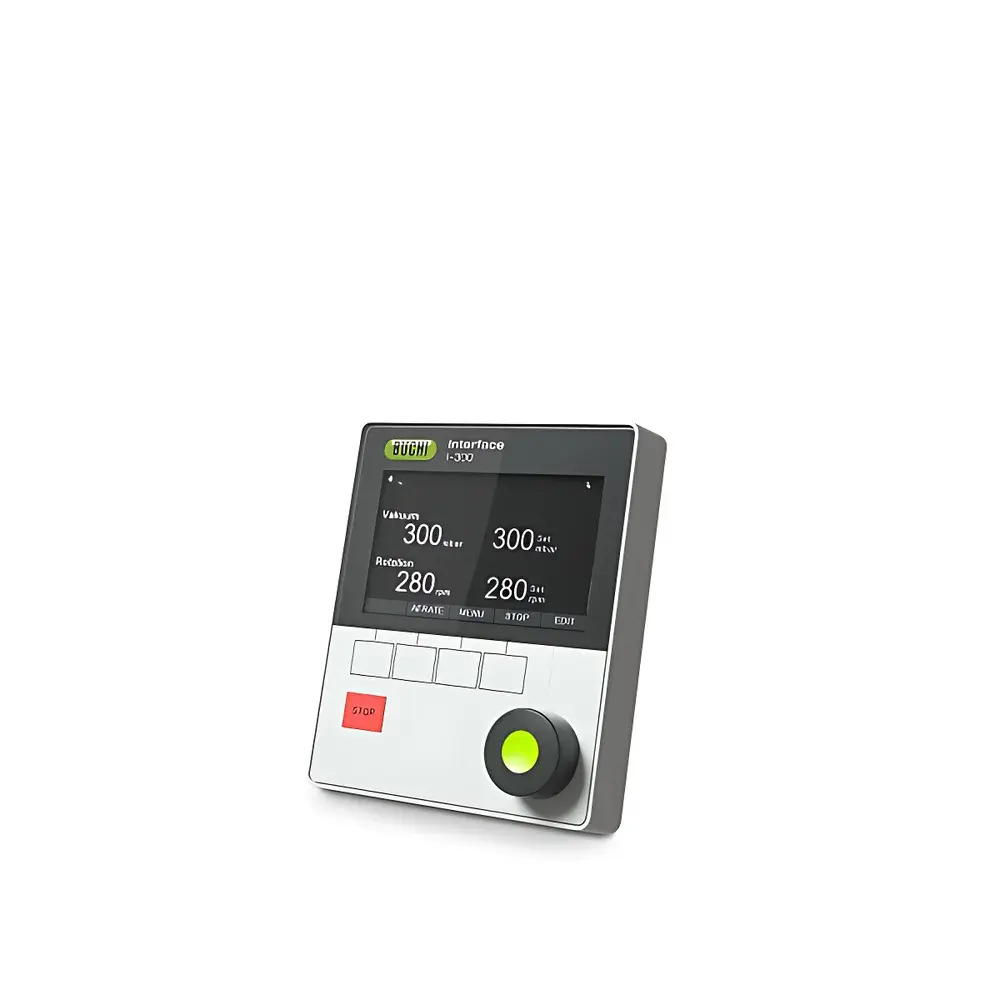
BUCHI I-300 Vacuum Control Interface
| Brand | BUCHI |
|---|---|
| Origin | Switzerland |
| Manufacturer | BUCHI AG |
| Product Type | Imported Instrument |
| Model | I-300 |
| Measurement Principle | Capacitive Absolute Pressure Sensing |
| Pressure Range | 1400–0 mbar (hPa) / 1050–0 Torr |
| Control Range | 1100–1 mbar (hPa) / 825–1 Torr |
| Pressure Accuracy | ±2 mbar |
| Vacuum Port | GL14 |
| Display | 4.3-inch TFT touchscreen |
| Power Supply | 30 VDC ±5% |
| Power Consumption | 3 W |
| IP Rating | IP21 |
| Certifications | CE, CSA |
| Dimensions (W×H×D) | 121 × 141 × 50 mm |
| Weight | 400 g |
Overview
The BUCHI I-300 Vacuum Control Interface is a dedicated central process management unit engineered for integration with the Rotavapor® R-300 rotary evaporation system. It serves as the operational hub for real-time monitoring and closed-loop control of critical process parameters—including rotational speed, bath temperature, coolant temperature, vapor temperature, and absolute pressure—enabling reproducible, method-driven evaporation and drying workflows. Unlike standalone vacuum gauges, the I-300 implements capacitive absolute pressure sensing using an alumina-ceramic sensor element, delivering stable, drift-resistant measurements across its full 1400–0 mbar (hPa) range. Its architecture supports both local operation via intuitive physical controls and remote supervision through the BUCHI Rotavapor App (iOS, Android, Windows), aligning with modern laboratory requirements for traceability, accessibility, and operational continuity.
Key Features
- Capacitive absolute pressure measurement with ±2 mbar accuracy over a 1100–1 mbar control range, ensuring reliable vacuum regulation during sensitive distillation steps.
- Integrated multi-device orchestration: synchronizes start/stop commands and setpoint adjustments for the R-300 main unit, BUCHI vacuum pumps (e.g., V-800/V-700), chillers (F-305/F-315), and optional foam sensors.
- Dynamic Distillation mode: initiates evaporation upon solvent selection from the built-in database—even before bath or chiller reach target temperatures—by dynamically ramping vacuum to match solvent volatility profiles.
- Dedicated Dry Mode: alternates rotation direction at user-defined intervals to maximize surface exposure and moisture removal from solid residues without manual intervention.
- ECO Mode: automatically powers down heating baths and chillers after configurable idle periods, reducing energy consumption while maintaining system readiness.
- Real-time graphical display of pressure, temperature, and rotation trends; visual status indicators confirm connectivity to peripheral devices (pump, chiller, valve, foam sensor).
- Overpressure protection: triggers automatic venting if system pressure exceeds 1400 mbar, safeguarding glassware and seals against mechanical stress.
- Expandable solvent library: preloaded with 43 commonly used solvents across 11 languages; users may add custom entries with boiling point, vapor pressure, and safety data.
Sample Compatibility & Compliance
The I-300 is designed for use with standard laboratory-scale rotary evaporation systems handling organic solvents, aqueous solutions, and thermolabile compounds. Its GL14 vacuum interface ensures compatibility with BUCHI’s modular vacuum line (including V-800 diaphragm pumps and V-700 oil-free vacuum controllers). The device complies with EU Machinery Directive 2006/42/EC, Low Voltage Directive 2014/35/EU, and EMC Directive 2014/30/EU, carrying CE and CSA markings. While not a standalone analytical instrument subject to ISO/IEC 17025 accreditation, the I-300 supports GLP/GMP-aligned workflows when deployed in validated R-300 systems—particularly through audit-trail-capable software logging (via Rotavapor App and optional LabX integration), time-stamped parameter changes, and ECO/Dry mode event records.
Software & Data Management
The I-300 operates independently but achieves full functionality when paired with the free BUCHI Rotavapor App. This cross-platform application delivers push notifications for process deviations (e.g., pressure drift >±5 mbar, chiller failure), live parameter dashboards, and exportable CSV logs timestamped to the millisecond. For regulated environments, the I-300 can be integrated into LabX software (v3.5+), enabling electronic signatures, user access levels, 21 CFR Part 11-compliant audit trails, and automated report generation. All local settings—including Favorites (custom solvent presets, leak test protocols), AutoDest calibration offsets, and Dry Mode timing sequences—are retained in non-volatile memory and survive power cycles.
Applications
- Method-driven rotary evaporation in pharmaceutical QC labs, where consistent pressure ramping and endpoint detection are essential for residual solvent analysis per ICH Q3C guidelines.
- Concentration of heat-sensitive natural product extracts under gentle vacuum conditions, leveraging Dynamic Distillation to avoid thermal degradation.
- High-throughput sample preparation in academic chemistry labs, where ECO Mode and Favorites reduce setup time across repetitive workflows.
- Automated drying of crystalline APIs or lyophilized intermediates using Dry Mode’s bidirectional rotation strategy to prevent cake cracking and ensure uniform moisture removal.
- Leak testing and system integrity verification via programmable vacuum hold tests, with real-time pressure decay curves displayed on the 4.3″ screen.
FAQ
Is the I-300 compatible with non-BUCHI rotary evaporators?
No—the I-300 is engineered exclusively for the Rotavapor R-300 platform and requires proprietary communication protocols and mechanical mounting interfaces.
Does the I-300 support analog or digital signal output for PLC integration?
It does not provide industrial fieldbus outputs (e.g., Modbus, Profibus); control and data exchange occur solely via BUCHI’s internal CAN bus and the Rotavapor App API.
Can pressure calibration be performed by the end user?
Field calibration is not supported; the capacitive sensor is factory-calibrated and sealed. Verification against a NIST-traceable reference gauge is recommended annually.
What happens during a power interruption?
All active processes halt immediately; the I-300 retains its last configuration and reboots to standby mode within 5 seconds upon power restoration.
Is the foam sensor mandatory for AutoDest operation?
No—AutoDest functions using inlet/outlet chiller temperature differentials alone; the optional foam sensor adds pneumatic anti-foaming intervention but is not required for basic AutoDest functionality.