
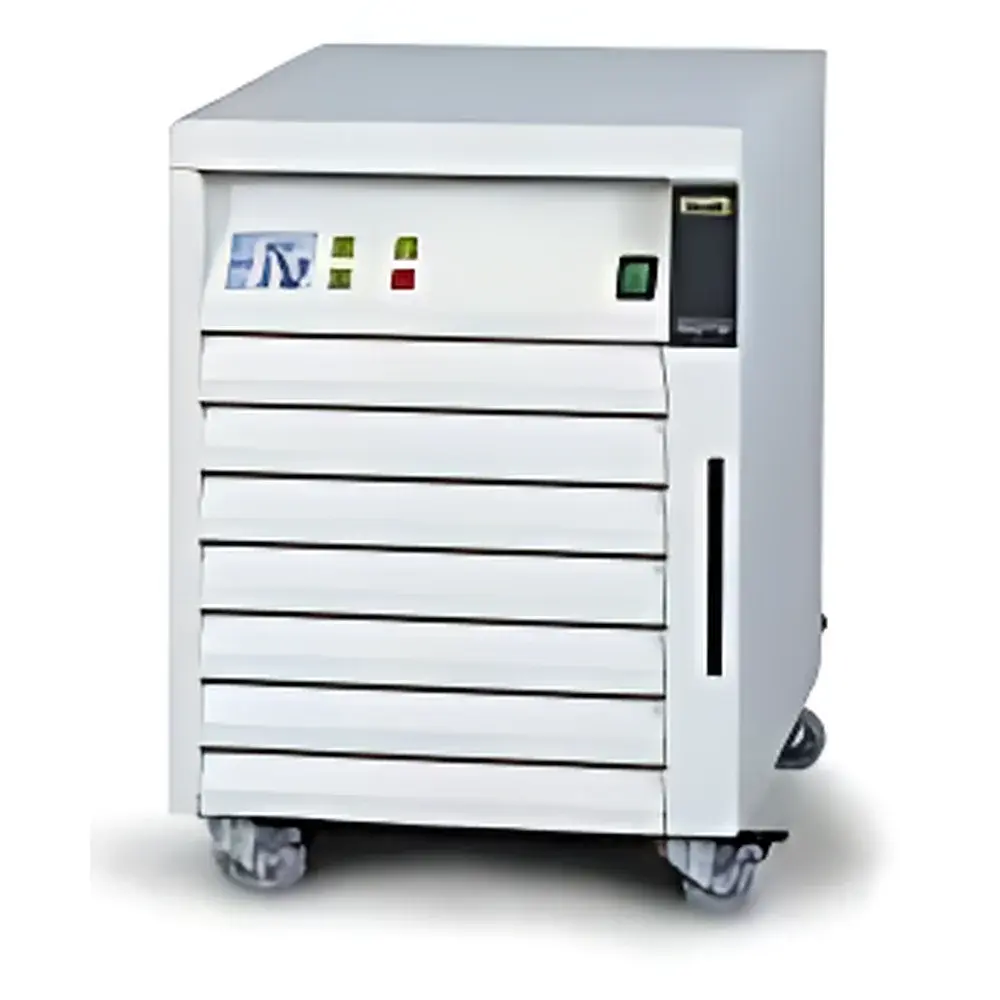
BUCHI F-308 Circulating Chiller
| Brand | BUCHI |
|---|---|
| Origin | Switzerland |
| Manufacturer | BUCHI AG |
| Type | Integrated Circulating Chiller |
| Cooling Method | Water-Cooled |
| Temperature Range | –10 to 25 °C |
| Cooling Capacity | 1100 W |
| Temperature Stability | ±1 °C |
| Circulation Pump Pressure | 0.6 bar |
| Circulation Flow Rate | 3 L/min |
| Reservoir Volume | 4.5 L |
| Operation Mode | Continuous |
Overview
The BUCHI F-308 Circulating Chiller is an integrated, water-cooled temperature control system engineered for precision thermal management in demanding laboratory applications—particularly rotary evaporation, distillation, and vacuum-controlled processes. Based on a closed-loop refrigeration cycle with R-410A refrigerant and optimized heat exchanger geometry, the F-308 delivers stable, low-temperature coolant circulation across extended operating periods. Its design prioritizes energy efficiency, thermal consistency, and seamless interoperability with BUCHI’s ecosystem of evaporation and vacuum instrumentation—including the R-300 rotavapor and V-800 vacuum controller—enabling coordinated process control and real-time parameter synchronization via RS485 or Ethernet interfaces.
Key Features
- Integrated architecture with compact footprint (W × D × H: 300 × 450 × 520 mm), minimizing bench space requirements while housing all critical components—including compressor, condenser, expansion valve, evaporator, reservoir, and variable-speed circulation pump—in a single enclosure.
- Water-cooled condensation system reduces ambient heat rejection by up to 75% compared to air-cooled equivalents, significantly lowering laboratory HVAC load and improving thermal stability in temperature-sensitive environments.
- Precise temperature regulation within –10 to 25 °C range, with ±1 °C stability under dynamic load conditions—validated per ISO 17025-compliant calibration procedures using traceable Pt100 sensors mounted at both inlet and outlet ports.
- High-reliability circulation pump delivering 3 L/min flow rate at 0.6 bar pressure head, compatible with standard 10–16 mm ID silicone or fluoropolymer tubing; flow rate remains stable across backpressures up to 1.2 bar.
- 4.5 L stainless steel reservoir with level sensor, overflow protection, and integrated filtration to minimize particulate ingress and extend fluid service life; compatible with water-glycol mixtures (up to 30% v/v) for sub-zero operation.
- Continuous-duty operation certified for 24/7 use under nominal load; compressor duty cycle managed via adaptive PID logic to maintain setpoint without overshoot or thermal cycling fatigue.
Sample Compatibility & Compliance
The F-308 is not a sample-contacting instrument but serves as a critical auxiliary system supporting thermal integrity across analytical and preparative workflows. It complies with IEC 61010-1:2010 for electrical safety in laboratory equipment and meets EMC requirements per EN 61326-1:2013. Its communication protocols (Modbus RTU over RS485, optional Ethernet/IP) support integration into GLP/GMP environments where audit trails and device interlock verification are required. While not directly subject to FDA 21 CFR Part 11, its digital interface enables secure, timestamped logging when paired with compliant data acquisition software—facilitating traceability during method validation per USP and ASTM E2500-13.
Software & Data Management
The F-308 operates via an embedded microcontroller with local LCD interface (4-button navigation, dual-line display) and supports remote monitoring and configuration through BUCHI’s LabX® software platform. LabX enables centralized control of multi-instrument evaporation workflows, including automatic chiller setpoint adjustment based on bath temperature feedback from the rotavapor, real-time power consumption logging, and event-triggered alerts (e.g., low-level alarm, high-pressure cutoff). All operational parameters—including runtime hours, compressor cycles, and temperature deviation history—are stored locally with non-volatile memory retention for ≥10 years. Data export is supported in CSV and PDF formats, with optional encryption and user-access role assignment aligned with ISO/IEC 27001 information security frameworks.
Applications
- Routine and high-throughput rotary evaporation of heat-labile compounds, where consistent condenser temperature prevents bumping and improves solvent recovery yield.
- Vacuum-assisted distillation setups requiring synchronized cooling capacity modulation to match vapor load fluctuations.
- Long-duration reflux or crystallization experiments requiring stable sub-ambient jacket temperatures without manual intervention.
- Support for cold-trap systems in freeze-drying pre-treatment or solvent removal under inert atmosphere.
- Thermal conditioning of analytical accessories such as HPLC column ovens or GC detector housings where auxiliary cooling exceeds ambient capability.
FAQ
Can the F-308 operate continuously at –10 °C in a 30 °C ambient environment?
Yes—its water-cooled condenser design ensures stable performance at minimum setpoint even under elevated ambient conditions, provided the facility cooling water supply remains ≤25 °C and ≥2 bar pressure.
Is glycol mixture required for operation below 0 °C?
A water-ethylene glycol (20–30% v/v) mixture is recommended for sustained operation below 0 °C to prevent freezing and ensure adequate viscosity for pump performance.
Does the F-308 support external temperature feedback control?
Yes—via analog 0–10 V input or Modbus register mapping, enabling dynamic setpoint adjustment based on process sensor readings from third-party devices.
What maintenance intervals are recommended for long-term reliability?
Reservoir fluid should be replaced every 6 months under continuous use; condenser water filter requires cleaning quarterly; full system performance verification is advised annually per ISO/IEC 17025 internal calibration schedule.
Is the F-308 compatible with non-BUCHI rotary evaporators?
Mechanically and hydraulically compatible with any rotavapor featuring standard 12–16 mm coolant ports; digital integration requires protocol matching (Modbus RTU or custom API handshake).



