
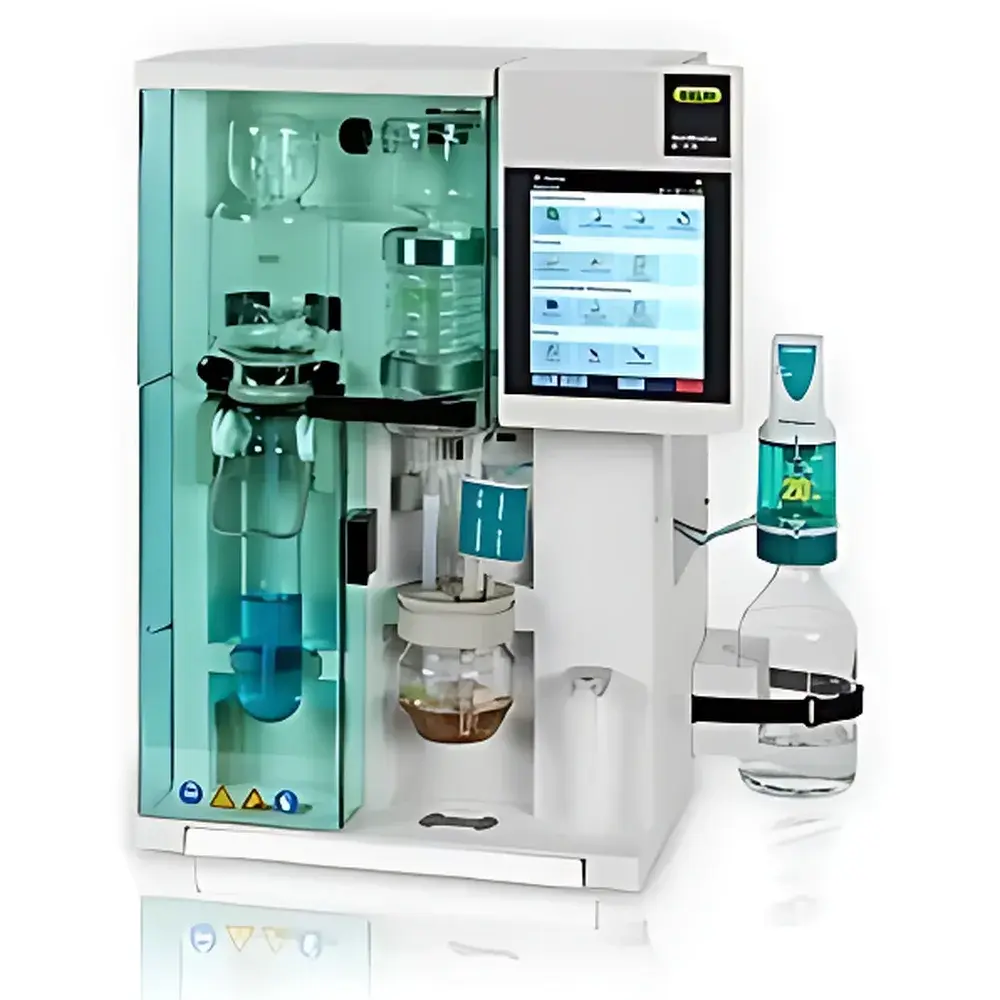
BUCHI K-375 Automated Kjeldahl Nitrogen Determinator
| Brand | BUCHI |
|---|---|
| Origin | Switzerland |
| Manufacturer | BUCHI AG |
| Product Type | Automated Kjeldahl Nitrogen Determinator |
| Model | K-375 |
| Nitrogen Range | 0.02–200 mg N |
| Distillation Time | 1–9999 min (typical: 4 min/sample) |
| Repeatability | RSD ≤ 1% |
| Sample Weight Capacity | ≤ 5 g (solid), ≤ 200 mL (liquid) |
| Nitrogen Recovery Rate | ≥ 99.5% |
| Max Power Consumption | 2.4 kW |
| Dimensions (L×W×H) | 458 × 670 × 431 mm |
Overview
The BUCHI K-375 Automated Kjeldahl Nitrogen Determinator is a fully integrated, benchtop system engineered for precision, regulatory compliance, and high-throughput nitrogen analysis in accordance with official AOAC, ISO, and DIN Kjeldahl methodologies. Based on classical wet digestion followed by alkaline distillation and titrimetric quantification, the K-375 delivers trace-level to macro-range nitrogen determination across diverse matrices—including food, feed, environmental samples, pharmaceutical excipients, and agricultural products. Its modular architecture supports both potentiometric and colorimetric endpoint detection, enabling method flexibility without hardware reconfiguration. Designed and manufactured in Switzerland, the instrument adheres to IEC 61010-1 safety standards and incorporates fail-safe mechanisms for digestion acid handling, steam pressure regulation, and condensate temperature monitoring—ensuring operational integrity under GLP and GMP environments.
Key Features
- Dual titration mode support: automatic switching between potentiometric and photometric (colorimetric) endpoint detection via software configuration—no manual sensor swaps required.
- Intelligent distillation algorithm dynamically adjusts steam generation rate and condensation cooling based on sample load and matrix complexity, ensuring consistent distillate volume and minimizing carryover risk.
- 8.4-inch high-resolution color touchscreen interface with intuitive icon-driven navigation, multilingual OS support (EN/DE/FR/ES), and context-sensitive help overlays.
- Integrated water-cooling management system that auto-regulates coolant flow and temperature to maintain optimal condenser performance across ambient fluctuations (15–30 °C).
- Multi-level user access control (administrator, analyst, supervisor) compliant with FDA 21 CFR Part 11 requirements, including electronic signature capture, audit trail logging, and password policy enforcement.
- Modular expansion capability: seamless integration with BUCHI’s K-377 autosampler (up to 60 positions) and optional digestion modules (e.g., K-449/K-446) for end-to-end automation.
Sample Compatibility & Compliance
The K-375 accommodates solid samples up to 5 g and liquid samples up to 200 mL, supporting heterogeneous matrices such as cereals, dairy powders, wastewater sludge, and polymer additives. Digestion compatibility extends to sulfuric acid-based oxidizing mixtures (including selenium, copper sulfate, or titanium dioxide catalysts), with built-in overpressure relief and fume extraction interlock. All analytical workflows comply with ISO 8968-1 (milk), ISO 1871 (cereals), AOAC 981.10 (crude protein), and USP (nitrogen content in pharmaceuticals). Full traceability is maintained through unique sample ID assignment, method version stamping, and timestamped raw data export (CSV, PDF, XML formats).
Software & Data Management
KjelLink PC software serves as the central platform for method development, instrument control, and data governance. It provides real-time monitoring of digestion temperature profiles, distillation kinetics, and titration curves; stores full audit trails with immutable timestamps, operator IDs, and parameter change logs; and exports structured reports compatible with LIMS (via ASTM E1384-compliant HL7 or direct ODBC connectivity). Data encryption (AES-256), role-based report generation, and automated backup to network drives or cloud repositories meet ISO/IEC 17025 and EU Annex 11 requirements for analytical data integrity.
Applications
- Crude protein quantification in animal feed and plant-based ingredients per AOAC 992.15 and ISO 5983-1.
- Nitrogen recovery validation in wastewater treatment plants (ISO 11905-1) and soil testing laboratories (ISO 13878).
- Quality control of nitrogen-containing APIs and excipients under ICH Q5C and USP general chapters.
- Regulatory submissions requiring documented method equivalence (e.g., comparative studies against Dumas combustion analyzers).
- Research applications involving non-protein nitrogen (NPN) fractionation and digestibility modeling in ruminant nutrition studies.
FAQ
Does the K-375 require external cooling water supply?
No—it features an integrated closed-loop chiller system with adjustable setpoint (5–15 °C) and automatic flow compensation, eliminating dependency on municipal water lines or external chillers.
Can the K-375 be validated for 21 CFR Part 11 compliance?
Yes—KjelLink software includes electronic signatures, audit trail review tools, and configurable security policies aligned with FDA guidance for computerized systems used in regulated environments.
What maintenance intervals are recommended for routine operation?
Daily: condenser cleaning and waste tank emptying; quarterly: steam trap inspection and titrant calibration verification; annually: full preventive maintenance by BUCHI-certified service engineers.
Is method transfer from older Kjeltec systems supported?
Yes—KjelLink enables import of legacy Kjeltec method files (v. 3.x–5.x) with automatic parameter mapping and validation report generation.
How is nitrogen recovery verified during system qualification?
The instrument supports certified reference materials (CRMs) such as NIST SRM 8414 (Bovine Serum Albumin) and LGC CRM 703 (Ammonium Sulfate), with automated recovery calculation and trending across consecutive runs.
Related Products





