
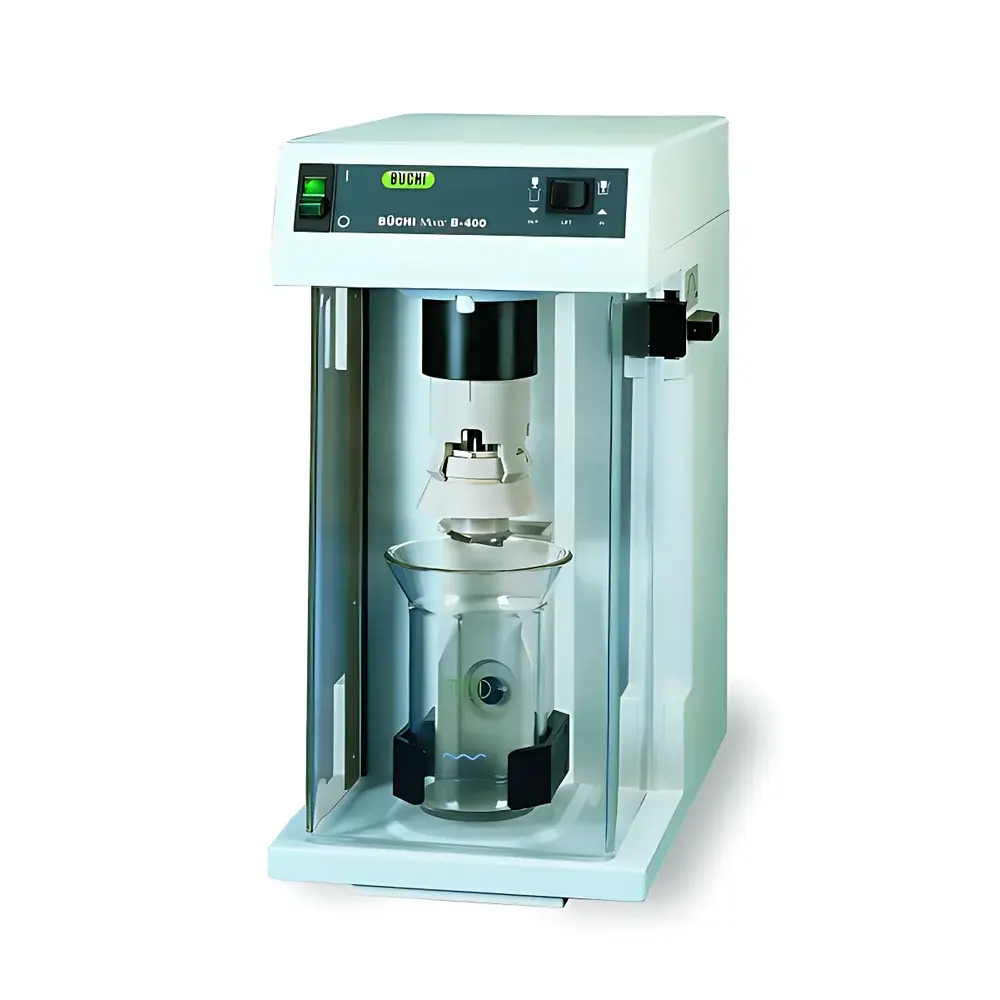
BUCHI B-400 Probe-Type Homogenizer
| Brand | BUCHI |
|---|---|
| Origin | Switzerland |
| Manufacturer | BUCHI AG |
| Type | Probe-type (rotor-stator) homogenizer |
| Model | B-400 |
| Dimensions (W×D×H) | 300 × 510 × 530 mm |
| Sample Capacity | 10–150 g |
| Maximum Cycle Time | 30 s |
| Sterilization Compatibility | Autoclavable components (glass, PEEK, PP, titanium, PVDF membrane) |
| Operating Temperature Range of PVDF Membrane | –40 °C to +150 °C |
| Final Particle Size | ≤2 mm (down to 0.3 mm typical under optimized conditions) |
| Compliance | GS-mark certified (German Safety Standard) |
Overview
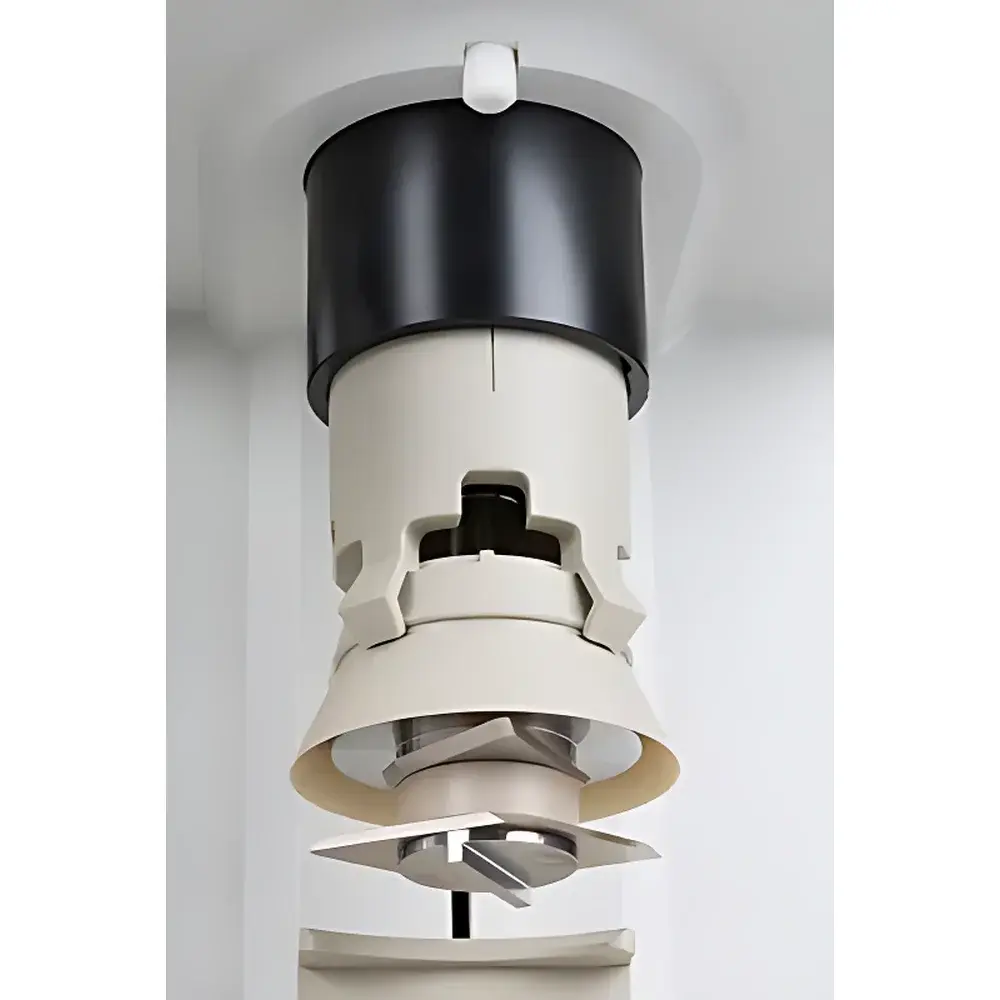
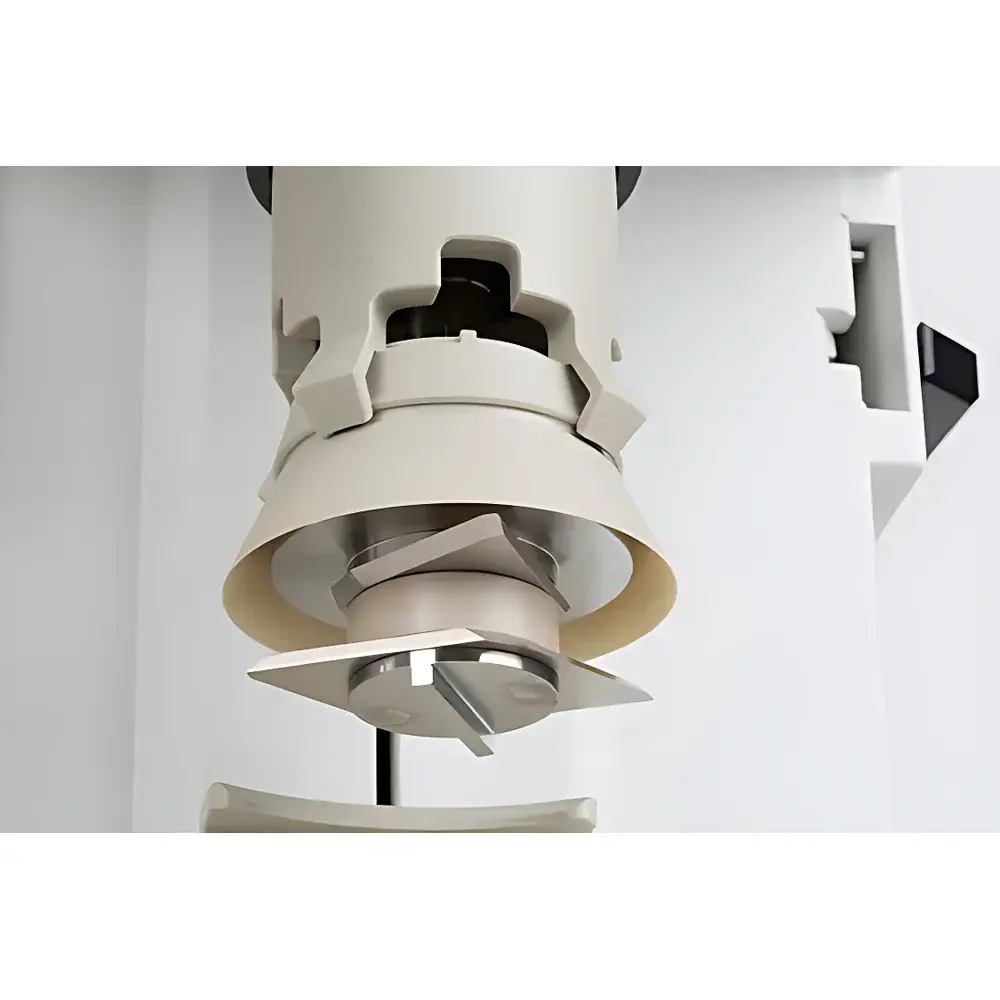
The BUCHI B-400 is a precision-engineered probe-type (rotor-stator) homogenizer designed for reproducible, high-integrity sample preparation in analytical, microbiological, and quality control laboratories. Operating on the principle of high-shear mechanical disruption, the instrument utilizes a rapidly rotating stainless-steel rotor within a fixed stator sleeve to generate intense hydrodynamic forces—including cavitation, turbulence, and radial shear—that efficiently disintegrate heterogeneous solid or semi-solid matrices into uniformly reduced particle sizes. Unlike blade-based blenders or ultrasonic systems, the B-400 delivers consistent energy input independent of sample viscosity or density gradients, making it especially suitable for low-volume, high-value samples where compositional integrity and minimal thermal load are critical—such as trace metal analysis, cryogenic microbiological processing, and regulated food safety testing.
Key Features
- Intelligent electronic force feedback system dynamically adjusts sample cup height during operation to maintain optimal rotor–stator gap, compensating in real time for variable sample resistance (e.g., fibrous feedstuffs vs. fatty tissues).
- Automated lift mechanism raises the sample cup to engage the probe—eliminating manual alignment and reducing operator variability and contamination risk.
- Full-cycle electronic monitoring ensures precise timing control (0–30 s, programmable in 1-s increments), with automatic shutdown upon completion or overload detection.
- Chemically inert, autoclavable wetted materials: borosilicate glass sample cups, titanium rotor/stator assemblies, polyetheretherketone (PEEK) and polypropylene (PP) structural components, and optional PVDF sealing membranes rated for –40 °C to +150 °C operation.
- No cross-contamination design: all contact surfaces are non-porous, non-leaching, and compatible with standard laboratory sterilization protocols (121 °C, 20 min, saturated steam).
- GS-certified electrical and mechanical safety architecture compliant with EN 61000-6-2 (immunity) and EN 61000-6-4 (emissions), ensuring safe deployment in ISO/IEC 17025-accredited environments.
Sample Compatibility & Compliance
The B-400 demonstrates robust performance across diverse matrix classes: high-moisture samples (fresh vegetables, ready-to-eat meats), high-fat tissues (pork, salmon, sausages), and high-fiber materials (animal feed, grass silage, botanicals). Its ability to achieve final particle sizes ≤2 mm—and routinely sub-0.5 mm under controlled parameters—supports downstream analytical methods requiring representative subsampling, including ICP-MS for trace elemental quantification, HPLC-based mycotoxin screening, and ISO 6887-3:2017-compliant microbial enumeration. All wetted parts meet USP Class VI biocompatibility requirements, and the system supports GLP/GMP-aligned workflows through documented cleaning validation and material traceability (titanium lot numbers, PEEK certification data sheets).
Software & Data Management
While the B-400 operates via an integrated tactile control panel (no external PC required), its parameter settings—cycle duration, start/stop confirmation, and fault logging—are retained in non-volatile memory and exportable via USB interface for audit trail generation. The firmware architecture complies with FDA 21 CFR Part 11 principles for electronic records: user-level access control (via physical key switch), immutable event logs (timestamped motor activation, thermal alerts, lid interlock status), and full traceability of operational history per sample batch. Optional integration with LIMS platforms is supported through RS-232 serial output (ASCII protocol) for automated metadata capture.
Applications
- Preparation of homogenates for heavy metal analysis (e.g., Cd, Pb, As in foodstuffs per EU Commission Regulation (EC) No 1881/2006).
- Cryogenic homogenization of thermolabile biological samples (e.g., bacterial cultures, enzyme-rich plant tissues) using the –40 °C–capable PVDF membrane kit.
- Standardized sample reduction prior to ISO/IEC 17025 method validation for AOAC 992.18 (microbial enumeration in meat products).
- Homogenization of composite reference materials (CRMs) for proficiency testing schemes administered by FAPAS or QUASIMEME.
- High-reproducibility tissue dispersion for qPCR template preparation in veterinary diagnostics labs operating under ISO 15189 requirements.
FAQ
Is the B-400 suitable for sterile microbiological applications?
Yes—the entire fluid path (cup, rotor, stator, seal) is autoclavable at 121 °C for 20 minutes, and titanium/PEEK construction prevents metal ion leaching that could inhibit microbial growth.
Can the B-400 process frozen samples directly?
It can homogenize partially thawed or cryogenically tempered samples; however, fully frozen solids require pre-conditioning to avoid excessive mechanical stress on the rotor assembly.
What maintenance is required to ensure long-term accuracy?
Annual calibration of the electronic lift sensor and torque feedback circuit is recommended; rotor–stator clearance verification should be performed quarterly using certified gauge pins per BUCHI Service Bulletin SB-B400-07.
Does the system support regulatory audit readiness?
Yes—electronic logs meet ALCOA+ criteria (Attributable, Legible, Contemporaneous, Original, Accurate, Complete, Consistent, Enduring, Available); raw data files are stored in CSV format with SHA-256 checksums.
How does the B-400 compare to ultrasonic homogenizers for protein extraction?
Unlike sonication, which introduces localized thermal denaturation and free radical formation, the B-400 provides mechanical shear without significant temperature rise (<3 °C rise typical in 30-s cycles), preserving native protein conformation and enzymatic activity.



